Tag: Gill Henwood

The King’s Cake

Galette des Rois photographed by Gill Henwood, cooked by her daughter, Kathleen.

This photo of an amazing and mouth-watering cake was sent to me by my friend Gill Henwood. It was made by her daughter Kathleen for the delectation of her two sons.

The cake is known as Galette des Rois, literally the Kings’ Cake. The name derives from the Kings or Wise Men who visited the infant Jesus in Bethlehem, having seen a bright star in the East. These Magi (Wise Men) travelled taking their bearings from the Star. The Gospel account recorded by Matthew in Chapter 2, verses 2 to 12, tells us of their journey, their visit to King Herod and then the arrival at the home of Jesus. Here, they knelt to pay Jesus homage and presented Him with three gifts ~ Gold, Frankincense and Myrrh.
Each of the gifts had a significance. Gold was given because Jesus is worshipped as a King; Incense to celebrate His Divinity (God) and Myrrh which is used to embalm the dead. It was a foretelling of the Crucifixion when the Son of God died for the well-being of humanity and opened the way for us to turn aside from sin and so live for God and in the depth of God’s love for us.

The feast of the visit of the Wise Men is known as the Epiphany – the showing forth of God’s Glory. There are other Epiphanies during this extended Christmas season to Candlemass (February 2nd). The Epiphany to the Magi is kept on January 6th, which coincides with Christmas Day in the Eastern Orthodox Churches.

Because the Wise Men brought three gifts it is commonly held that there were 3 of them and because they travelled from the East over desert lands, it is believed that they rode on three camels.
Later documents increased the number of kings – St John Chrysostom even suggested that there were 12 of them!
The Venerable Bede, writing in the 7th Century named them and that has become fairly definitive – Balthazar, Gaspar (Caspar) and Melchior.
Many other legends and customs grew up around them.
The Galette des Rois is one of them.

In many places on the night before the feast of Epiphany, a special cake would be served with three beans hidden inside, two white beans and one black one. Whoever found the beans would be the King at the Epiphany feast. Dressed in fine robes, they would preside over the feast and before leaving would hand out small gifts, equivalents of gold, frankincense and myrrh. In the royal courts of the Middle Ages, Epiphany Cakes would contain a bean for the king and a pea for the Queen. Whoever found the bean and the pea would be the King and Queen of the feast. A more recent variation is that the figure baked into the cake (especially in France) is a tiny plastic or ceramic statue of Christ. An alternative name for the Cake is therefore Christ cake. Whoever found the statue would be especially blessed throughout the coming year.

There are many recipes available for making the cake, especially in France, from where it takes its name. It is as popular in France as the Christmas Cake or Pudding are in Great Britain. The cake itself can be made with puff pastry, though often it is brioche. It is often filled with frangipane, an almond paste. As you will see on Kathleen’s cake, it is decorated with crowns and small figures of the kings. There are hearts representing God’s love and in the centre, a circle of pastry which tells me about this love of God which is eternal.

Though we are beyond January 6th it is not too late to bake a Galette des Rois. In France it is quite common to eat this cake throughout January.

[Mr G. 9th January 2026]

Seek Peace

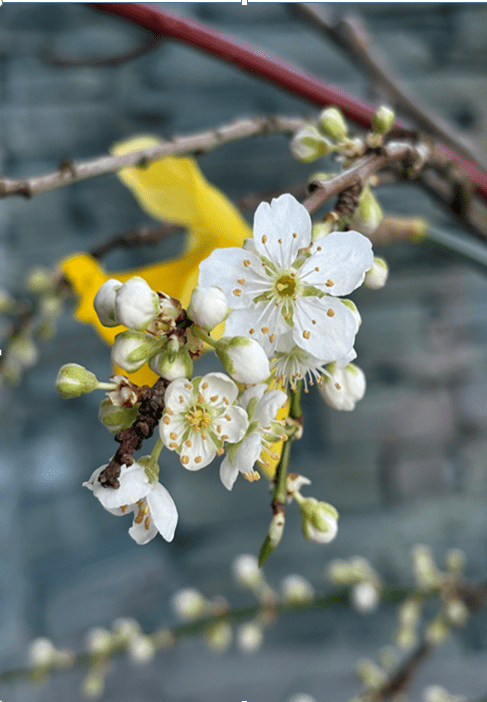
Photo: Kew Garden, Gill Henwood

My friend Gill Henwood’s photographs and thoughts regularly appear on this blog. The other day she sent me this photograph of a winter cherry tree at Kew and the thoughts it inspired.

“Here’s a beautiful winter cherry in the Japanese garden at Kew Gardens, yesterday.
The tree is a cloud of delicate blossom in the winter gardens of bare skeletal deciduous trees and dark sombre conifers.
For Gill it speaks to her of “Hope, for peace in the world. Prayers, for Japan and so many places where natural events challenge, and wars destroy. Trust, in the presence of God’s cloud of peace with us, is often unnoticed.
May the gracious, comforting Spirit bring the peace that passes all understanding to sore hearts.”

At a time when intense negotiations are going on about brokering peace in the Ukraine and in the aftermath of Gaza, the photo brings a glimpse of purity in what feels like a dark, sombre and impure world.

What I am constantly hearing and seeing is despair, uncertainty and a sense of futility. The question : What can I do or make a difference, in the sense of not being in a position to affect real change in the International struggles in our world?

Perhaps we could take a more local and personal view.
The late Rabbi Lionel Blue once told a story about meeting  an old-time party member of the Soviet Communist Party. He spoke in tears that the Revolution got hijacked because of personal ambition, greed and power. “We tried to understand society to change it, but we didn’t start with ourselves.”  (Rabbi Blue).

That is where we all can start – with ourselves. We can cultivate gentleness, kindness, care, approach-ability. We can and should stand up for goodness in our society and acceptance of others. Perhaps even a bit more listening to others rather than telling them what they should be like or believe. Above all we should open our hearts to a hope which isn’t just a feeling but a prayer and an action.

A little story I love tells me that one thing we can avoid is believing that we have nothing to contribute to growing peace in our world.

A little sparrow laid on its back with its legs in the air. Another sparrow walked past and asked the sparrow in its back what it was doing. It replied that it had heard that the sky was going to fall in and thought that it should try and help hold it  up. The other sparrow laughed and said, “You’re only a little sparrow with little legs. How can you hold up the whole sky?The little sparrow lying on the floor with its legs in the air, turned its head and said:“I know, but one does what one can.”

Doing what we can is about living in peace and harmony with others and with creatures and the world in which we live. It’s about rejoicing in creation and protecting the part of our world where God has placed us. It’s also about refusing to let our world be taken over by those who would dominate, abuse, bully and live self-centred lives.
It’s about allowing God’s beauty, joy, hope radiate from our lives just as it radiates from the Winter Cherry Tree at Kew.

It’s about praying this prayer, written for world peace in 1978. By praying and seeking to live it out in our lives may we recognizing that we have just increased peace in the world.

A Prayer for World Peace, 1978

We pray for the power to be gentle;
the strength to be forgiving;
the patience to be understanding;
and the endurance to accept the consequences
of holding on to what we believe to be right.

May we put our trust in the power of good to overcome evil
and the power of love to overcome hatred.

We pray for the vision to see and the faith to believe
in a world emancipated from violence,
a new world where fear shall no longer lead men or women to commit injustice,
nor selfishness make them bring suffering to others.

Help us to devote our whole life and thought and energy
to the task of making peace,
praying always for the inspiration and the power
to fulfil the destiny for which we and all men and women were created.

– Author Unknown, Offered by Beth Amyot
published by Xavier University Cinncinati

[Mr G & Gill Henwood. 11th December 2025]

Advent Hope

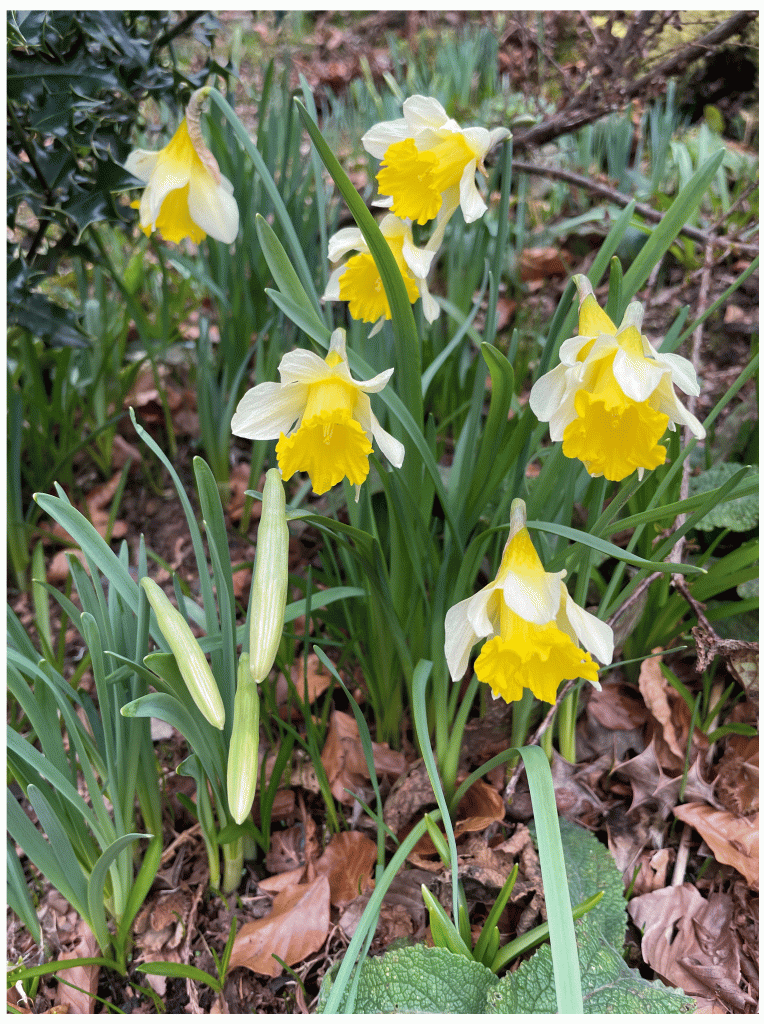
Fallen leaves / buds appearing. Advent hope. photos by Gill Henwood.

ADVENT HOPE

Last leaves turning gold and falling from a Japanese maple, on Advent Sunday.
Nearby, very long established daffodil shoots seeking the short daylight,
waiting for their time in Spring.

Waiting, watching, sensing the time is coming: themes of Advent.
Hope, for light in darkness.
Longing, for the approaching birth.
Trembling, with anticipation for new life.
Fearing, for hostile forces muster.

“Rejoice, rejoice,
Emmanuel shall come to us
O Israel”

The angels will sing:
“Glory to God in the highest 
and peace on earth
to all people of good will”

Our Advent Hope.

[Advent reflection by Gill Henwood]

Learning of God from Island Saints

Sunrise from Lindisfarne over the Farne Islands, St Cedd’s day, October 26th 2025. Photo by Gill Henwood.

October 26th is St. Cedd’s Day:

The little that is known about Saint Cedd comes to us mainly from the writing of Saint Bede in his Ecclesiastical History Of The English People.
Cedd was born in the kingdom of Northumbria and brought up on the island of Lindisfarne by Saint Aidan. He was one of four brothers: Chad (originally Ceadda), Cynibil and Caelin being his siblings. The first datable reference to Cedd by Bede makes clear that he was a priest by the year 653. It is likely that Cedd was oldest of the brothers and was acknowledged the head of the family. While he was alive, he seems to have taken the lead, while Chad was his chosen successor.
Cedd was sent out from Lindisfarne to take the Gospel to Essex, landing after a sea journey at Bradwell where, today, there is still a Chapel built on the foundation of Cedd’s monastery.

As well as this mission, Cedd also established a monastery at Lastingham in the Cleveland Hills. From here he established a mission in North Yorkshire. When he died of the Plague, his brother Chad took over. Today, at Lastingham, the crypt chapel is said to date back to Cedd’s time.

Learning of God from Island Saints.

I come to this Holy place
where, when the tide turns,
silence and conversation
meld into stillness.
God is here.
His sanctuary, enclosed by the sea,
welcomes those who are seeking after meaning.

What am I looking for, here on Lindisfarne,  
where the spirit of Aidan
gathered together those chosen by God,
on whom the Saint poured out his soul,
his faith, into their waiting hearts?

I sense and seek the company
of those who first prayed here
through the storms of the sea, the blowing of the winds
sweeping over the Headland Heugh,
in the strange light of pale day
and the fading shadows of eventide.
In silence and in prayer; through learning and in listening;
by becoming steeped in God’s word;
twelve young monks, were inspired to mission the good,
Gospel news, of Jesus Christ.

Cedd and Chad, Cynibil, Caelin and companions
allowed Jesus to be etched upon their hearts,
discovering a love which must be shared.
How else would others inhale God’s blessing
and love in their own lives
and cause a world’s darkness to be bathed and transformed
by the dazzling  light of God’s Spirit?

And I, kneeling somewhere between the waves and shore
of my inner being, must hear anew this call
to open the Gospel pages illuminated by God within my soul,
that through me also
God may mission to others His amazing and saving Love.

Mr. G.
St Cedd’s Day 2025.

Dawn over Lindisfarne, taken from Bamburgh by Gill Henwood. St Cedd’ s Day 2025