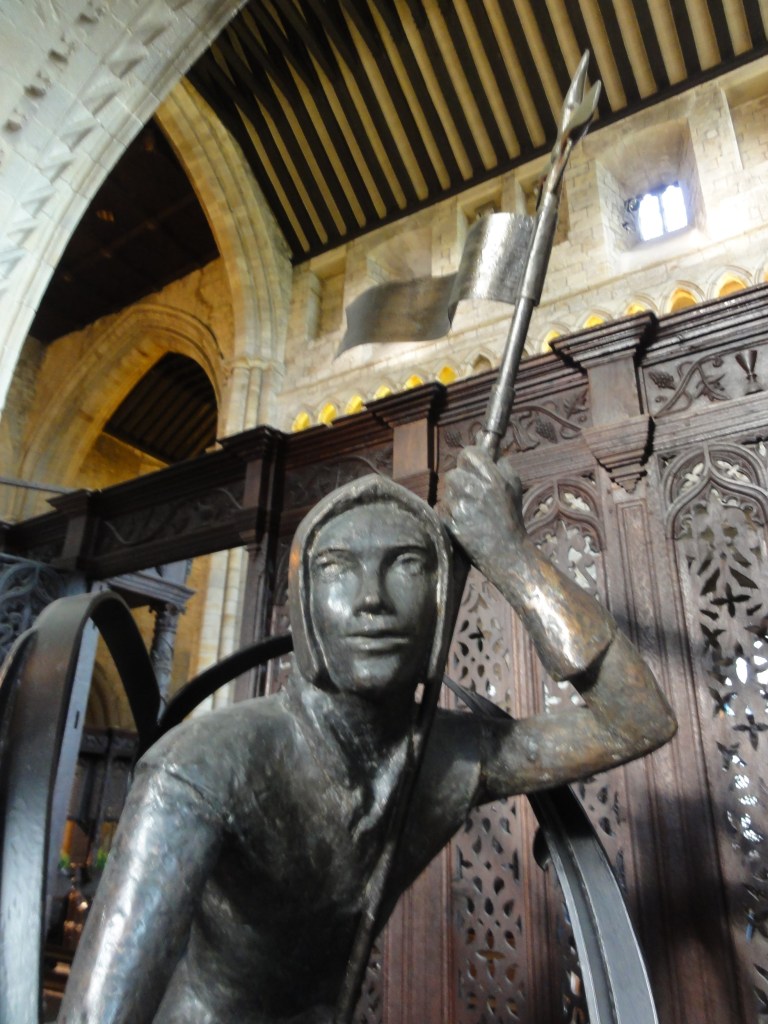
St. Michael ~ detail~ Statue carved by Josefina de Vasconcellos ~ first exhibited in Manchester Cathedral in the winter of 1991 ~ now it is on permanent display in Cartmel Priory, in the Lake District. photo by Mr. G.
Therefore with Angels and Archangels …
At almost every Eucharist Christians pray: “Therefore with angels and archangels and with all the company of heaven, we proclaim your great and glorious name.” The picture is of our being part of a great company, invisible but near, who worship Almighty God without ceasing. At this point in the Eucharist we are at what the Celts call a ‘thin place’ when the barrier between earth and heaven is opened to those who have faith to see it. That can be very helpful when we are missing departed loved ones but we are also reminded that our worship is caught up in a greater praise. We, as it were, plug in to a current of worship which is forever flowing and for ever being proclaimed. But for many, angels belong to myth and one wonders what is going through many Christian minds when they reach that point in the Eucharist. Despite the fact that Holy Scripture is crammed with references to angels and they play a significant part in the Christmas and Easter stories, it is easy to dismiss them. It is also rather arrogant because it assumes that God who is the great creator of everything on earth, is incapable of creating any other order of being than we can actually see. Yet we continue to explore space for other forms of life—assuming, naturally, that what we will find will be ‘human’ life! As we seem to be making quite a mess of our own planet it might be better if we hoped any life form found might not be human! The writer of Psalm 8 praises creation and puts humanity in its place: “When I consider your heavens, the work of your fingers, the moon and the stars that you have ordained, What are mortals that you should be mindful of them; mere human beings, that you should seek them out? You have made them little lower than the angels and crown them with glory and honour.
Though human beings have dominion (or stewardship) of creation on earth we are ‘lower than’ angels. They have a special place in God’s scheme of things—as Defenders in the cosmic battle between good and evil; as messengers of God’s word to humanity as in the Annunciation; as healers and as guardians. Jesus himself spoke of angels in this way saying that God’s little ones have their Guardian angels and he, himself, knew of their ministrations at the end of his wilderness experience. If Jesus believes in angels, who are we to dispute their existence and their part in God’s plan?
One Sunday afternoon in heaven, a wing of Guardian Angels met God and he noticed their glum faces. “Why are you looking so miserable”, God asked. “We’re bored” they replied. “How can you be bored! You have so many humans to look after, and animals too.” “That’s the trouble,” Angel Anthropos said. “Many of the humans aren’t much fun and right now so many of them are anxious and sad.” “Some are downright wicked” said Angel Pax. Angel Vocalis, ever one to put in its opinion, added that, “many are just dull. “and,” said Angel Gloriana, “so many of them keeping asking for things for themselves. Some of them think they are so important that they want bigger and better homes, cars, boats, holidays. They are possessed by their possessions. They don’t care about anybody else. Angel Anthropos concluded, “There is no joy or colour in their lives.”
God smiled at his little group of angels whom he loved so dearly. Then he shook his head and sighed, “I know just what you mean. So many dark things are going on at the moment, causing many of the little ones to suffer. The vulnerable ones have so many things to deal with. That’s why they need their Guardian Angels now more than ever. The Angels twitched their wings and began to feel guilty, though God reminded them that there in no room for guilt in heaven. You must brush away your guilt with love. Go and love those in your care more than ever. They knew God was right, of course, but it was hard to do that right now.
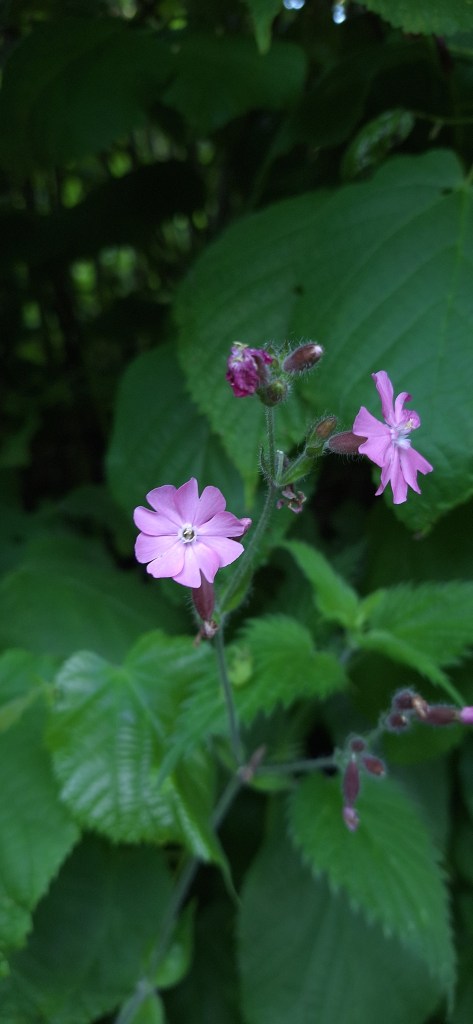
Then God smiled. “I know a way to cheer you up, and maybe some of the humans too.” He beckoned them into his studio where he kept his art material. It was the Creative heart of heaven where God made things. The Angels noticed the design of a tiny flower. Angel Vocalis said that, though it was pretty, the flower didn’t look that much. It was hardly worth making. Then he flung a wing over his mouth, “Sorry, Father God, I shouldn’t have said that.” “Don’t worry,” God replied, “who gave you your mind to think, to have opinions, to speak. But let me tell you about this flower. As you say, it’s tiny and most people won’t notice it. It could so easily be ignored. That’s why I’ve painted it pinky-purple with dark foliage – and there’s something I want to show you but I need all your help.” The angels looked at God expectantly. “I’ve made lots of copies and I need you to colour them in for me. Now get on with that whilst I go to Evensong and listen to all the voices singing throughout the world, and listen to their prayers.
After God had gone, the Angels got busy and carefully and quietly painted the flowers and the foliage. A hush descended as it often did when they were doing creative things. It also helped that they were absorbed doing part of God’s work. As they worked skillfully, they remembered how much of Himself God poured into the things he made – including themselves. The secret was that everything was made by Love as love.
When God returned he brought the Holy Spirit with Him and together they examined what the angels had done. “Tove!, Tove!” said the Spirit, which was a Hebrew word meaning Good, Beautiful. The angels were pleased because God was pleased. They all looked at their paintings and loved them. The tiny flowers were bursting with life. God agreed that they were little and would be dwarfed by bigger, brighter, more showy flowers. Some would be hidden by the grass and would be mown when the grass was cut but God had a plan, as always!
First, he explained something very important. He told the angels, “It’s not always the big flowers, or the big things or big people who show people what I am like, nor is it always by big gestures that people serve me. My dear daughter, St Teresa of Calcutta , once reminded people that we don’t necessarily do big things in our life but rather little things with a big love. These little flowers are signs that we can bring beauty and peace and love to others by the little things we do – smiles, thoughtfulness, acts of kindness, just ordinary things which make others feel better and wanted and loved.” “Now put your paintings next to each other”.
When they did, there was a carpet of colour and the table, the floor, everywhere was covered in beauty. Then God, the Holy Spirit blew on them and the little flowers came alive and danced, and danced. And as they swirled to the music the Holy Spirit made, tiny seeds flew from the flowers. “Catch them!” said God, and they did. “Go now” said God as he smiled on them and they were filled with joy. “Be off with you to the earth especially to dark and sad and lonely people who need brightening up, but go everywhere – cast the seeds all over the place. It’s the tiny seeds of love which bring joy to life, even in the difficult and broken places. Place some of your seeds gently in the cracks and reclaim people’s hearts with beauty and love. May these little flowers bring hope and joy and remind people that little things make a big difference, especially when those little things are joined to each other in a big carpet of love and care.
“Tove! Tove!” said the Holy Spirit, blowing God’s love over them… and they went gladly and willingly.
photo by Mr G
It is in little things that we show people what God is like. Simple things like caring, smiling, showing people that they matter and are valued, holding a hand, giving a hug, acts of practical kindness, praying for people, breathing God’s love over them. It is such things that really change the world and make it a better place. Every time you see a little flower, give thanks to God for making it and breathing the same love into it as He does into us …. And remember the words from the Book of Genesis: “and God saw all that He had made, and it was very good”.
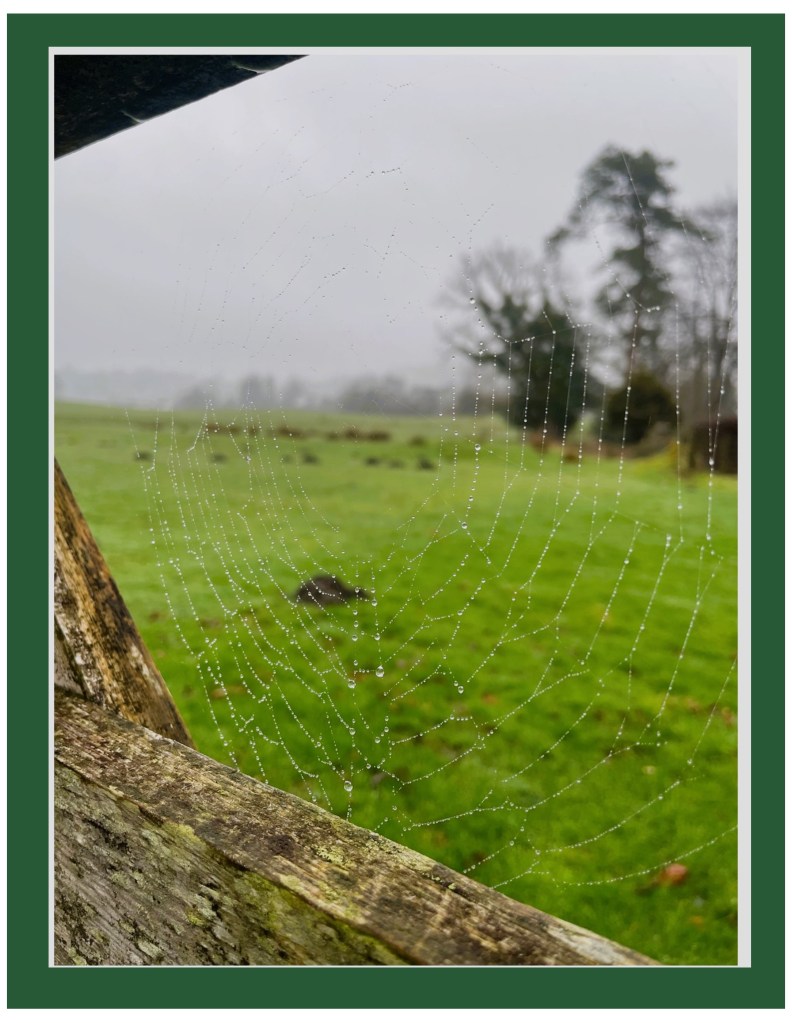
Dewdrops on spider’s web. photograph by Gill Henwood
My friend Gill has recently sent me this photograph of dewdrops on a cobweb near her home in the Lake District. My thoughts centred on the fragility and ephemeral nature of the scene. A word often associated with spiders’ webs is ‘gossamer’ – a fine filmy substance consisting of cobwebs spun by spiders; light, thin, delicate, almost insubstantial. Certainly short-lived. But another way of seeing it is that of a thin place, a tissue paper kind of boundary between two worlds.
‘Thin Place’ is an idea many of us use to describe places where God seems spiritually and, in a way, physically present to us. Obvious thin places are religious shrines, like that at Santiago de Compostella where pilgrims walk from many places in Europe to the Northern area of Spain, to a journey end at the Shrine of St. James the Great there. When I made the pilgrimage there a few years ago, I was deeply moved by the experience of God I had and I knew then what a thin place truly is. There are many such places, such as Iona, the Holy Island of Lindisfarne and legions of other places. Every religion has such holy places which have been sanctified by God and by prayers of the pilgrims. Not all are huge centres like Lisieux in Northern France or Lourdes where many go to pray for healing. Some are almost backwaters like Little Gidding near Huntingdon, Cambridgeshire. It is a quiet oasis and not that easy to find. However, those who visit, certainly can say of it, words which the great poet T.S.Eliot coined in the Quartet Poem to which he gave it’s name. It is a place where Prayer has been valid. It is valid still. It is truly a thin place where it feels very easy to meet God.
Though all that is true, Gill’s photo reminds me that not all thin places are permanent nor beyond the immediate moment, spectacular. God sanctifies all our meetings with him, it’s just that we don’t often recognize it. (at least, I don’t !) I have to keep remind myself of something St. Teresa of Avila said – God walks among the pots and pans. Her soul friend, St John of the Cross, puts that rather more beautifully, when he says, “God passes through the thicket of the world, and wherever His glance falls He turns all things to beauty.”
In the spider’s web decorated with dewdrops we can be aware of that. It becomes a way in which God reveals his presence and it is a personal revelation so everything could be experienced as a thin place. Whether it be cleaning the dishes in the kitchen or catching our breath at some lovely sight in the world. Being touched by God, becoming aware of the spiritual in the midst of the ordinariness of life, can be a breath-giving moment. Such an experience can be seen as an act of love on God’s part. In such ways, he presents his ‘calling card’ to us In the war torn areas of our world it may not seem like that but even there,maybe especially there, in kindnesses and moments when people are touched by love, care and by prayer, almost unawares, certainly not always invited, God comes to call.
The Daily Reflections on Scripture Readings by the Church of England over the past 2 days have been based on the Book of Genesis, Chapter One. This inspired me to think of it as a Love Poem from God.
Father God,
Your poem spoke creation into being telling us of our origins, our companions, the light and darkness of our existence, the moments of our being; your gift, which is the earth.
You appoint us custodians of all that you have made and go on making, stamping your image on us and all that we receive; showing us how good it is.
Help us to hear your poem and fulfill its meaning of who and where and what we are, of all that you have given us to cherish ~ a poem spoken out of pure love.


 Mr G's Ponderings