
A Reflection about Mothering Sunday by Piers Northam.
There is a Neopolitan saying about cockroaches
Ogni scarrafone è bell’ a mamma soja–
which translates as ‘every little cockroach is beautiful to its own mother…’
It feels relevant, because the cockroach’s mother looks on her offspring with a eyes filled with love – and that set me thinking about how we are each looked on by God.
As we journey through Lent, I think it’s an important thing to ponder on for ourselves: how does God see us?
I mean really see us?
I suspect that answers to this question will vary, but they might include the fact that he loves us; that he might also be a bit disappointed in what he sees us getting up to; that he’s forgiving and always willing us to turn back to him; that he’s also forward-looking and sees the potential in us: sees the best that we can be; and that he sees the beauty that we might think is either not there or well-hidden under our crusty, cockroachy exteriors – and so he gazes on us with love and affection – with the gaze of a loving parent.
On Mothering Sunday, that notion of the relationship between parent and child – by which I mean the very best version of that relationship – might have a lot to teach us: it’s bound up in notions of nurturing and feeding us; protecting us; teaching and equipping us for life; perhaps a bit of necessary discipline from time to time, but above all that sense of wanting the best for us; loving us: and that unspoken bond and shared identity…
The Bible Readings for Mothering Sunday, from Exodus and from St John’s Gospel, have some other interesting things to say about parenthood:
First there’s the story of Moses’ mother. It’s perhaps useful to remind ourselves of the background to this story: the Hebrews were enslaved to the Egyptians, but they had grown hugely in number and the Pharaoh feared being overrun by them so, in order to keep down the population, he commanded that all Hebrew male children be thrown into the Nile and killed – they were living in dark times.
When Moses was born and his mother could no longer hide him, she made a basket for him, sealed it with pitch to make it watertight and hid him amongst the reeds. Here is a mother who can no longer protect her child, so she entrusts him to God, leaving him somewhere she prays he will be safe. And then, of course, Pharaoh’s daughter comes along and finds him – she acts instinctively; taking pity on this defenceless baby. She is aware that he is probably Hebrew – an alien that her society looks down on – but what she sees is a fellow human being: a child in need of care and nurturing whom she goes on to bring up as her own.
And then we see the two women working together to raise Moses: his biological mother hired as a wet-nurse to feed him and raise him for a period. Later, she hands him over to Pharaoh’s daughter because she realises that by doing so he will survive and thrive and be safe and well looked after. In her we see sacrifice and trust in God; putting her child’s needs before her own; nurturing him and wanting the best opportunities for him in life. And in Pharaoh’s daughter, we see compassion and generosity; she looks beyond the views of her society, to see a defenceless child and she responds to his need, bringing him up as her own. Both these women think of Moses first and both act in his best interests.
The other little thread here, that is picked up in the Gospel reading, is that motherhood for Pharaoh’s daughter goes beyond blood-ties. Moses is her child by adoption, yet he is treated as her own. And this is what we see at the Cross when Jesus entrusts Mary and John to each other. The beloved disciple takes Mary into his household and treats her as his own – as she does him. In entrusting them to each other, Jesus is asking them to form this interdependent, loving relationship.
It is these relationships that are at the very heart of our Christian faith. Jesus tells us that we are children of his Heavenly Father, who is also our Father – we’re reminded of it every time we pray that great prayer he taught us. And so, by extension, we are to be family to each other – with all that that might entail. As with Pharaoh’s daughter, we are to see beyond the blood-ties of our own families and beyond the borders of race and nationality and to regard each other as beloved brothers and sisters.
But on Mothering Sunday, I think we could push things a stage further. We’ve all heard of sibling rivalry and there’s never a guarantee that we’ll get on with our brothers and sisters. But if we focus on the way that the best parents look on their children, we might find a stronger imperative.
In the 16th century, long before it was subsumed into the Mothers’ Day peddled by the card companies, this Sunday in Lent was a day when churchgoers returned to their ‘Mother Church’ – often the local cathedral or big church, or perhaps the church where they were baptised. In later times, domestic staff who lived away from home, were given the day off to return to their families – and usually to their mothers – and this is where some of the customs that we keep today came from. But that notion of ‘Mother Church’ is an important one, for if we take it seriously, then it tells us something about how the church should be – not a church that fences us out with rules and regulations about who’s in and who’s out, but one that loves and nurtures us. One that, like Pharaoh’s daughter, simply recognises our common humanity – whether we’re Hebrew or Egyptian, black or white, rich or poor, gay or straight or any of the shades and variations in between. Because if we look beyond our cockroachy exteriors, we’re all simply children of God and the Church needs to recognise this and gaze upon us with abundant love – irrespective of who we are or what we look like.
Now I know that for some, the phrase ‘Mother Church’ will evoke notions of an Institution that knows best; perhaps even one that lays down the law and tells you what to think; or one that is too slow to show true love and acceptance to all. And that’s not what the best parenting is all about is it? What I would love to be able to say of the Church of England is that it isn’t entirely like that – and actually, at grass-roots level, I don’t think it is. For me, Anglicanism – in its best form – aims to brings us to maturity: helping us to learn that we are loved by our Father in Heaven so that we grow in confidence; teaching and equipping us; encouraging us to think for ourselves and to learn so that we can grow into adults – or at least mildly sensible teenagers – who have enough nous and confidence to go out into the world and treat our fellow men and women lovingly.
That’s what the best parents do, don’t they? They bring up their children confident in the knowledge that they are loved and therefore able to be loving to others; equipped to be good and valuable members of society.
Now I referred to ‘Mother Church’ a moment ago as an Institution, but of course the really important thing is that the church isn’t an institution at all. It’s you and me – we are the Church.
So it seems to me that our calling is not just to treat each other as brothers and sisters, with whom we might bicker around the dinner table, but actually to look at each other with the loving eyes of a parent – with all that that entails.
Of course that’s a lot more challenging isn’t it? We’ve got to be like the cockroach’s mother, seeing past the carapace to the lovely little cockroach inside. We’ve got to want the very best for each other – and not just the ones who are like us – Jesus, with his words to John and Mary, blew the whole thing wider from up there on the cross. We need to be like this to the whole of humanity.
I was chatting with a friend in the week who I haven’t seen for quite a while and we were talking about the rather depressing state of the world right now and she said, ‘wouldn’t it all be so much better if we could simply treat each other with kindness?’
I think she’s absolutely right – and I think St Paul would agree:
‘clothe yourselves with compassion, kindness, humility, meekness, and patience.
Bear with one another […] forgive each other.
And above all, clothe yourselves with love.’[1]
The other day I was telling someone, who didn’t know it, that wonderful story of the Prodigal Son – it’s one of my all-time favourites: I never cease to be moved by that moment when the father, who’s been sitting all day at the front step gazing down the road, sees his son returning home. What does he do? He hitches up his skirts and goes running, full pelt down the road to meet him and sweep him up in a loving embrace. That bursting-at-the-seams joy at seeing his lost child come home, gets me every time. And that needs to be us.
We need to be out on the front step, looking down the road to see which one of our children might be coming home; we need to be rooting around in the bulrushes looking for those whom we can protect and clothe and give a home to; we need to be feeding and nurturing those who are with us and – in the manner of all good parents, giving them the confidence that they are loved and valued; we need to be inviting and gathering those around us to the table to break bread with our brother, Jesus.
It’s not much to ask is it?
[1] Colossians 3:13-14
Other readings referred to – Exodus 2:1-10 ; John 19:25b-27
Luke 15: 11-32
Piers Northam.
15th March 2026 (Mothering Sunday)
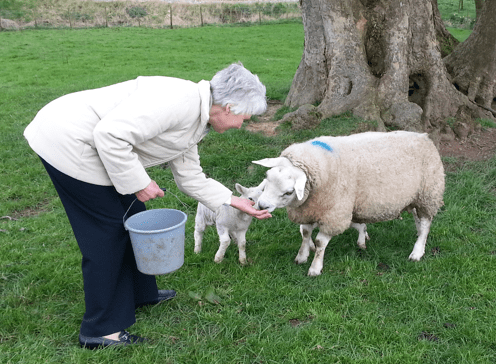
Whitechapel, Lancashire.
[photo: Mr G]



 Mr G's Ponderings