Tag: Jesus

His meaning is Love

Baubles on the tree. photo by Mr.G.

Love is His meaning

A school teacher once asked her class what was special about Christmas and a little child shot up a hand.   “Jesus has the birthday and we get the presents”.    Very perceptive – or was it simply hopeful! 
It is also a profound truth because that is what happens.  

At the heart of Christmas is a Gift and the present above all other presents that we receive is Love.  The whole meaning of Christmas is summed up in that one gift.  In the birth of Jesus right through to his glorious Ascension, God is giving us a living testimony of how much He loves is.  

The 14th century English mystic, Julian of Norwich was given a number of visions of the love of God.  She meditated on these in the quietness of her cell and she left the world the fruit of these meditations in her book Revelations of Divine Love.     At the very end of the book she deals with the questions of what our Lord’s meaning is – what his purpose is towards us – and she comes up with the answer; “Love is His meaning”.     It is worth quoting her in full:

Love was His meaning.  That message shines out from the crib as much as it was later to shine out from the cross.  It gives us the meaning and the purpose of God for us but it also shapes the purpose of our own lives.  

Christmas can be a time for sentimentality; for momentary truces in the battles we wage against each other for dominance, power or control. This is true between Nations but it can also be true in families. We can be filled with goodwill towards people for a time but it is often fragile. Real love, however, takes the hard road from Bethlehem to Calvary and never deviates.  Real love demands costly forgiveness, repentance, understanding, compassion and a bearing towards one another that imitates the love of Christ.    
Too often, as now, our world fails to show that love; too often, sadly, so do we.     Yet if we are to look towards the Bethlehem crib and understand its power and meaning, then only genuine Love will give it to us. As Christians we believe and experience God’s Love for us in Jesus Christ which awakens our love for Him and a sharing of that love with each other.   If that is lacking, the meaning of Christmas is lost and so are we.

[Mr G]

Your Love

Bless us with Love, O Merciful God;
That we may Love as you Love!
That we may show patience, tolerance,
Kindness, caring and love to all!
Give us knowledge; O giver of Knowledge,
That we may be one with our Universe and Mother Earth!
O Compassionate One, grant compassion unto us;
That we may help all fellow souls in need!
Bless us with your Love O God.
Bless us with your Love
.

– Author Unknown

Love came down at Christmas

Incarnation, a collage by sisters of the Community of St Mary the Virgin, Wantage. Photo: Piers Northam.

Love came down at Christmas,
Love all lovely, Love Divine,
Love was born at Christmas,
Star and Angels gave the sign.
Worship we the Godhead,
Love Incarnate, Love Divine,
Worship we our Jesus,
But wherewith for sacred sign?
Love shall be our token,
Love be yours and love be mine,
Love to God and all on earth,
Love for plea and gift and sign.

Christina Rossetti
Christian poet. 1830-94

By star and candlelight

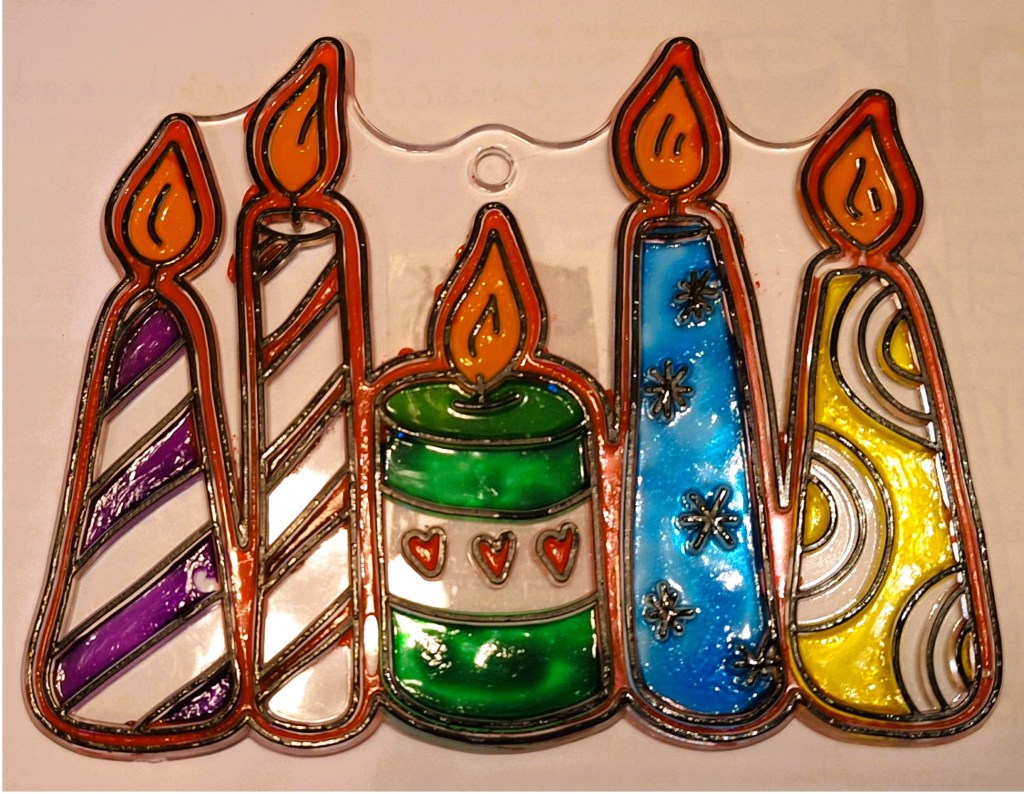
Candles decorated by children at St Mary-at-Latton.(and below) Photos: Mr G

Every so often, astronomers astound us with yet another discovery in space. 
On December 11th we received news that NASA’s James Webb space telescope has captured an image of what our galaxy was like as it was forming. The telescope, the most powerful ever built, is orbiting in space free from hindrance by the Earth’s atmosphere. This makes its images more pure and more accurate.
The particular image that has excited astronomers shows 10 balls of stars of different colours which has led space scientists to liken it to baubles on a Christmas tree.
The real significance of the image is that it’s the first time it has been possible to witness the stars assembling to form a galaxy which holds clues of how our own galaxy, the Milky Way came into being.
It’s rather good that we have news of our Universe which is positive just when various sections of humanity are trying their hardest to destroy our bit!
Much more will be gleaned from this discovery which continues to add to the knowledge we have of our own universe. In many ways the Universe is a mystery but each new discovery adds to our enlightenment.
Perhaps in that respect it is mirroring God who created the Universe and even found time to create us! God is a mystery who constantly reveals himself to us especially, Christians believe, through Jesus Christ but also through our gifts, knowledge, skills and talents.

Sometimes God’s revelation is accompanied by some celestial event like a bright star. 
Writers in the Bible tell us of many constellations. Individual stars are mentioned. In the Book of Job there is a beautiful conversation between God and Job (in chapter 38) where God asks Job where he was when the Lord laid the foundations of the earth. The writer shows the depth of ancient knowledge when he asks whether Job can bind the chains of Pleiades or loose the cords of Orion. 
The star of Bethlehem referred to in Matthew’s Gospel as the one leading the Magi to the Christ child has also led many scientists into the realms of speculation.  As far as the Bible is concerned this is the star which heralds Christ’s birth.
The theme of light which is signified by such stars is central to Advent because it speaks to us of the expectation of God coming to light up the world with his new presence in Jesus Christ.  This is the Love of God beginning the process of transforming the world with light. 

Not surprisingly, when the Church leaders chose December 25th *** for our celebration of Christmas it was the time in the West at least, when the world is at its darkest.  It was also the time of the pagan Winter festival and early Christians preferred to overlay pagan religion with new Christian meaning. Sweeping pagan practices away would merely drive them underground.  Changing their meaning and adding new depth made for a more permanent and ready acceptance of the, then, new faith. Good missioners always start where people are before helping them into new understanding.
It may well be that the pagan solstice was subjected to a pincer movement because December 13th is the feast of St Lucy whose very name means Light (and from which we get the word lucid – to make clear) 
Lucy was a 4th century Christian who fell foul of an attempt by the Roman Emperor to re-establish worship of the old  gods. She was betrothed to a man who expected a decent dowry. Instead of which she gave her possessions to the poor.  The angry suitor denounced her to the authorities and she was put to death for her faith in 304AD.  Because her martyrdom was in December her festival quickly became associated with Christmas. 

Probably, the main reason why Lucy became associated with Light overcoming darkness is because the final act of torture was that her eyes were gouged out, plunging her into complete darkness physically. Yet the physical darkness was itself overcome by the brightness of her faith. She had within her the love and light of Christ and her enemies couldn’t quench that. That encouraged other Christians facing persecution. The light of her faith pointed believers to Jesus, the one true light who was coming into a darkened world with hope and new life.  Christ Jesus, who in the final book of the Bible is called the Bright Morning Star, fills all our lives with light. That is both the hope and the witness we must bear in a deeply darkened world.

Maybe we can look to the people of Scandinavia who understand more than most about darkness at the heart of Winter. St Lucie’s  day is an important feast not only because of her own overcoming of darkness but because of the physical darkness in Scandinavia at the time of the Winter Solstice ~ the darkest day of the year. In the old Calendar, December 13th, her feast day, was at that time. She became a symbolic example of light conquering darkness. This is why, in Scandinavia, the feast incorporates a celebration of light involving processions in which girls chosen in communities to represent the saint in wearing a crown of candles (possibly battery operated these days!) and accompanied by others including boys known as star boys.
This deserves an article of its own but the underlying reason is that St Lucy was light in a dark place and her faithfulness to God was an example from which others could draw strength and inspiration.
Never is this more needed than today!

The night treads heavily
in places unreached by sun,
the shadows brood
in the dark places of our world,
where human deeds are black.
St Lucy comes,
bearing lighted candles,
heralding the light of God,
the Christ-child who comes anew
at Christmas.

Let us be ready to greet Him
with the joyful light of goodness
and of peace.

[adapted by Mr G from a traditional song from Sweden)

*** The Orthodox Church follows a different Calendar and keeps Christmas on January 6th

[Mr G]

Remembrance is important

A Reflection from Piers Northam on Remembrance Sunday

The beginning of St Mark’s Gospel tells of Jesus walking along the beach at the Sea of Galilee, calling his disciples, the fishermen Peter and Andrew, James and John.  Calling them to follow him and calling them to a life of service.  Ultimately, for many of his disciples, it would turn out to be service that would cost them their lives.

And on this Remembrance Sunday morning we remember those who have answered another call to service – in this case the service of their country – and who have given their lives in that service.

As I’ve reflected, this week, on what I might say on this Remembrance Sunday morning, I’ve been pondering on the difference between ‘memory’ and ‘remembrance’, and I wonder if we might take ‘remembrance’ to be the shared calling to mind and recounting of events or people that we don’t necessarily directly remember ourselves?  Certainly, if we take the Second World War, there is a sense that it is receding into history and that fewer and fewer people remember it first-hand and with that comes the danger that it will seem less and less ‘real’, less and less affecting.  And, of course, there have been many other conflicts since, that British forces have been involved in – Aden, Korea, the Falklands, Kosovo, Iraq, Afghanistan – all of which will be remembered by those who served and were involved, but which otherwise can also seem increasingly distant and less relevant. 

Yet on Remembrance Sunday each year we gather as a nation to remember; to recount the stories of war and the cost of war; to remember and give thanks for the sacrifice of those who gave their lives – or who had their lives irrevocably altered – hopefully, in the pursuit of peace and stability.  Remembrance and the wearing of poppies is also bound up in our sense of identity – one of the rare times in the year when so many of us, from all walks of life, are drawn together collectively to reflect and to remind ourselves of the horrors of war; of the ways that we can, as humans, descend so quickly into conflict and of the urgent and constant need to work for peace and never to be complacent.

Currently, as we look around the world, it seems as though the vital lessons of war and conflict have been entirely forgotten in some places.  Mr Putin blithely sends thousands of men to their deaths in an attempt to grab land and territory from the Ukrainian people; Mr Netanyahu – despite the historic imperative for remembrance of the horrors of the Jewish experience in the Second World War – rains bombs and missiles on thousands of defenceless civilians in Gaza and now in Lebanon.  It seems that, all too easily, we forget the human cost of war – or we forget what it was like to be on the receiving end of such aggression and begin to entertain the notion of meting it out on others.

All of which underlines the importance of gathering together to remember.  Of looking the cost of war in the eye and striving all the more conscientiously and urgently for peace.

Remembrance is important.

In our Tuesday housegroup, we’re currently doing a series of sessions where we’ve begun looking at and comparing readings from the Old and New Testament to see what they help us to understand about Jesus.  This last week we looked at the first Passover in Egypt when the Israelites, who had been living in slavery under the Egyptians, were given specific instructions about killing and eating an unblemished, year-old lamb and using its blood to mark the doorposts and lintels of their dwellings so that, when the Angel of Death came over the land in the final plague on Pharaoh and the Egyptian people, it would pass over their houses and the Israelites would be spared death – and subsequently would be able to flee the country and the years of slavery they had endured and so set out on their very long journey to the Promised Land.

The book of Exodus sets out the very particular instructions that the Lord gives to Moses and Aaron for the people and the Lord also says:

‘This day shall be a day of remembrance for you.
You shall celebrate it as a festival to the Lord; throughout your generations you shall observe
it as a perpetual ordinance.’

And, of course, that is what the Jewish people have done ever since – they have gathered around the family table each year to keep the Passover and to tell the story: to recount how, through the goodness and faithfulness of God, they were spared death and set free from their years of bondage and slavery.  The Passover story is a huge part of Jewish identity – a story that all Jews brought up in the faith will know.  A story that teaches them about the nature and the goodness of God.

And on Tuesday night we discovered some of the strong parallels between what happened at the Passover in Egypt and the story of Jesus’ Passion in Jerusalem.  Because of course, at the Last Supper, Jesus and his disciples were keeping Passover – they had gathered around the table in the upper room to remember; to recount their story and to share food for the journey and, in a new twist, Jesus gave them just that.  Not the traditional food of the Passover meal, but bread and wine: the body and blood of Jesus, the Lamb of God.  And what does Jesus say as he gives them the broken bread and the cup of wine?

‘Do this in remembrance of me…’[2]

The details of the ancient Passover were fulfilled in Jesus – he was the perfect, unblemished Lamb.  And the next day, as he was crucified, his blood was shed for us, marking not the posts and lintels of the Israelites’ doors but the wooden upright and crossbeam of the cross.  It was his blood that set us free from the slavery of sin and opened us up to everlasting life.  And so, we became a pilgrim people: the people of the Way – Christians from all over the world and down the ages, travelling towards God’s Kingdom.

So, in a sense, for us as Christians, every Sunday is Remembrance Sunday; every Sunday is a family Passover where we gather to remember what Jesus did for us on the cross.  In the eucharistic prayer that we will hear in a moment and in the creed that we say collectively, we recount the story of God’s saving and redeeming love for us in Jesus – of how he set us free from the limitation and slavery of sin and how he spared us from death and opened the gate of glory – the way to everlasting life.  And every Sunday we share the family meal – the food for the journey – the bread and the wine that we take in remembrance of Jesus, to nourish and sustain us.  And then we are sent out into the world – ‘to love and serve the Lord’ and to help the world to make its way into God’s Kingdom; to bring His Kingdom in…

You see, remembrance is important.

Amen.


[1] Exodus 12:14

[2] 1 Corinthians 11:24-25

[Piers Northam, Deacon at St Mary’s-at Latton]