Daniel Berrigan was an American Jesuit priest, anti-war activist, Christian pacifist, playwright, poet, and author. His protest against the Vietnam War led him to be arrested many times but earned him much support. Destruction of Government documents (draft papers) led to him being placed on the FBI’s most wanted list, and eventual imprisonment. A radical, his heart was absolutely centred on God combined with a deep concern for those who lived impoverished lives. He served the poor, unwanted, unloved. This piece is a poem he wrote about Advent and the hope and truth of the Love of God given to the world in Jesus.
ADVENT CREDO It is not true that creation and the human family are doomed to destruction and loss— This is true: For God so loved the world that He gave his only begotten Son, that whoever believes in Him shall not perish but have everlasting life;
It is not true that we must accept inhumanity and discrimination, hunger and poverty, death and destruction— This is true: I have come that they may have life, and that abundantly.
It is not true that violence and hatred should have the last word, and that war and destruction rule forever— This is true: Unto us a child is born, unto us a Son is given, and the government shall be upon his shoulder, his name shall be called wonderful councillor, mighty God, the Everlasting, the Prince of peace.
It is not true that we are simply victims of the powers of evil who seek to rule the world— This is true: To me is given authority in heaven and on earth, and lo I am with you, even until the end of the world.
It is not true that we have to wait for those who are specially gifted, who are the prophets of the Church before we can be peacemakers— This is true: I will pour out my spirit on all flesh and your sons and daughters shall prophesy, your young men shall see visions and your old men shall have dreams.
It is not true that our hopes for liberation of humankind, of justice, of human dignity of peace are not meant for this earth and for this history— This is true: The hour comes, and it is now, that the true worshippers shall worship God in spirit and in truth.
So let us find in Advent, hope, even hope against hope. Let us see visions of love and peace and justice.
Let us affirm with humility, with joy, with faith, with courage: Jesus Christ—the life of the world.
(From Testimony: The Word Made Flesh, by Daniel Berrigan, S.J. Orbis Books, 2004)
My friend Pete Hellard-Malt, who shares worship with me at Church, has recently begun to write a Blog of Christian musings under the title godblog.org.blog Some thought-provoking and helpful spiritual gleanings are the result. He has kindly allowed me to include some of these in Mr G’s Ponderings and what better to begin with finding Jesus at Christmas. [Mr.G.]
Not Another Christian looking for Christ at Christmas
Recently, I went Christmas shopping and came home with a feeling I did not expect. Not panic over presents. Not sore feet. Not even shock at the price of wrapping paper. It was sadness. A quiet sort of sadness, like when you realise something precious has slipped out of sight without anyone noticing.
We were in The Range (a local shop), where Christmas has clearly gone to the gym and bulked up. Six foot lamp-posts with swirling snow inside. Lights that can change colour more often than a toddler changes their mind. Tiny ballerinas spinning in little glass worlds. Foxes dressed as Santa for reasons no theology textbook can explain. Carousels and wheels all moving in perfect mechanical cheer. My daughter stared in amazement!
And yet in the middle of all that spectacle, the one thing missing was… Christmas. Not a manger. Not a star. Not a shepherd. Not a single baby in a crib. Even the word itself had gone. It was “Xmas”, “Season”, “Festive Event”. A party without the birthday child. A story stripped of its opening line. It reminded me of that scene in Friday Night Dinner where the son says, “Isn’t it a bit odd, us being Jewish and celebrating Christmas?” Mum replies, “Why?” He says, “Because it is a Christian holiday.” She pauses and says, “It is not.” It used to be a joke. Now it feels like a shop policy.
For a moment, I felt like Christians had been politely uninvited. As if the world had taken the feast, kept the lights, the food, the music, the glitter, and gently pushed away the Christ it was all built around. It is a strange thing, to feel like a guest in your own holy day.
But then something shifted in me. A warmer thought began to grow. The very first Christmas looked a lot like this.
Nobody noticed. Nobody was waiting. There were no fireworks, no shop displays, no banners saying “Welcome Saviour”. Just a tired couple in a borrowed stable. Just a baby born where animals sleep. Just a single star and some shepherds who were working the night shift. God arrived so quietly that only the ones who were listening in the dark heard the news. And yet that quiet birth split history in half. Which made me realise: maybe Christ has always been most himself at the edges. Not in the grand displays. Not in the spotlight. But in the humble, the hidden, the overlooked places.
Maybe the absence of Christ in the shops is not the end of Christmas, but the beginning of something truer. Maybe when the high street forgets Him, the home remembers Him more deeply. Maybe when “Xmas” replaces “Christ” outside, His name becomes sweeter when spoken around the dinner table. Maybe the less the shops say about Jesus, the more meaningful it becomes when a parent tells the story to a child at bedtime.
And there is joy in that. Because the world, even when it does not use His name, is still hungry for everything He brings. People still long for light in the darkness. They still want peace on earth, even if they cannot explain it. They still reach for love that does not run out. They still gather round a table because something in us knows we are made for community.
Even the inflatable penguin wearing a Santa hat is trying, in its own confused way, to point towards joy!
The lights are still searching for the Light of the World. The gifts are still longing for the Gift beyond all price. The songs are still echoes of the angels’ first words: “Do not be afraid. I bring you good news of great joy for all people.” (Luke 2:10) And that is where the hope lives.
Not in complaining that the shops have lost the plot, but in quietly living the plot ourselves. Not by fighting the culture, but by filling the spaces we do have with wonder, prayer, story, and love. We can put a nativity in the window and know it shines brighter now than it did 30 years ago. We can sing a carol and trust it still touches something ancient in the soul. We can teach a child that Emmanuel means God with us, and watch their eyes widen as if they had heard it for the first time. We can light one candle and let it speak louder than a thousand LEDs. In a world that has forgotten the centre of Christmas, even the smallest act of Christlike love becomes radiant. And maybe that is the gift God is giving back to us: not a loud Christmas, but a meaningful one. Not a cultural tradition, but a living story. Not a holiday we share with the world, but a hope we gently carry into it.
So yes, I walked out of the shop a little sad. But also more hopeful than before. Because maybe Christ is not missing after all. Maybe He is still exactly where He has always chosen to be: not in the flashy places, but in the quiet ones. Waiting to be noticed. Ready to be welcomed. Alive in every loving heart that whispers, “This is why we celebrate.”
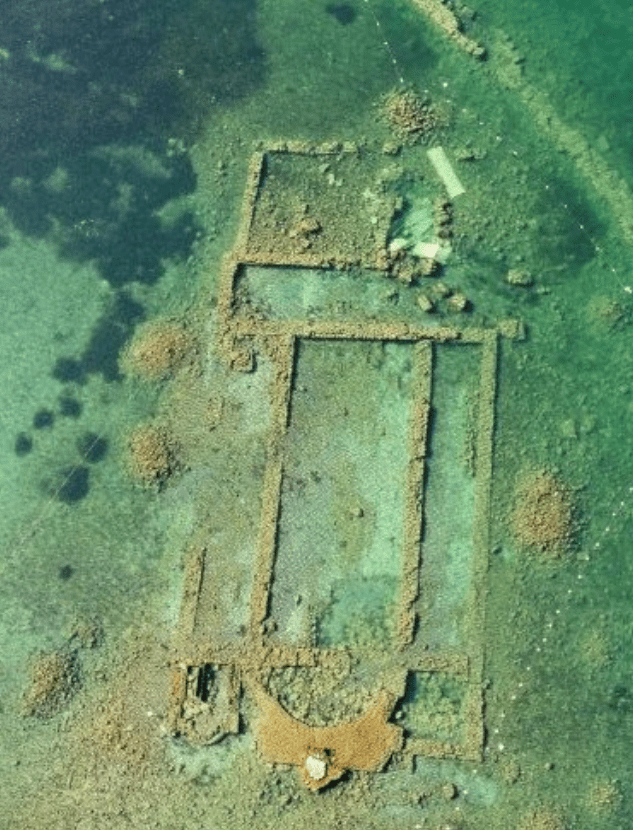
Basilica of Saint Neophytos is the name of the underwater basilica in Lake İznik, modern-day Turkey. This was where those who gathered for the Council of Nicaea .
The Telling of our Faith.
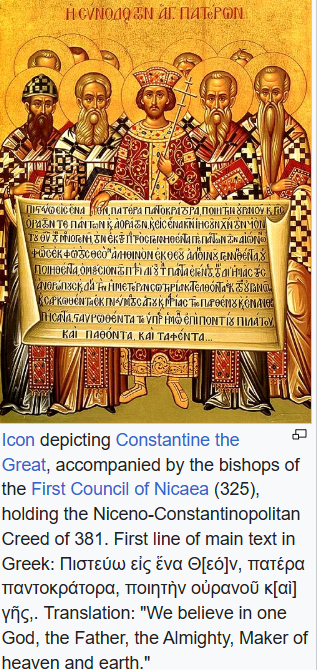
Over the past weekend, the Christian Church has been celebrating one of the most important anniversaries of our faith, the 1,700 Anniversary of the First Ecumenical Council which was held in Nicaea, (now Iznik) in what is now Turkey. Until 325AD, the Christian Church was established in various centres of mission but, as it grew, it was also dealing with persecution on a large scale from those who did not want the Christian faith, rooted in the life, witness and teaching of Jesus Christ to succeed. Whilst we have never been free from persecution nor strangers to martyrdom, the period until the 4th century was particularly one where many Christians were put to death or tortured for their faith. In the 4th Century, under the reign of Emperor Constantine, things changed. His mother, Helen(a) had become a Christian during a time in the Holy Land and her faith influenced her son. Though he did not immediately become a Christian himself, (though he died one), he declared that Christianity would become the official religion of the Roman Empire. Peace and stability came to the Church.
Except, not quite! When people are up against terrible suffering, persecution and death, there is a unity which concentrates everyone on survival and on being loyal to what they believe. It brings with it its own high level of support for each other. There is no time or freedom to concentrate on anything but holding each other together, caring, loving and sustaining each other in mutual hope and encouragement. When danger passes, the personal relief can sometimes give people the opportunity to face issues of disagreement which trouble them and can produce division. That is what happened and the church faced differences in practice and custom caused by not being able to worship and prayer together. Things like the date when the Church observed Easter and other practices needed to be dealt with but the Church was facing its biggest ever challenge at Nicaea. At this moment in the story of the Church the biggest and most important question of our faith had to be faced: Who is Jesus? Under its new found peace, Christianity had to face the question about the nature of Jesus. Followers of a theologian called Arius maintained that Jesus was a created being, who whilst a good man and infused with the vision of God, was not God. More than anything else before or since this view threatened to destroy the church. The fierce debate it created division amongst Christians and everything we stand for was in danger of falling apart. So concerned was Constantine that the Christian faith he had chosen to bring stability and harmony to his Empire was itself in grave crisis, that he called together Christians leaders at Nicaea. This was the first Synod or gathering and here the question about who Jesus truly is, was debated. The Council rejected the teaching of Arius and affirmed the total belief that Jesus is one in substance with his Father; that both are God together with the Trinitarian belief that the Holy Spirit is part of a three-fold God. At Nicaea, the Church set out our belief in a ‘Statement’ or ‘Creed which became, at one level the ‘Constitution of the Christian Faith. Though it was refined and deepened at the Council of Constantinople in 381AD and again at Chalcedon in 451, it has become the ‘foundational statement of the Christian faith’ and it forms an essential part of our expression of personal and corporate belief to be recited by the whole Church, Roman Catholic, Orthodox, Anglian, Methodist, every Sunday. Essentially it is summarized by the acclamation often made in worship.
This is our faith. We believe in One God, Father, Son and Holy Spirit.
Pope Leo gathered last weekend gathered with 27 other Christian leaders to celebrate the 1700th anniversary in Nicaea, modern-day Iznik, Türkiye. Pope Leo thanked Patriarch Bartholomew I, Ecumenical Patriarch of Constantinople, for his “great wisdom and foresight” in calling for Church leaders to celebrate this important anniversary together. He spoke of the power of the Nicaean Creed to “invite Christians, even today ,to ask ourselves who is Jesus Christ for us personally,“ especially when there is a risk of reducing Jesus Christ, “to a kind of charismatic leader or superman, a misrepresentation that ultimately leads to sadness and confusion.” The Pope went on to point out that reducing Jesus to an intermediary between God and humanity, and therefore not Divine, ignores the reality of the Incarnation.”“But if God did not become man, how can mortal creatures participate in His immortal life?” asked Pope Leo. “What was at stake at Nicaea, and is at stake today, is our faith in the God who, in Jesus Christ, became like us to make us ‘partakers of the divine nature’.”
He went on to say that, because the Creed was professed by all Christian Churches and Communities, “it is of fundamental importance in the journey that Christians are making towards full communion. Faith in one Lord Jesus Christ, the only Son of God, born of the Father before all ages…consubstantial with the Father (Nicene Creed) is a profound bond uniting all Christians.”
For me, reciting the Creed grounds my faith in Jesus who, in his birth, life, teaching, death and resurrection, speaks to me of the immensity of God’s Love, for me personally; for each other;and of my love for God; and of the power of that love to embrace all. Telling the story of what God, the Holy Trinity has done for us and goes on doing, and speaking it prayerfully at the heart of worship is a tremendous experience of belonging and believing which holds us in a deeply inclusive and profound relationship and so becomes the prayer which speaks from the heart of our living faith in God.
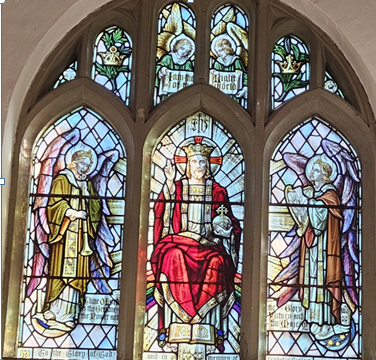
Christ the King window, St Eadmer’s Church, Admarsh-in Bleasdale, Forest of Bowland, North Lancashire. The dedication to Eadmer is thought to be unique in the United Kingdom and possibly the world. Eadmer is probably the name of a monk who, during a Vigil called to determine where Saint Cuthbert’s body should be laid finally to rest, received a vision from God that his Shrine Church should be built at what is now Durham. Those who established the Church at Bleasdale where a family who came from Hexham which at the time was in the Diocese of Durham. The window is a Triptych with Christ in glory taking up the centre panel (above). The window was made by Abbot & Company of Lancaster in memory of Isabella Bullock and was installed on 5th November 1925, 100 years ago. (Photo: Robert Gardener, former churchwarden)
Christ our King in Glory reigning.
This week, the Christian Church celebrates the Feast of Christ the King, the last week of the Church Year, which begins again on Advent Sunday.
The title, Christ the King in glory reigning is a theme found in a number of hymns. Specifically it is the title of a hymn by Canon Patrick Appleford to which was given the tune Sunderland, written by Father Geoffrey Beaumont CR. Both were members of the Twentieth Century Music Group which sought to give the church new hymns in contemporary style with new words and tunes. The hymn Christ our King in glory reigning is rarely sung now but its title celebrates the universal sovereignty of Jesus Christ combined with a longing for God to reign over the world He has created, as a Kingdom filled with Justice, Love and Peace.
This is a Kingdom which contrasts deeply with how much of the world regards kingship. It is a rule of self-giving love rather than one of domination or control. It is a rule of gentleness. It is also a reminder to us that God rules in glory. That glory is expressed in worship not just on earth but especially in heaven. This state of living close to God in His nearer presence is experienced together with all who have entered fully God’s Kingdom and who form a great myriad of beings which include Angels and Archangels, Saints and Holy Ones; all who form what the Eucharist calls the whole company of Heaven and of which we are part. We are citizens of a Kingdom which calls us to live by the values shown to us by Jesus. These values are not as many in our world understands them. The foundations of God’s Kingdom are holiness, justice, freedom, peace and love. To be citizens of such a kingdom means to have far more radical and differing values than those often found in the world around us.
To establish this Kingdom was costly and totally self-giving. The poet, T S Eliot, has a phrase, Costing not less than everything and that is precisely what it cost Jesus to bring God’s new Kingdom into being. It needed love and sacrifice because God was releasing a new, powerful force into the world. The Kingdom that Jesus inaugurated from the Cross is not a Kingdom as this world understands it. God’s Kingdom is very different. In the face of hatred it brings love; gentleness replaces might; peace instead of strife; mercy instead of retribution; justice rooted in fairness; liberty and freedom in the place of oppression and intolerance; self-giving replacing self-centredness; service to others rooted in humility replacing pride; forgiveness removing blame and generosity overcoming greed.
All this and much more come at a cost but it is one that God chooses to pay in the sacrifice of Jesus on the Cross. There is the throne of God from which he reigns over our hearts and lives. From that very cross He claims us as His own and he asks us to claim each other in love and acceptance and generosity, valuing each other as God values each one of us.
We often speak of Service to God and to each other as hallmarks of the Kingdom. This service is initially one of the heart before it is of the hand. We are called to carry within us the signs of the Kingdom as companions of our High King. We are called to share those signs , the values we follow, and in the words of St Mother Teresa of Kolkata, to share the simple, little things we learn from our King, but with a great deal of love.
I have often been encouraged by a little prayer I came across, written by a new Christian who had just come to faith. His experience of God’s love showed him what he must do.
O Lord, you are King of our spirits. You have issued orders to your subjects to do a great work. You have commanded us to preach the gospel to every creature. We are going on that errand now. Let your presence go with is to enliven and enable us to persevere in that great work until we die. Amen



 Mr G's Ponderings