Tag: Love

Famous last words

St Non’s Well where St David is said to have been baptized near St. David’s. Photo Mr G

Not far from St. David’s Cathedral in Wales, there is a lovely scenic walk along the coastal headlands to a place where St. David is reputed to have been born in the 6th century.
It is said that David’s mother, Saint Non, gave birth to David in a house on the site of an ancient chapel and nearby there is a small well bubbling up from the ground and forming a little pool before cascading away. Today it is known as  St. Non’s Well  because tradition says that it first sprung up at the time David was born. The water is said to have healing and miraculous powers. It is regarded as one of the most sacred Wells in Wales. It certainly feels a holy place – one of those spots where you sense that God’s grace has been specially dispensed. Visitors to the well strew garlands of flowers and herbs in the pool of water and some, like me, fill water bottles with the crystal clear spring water. Cupping one’s hand and letting the water trickle through the fingers is a delicious sensation.

David himself was very fond of water – the only liquid he drank, except the wine of the Eucharist. He and his followers were known as the Aquati because of this.  Perhaps, too, David’s affinity with water stems from the legend which surrounds his birth. He is said to have been born in the midst of a terrific thunderstorm!

St. Non, David’s mother, was the daughter of a local chieftain and she is said to have been made pregnant (perhaps even by force) by Prince Sant of the royal house of Ceredigion. Some say he was King. Whatever the circumstance of the pregnancy, Sant seems to have tried to make amends by renouncing his kingdom after David’s birth and following the life of a hermit.

David himself eventually became a monk and a scholar. He is said to have founded 12 monasteries and certainly many came to him to learn the Christian faith. Of those, quite a few went on missionary journeys to Cornwall and to Brittany. There they established the faith and proclaimed the Gospel. David continued to live in Wales but his reputation for holiness and scholarship, as a spiritual warrior,  spread throughout Europe.

He and his monks lived a simple life of prayer, worship and study. They ate frugally on a diet of vegetables with water. Not all his monks approved of this and it is said that a group of them were so fed up that they tried to poison him! Hagiography is not always noted for its accuracy!

It was as death approached that David prepared himself for his final words to his monks and nuns. According to his chief biographer, Rhgyfarch, himself a son of a later Bishop of St. David’s, David gathered his loved ones to his side and spoke these words:

The little things which David taught included prayer, being present for the breaking of bread at the Eucharist; reading scripture; speaking only when necessary and helping the poor. He believed also that we should have a deep respect for others. Learning to listen to each other with real love is a way towards greater understanding but it also leads to godliness. We are encouraged to be lowly, possessing a humility which never expresses itself arrogantly and which steers us away from pride. He also set great store on hospitality – always being ‘at home’ for others and for God – having time for both.
There are so many big, dark things happening in our world today and we might wonder what doing some little things can make such a difference. You would be amazed – in fact do be amazed!

It is the little things we do in Christ’s name which matter most. Mother Teresa of Calcutta expressed much the same thing when she said that she and her sisters didn’t do great things but rather little things with a great love. St. David would have approved of that.
Mother Teresa points us to one particular thing we can do more than anything else and it is suggested by the lovely Saint John of the Cross.

That will change everything in a world of great sorrow and need.

[Mr G]
Why did they bother?

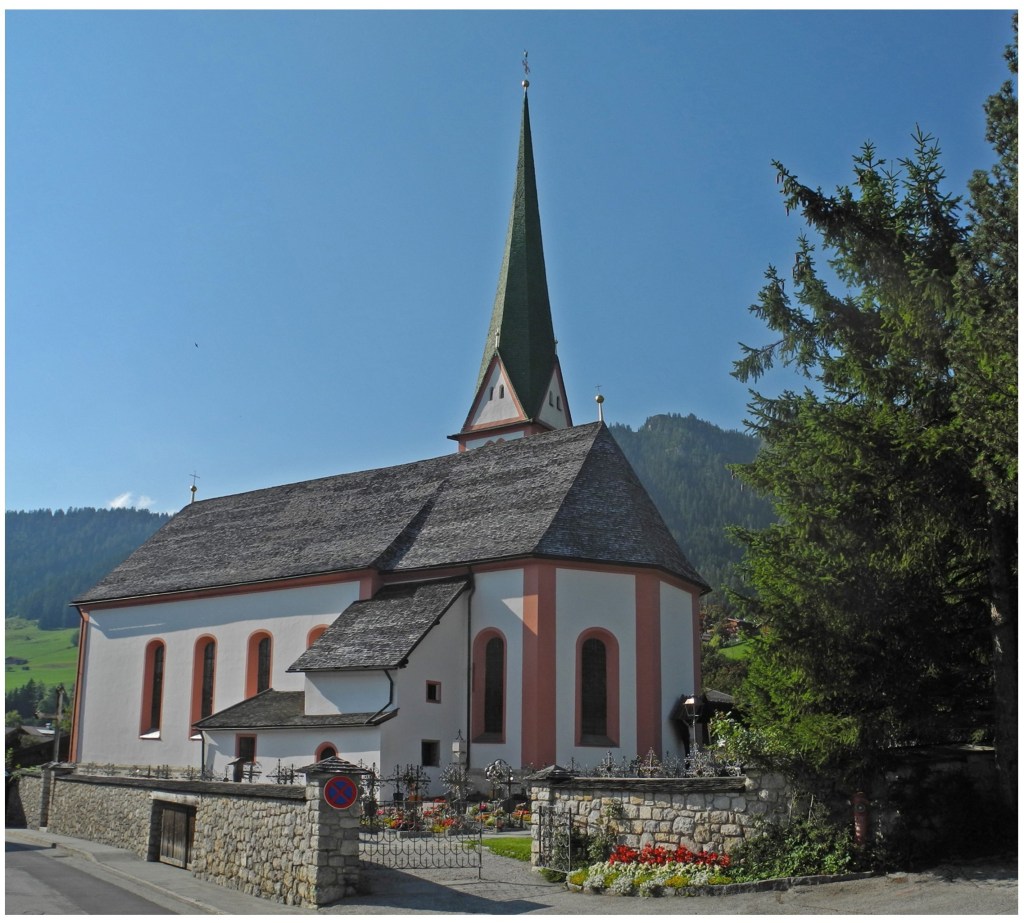
St Oswald’s Church, Alfbach, Austria
This image is licensed under the Creative Commons Attribution-Share Alike 4.0 International license.

Photo by SchiDD/2018-WLM

 When Bishop David Jenkins was Bishop of Durham, he often spent his summer holiday leading tours to Christian places.
On one such occasion he found himself at a place in Western Austria, the mountain village of Alfbach.
He visited the church and, to his surprise he found that it was dedicated to St. Oswald of Northumbria. His own Cathedral in Durham was the place where some physical remains of St. Oswald rested alongside Saint Cuthbert. David Jenkins fell to wondering why this Austrian Church had this dedication to a saint in faraway Northumberland.
He found a tourist leaflet which said that in the 7th and 8th centuries Christianity was brought to the region by Irish and Northumbrian monks.
The bishop’s journey to the village had been in an air-conditioned coach but it had still been a difficult journey along narrow mountain  roads. How much more difficult must it have been for those monks who had travelled through darkest Europe to bring the Gospel to that place. The bishop could only imagine what it must have been like and what hardships they endured.

More importantly, why did they bother?
The Bishop asked himself that question and this is the answer he came up with:
They had discovered in Jesus, that God loved them so they fell in love with God.
As a result they wanted to share that love with others.

That was what took them through Europe at a time when the flame of Christianity was burning dim—and their mission—to spread the Good News of God’s love renewed the faith of Europe and took the Gospel to new places.

In an age when, for the majority of people, the Christian light burns dimly —God continues to  love us so much that we too might fall back in love with Him—and when we do, like those monks, we will want to tell others.
A way of describing mission. That’s a good thought for Lent.

[Mr G]

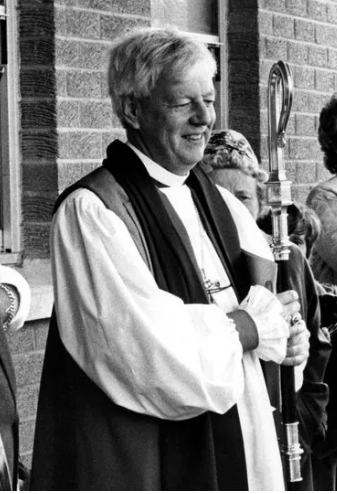
David Jenkins when Bishop Of Durham

for love of Ukraine and Ukrainians

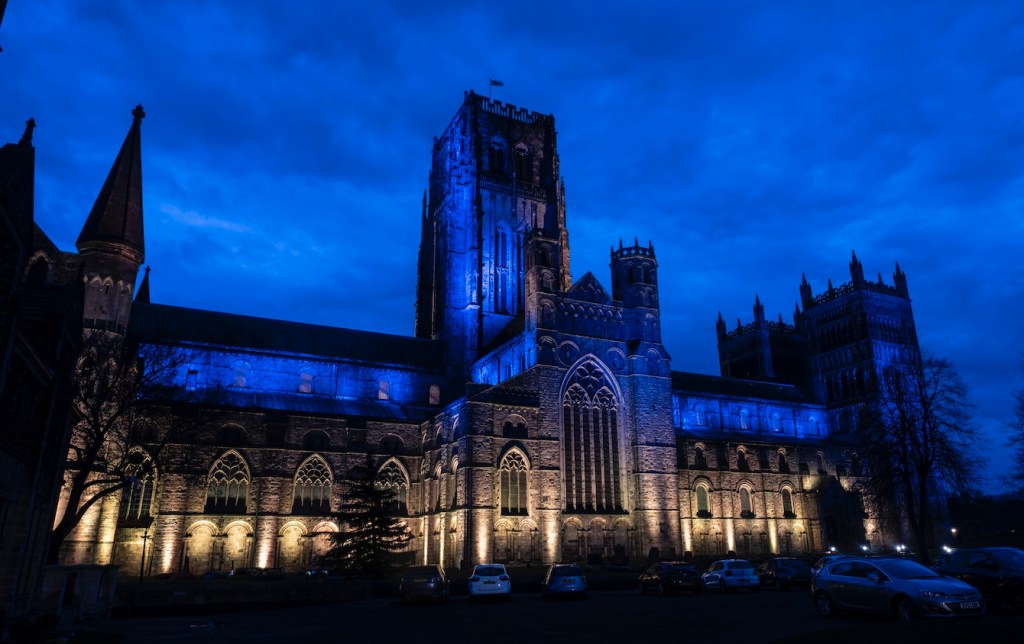
Durham Cathedral floodlit in Ukraine’s colours, joins many churches, cathedrals, public buildings in solidarity with the people of Ukraine, February 24th, 2023

Many churches are holding prayer vigils on the anniversary of the beginning of the Russian invasion of Ukraine  with contributions from Ukrainian refugees, choirs and other members of the community.

The services are being arranged as the Government announced a national moment of silence at 11am today in solidarity with Ukraine.

In rural as well as urban areas, parishes where families are hosting Ukrainian refugees will open their doors for prayer, reflection and music to mark the anniversary.

A prayer for Ukrainian Refugees in our countries.

Dear Lord, you blessed us with new life
by crossing the borders of heaven and moving into our neighbourhood.

Your parents fled with you from violence,
carrying you in their arms in hope-filled fear.
We still our hearts:
help us know you are with us, making your home in us,

being yourself, in the presence of us being fully ourselves.
We act for justice and mercy:
help us see in those we host, and those who welcome us,
your image, valuable beyond words,
and your blessing that will bring new life.

Amen.

A radiant smile blesses our coming days.

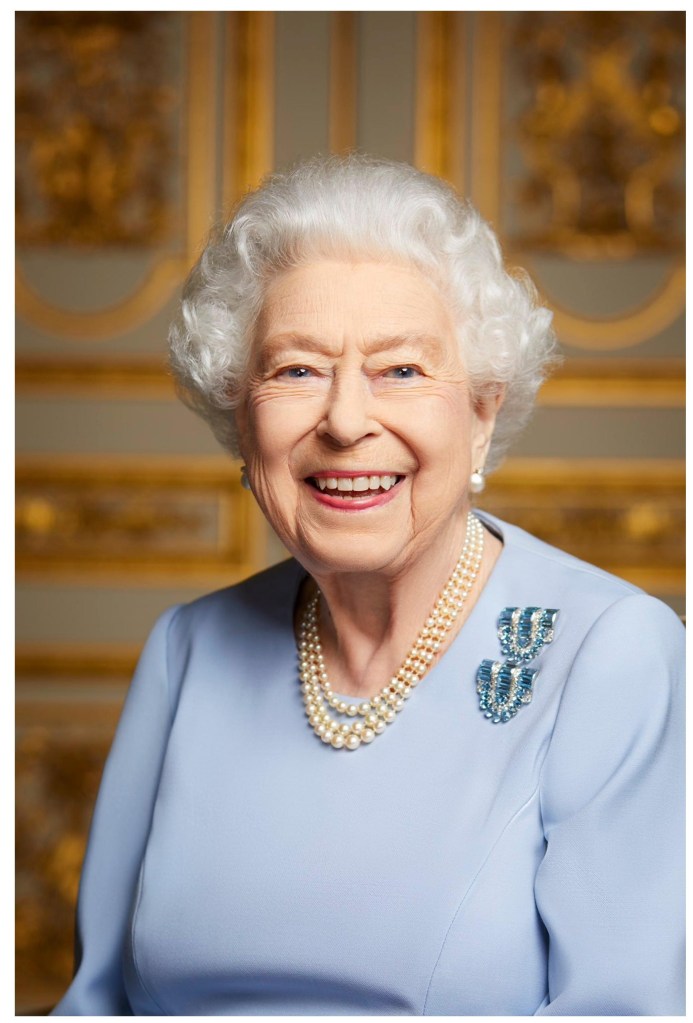
Portrait of Queen Elizabeth taking at her 70th Anniversary but not released until this weekend

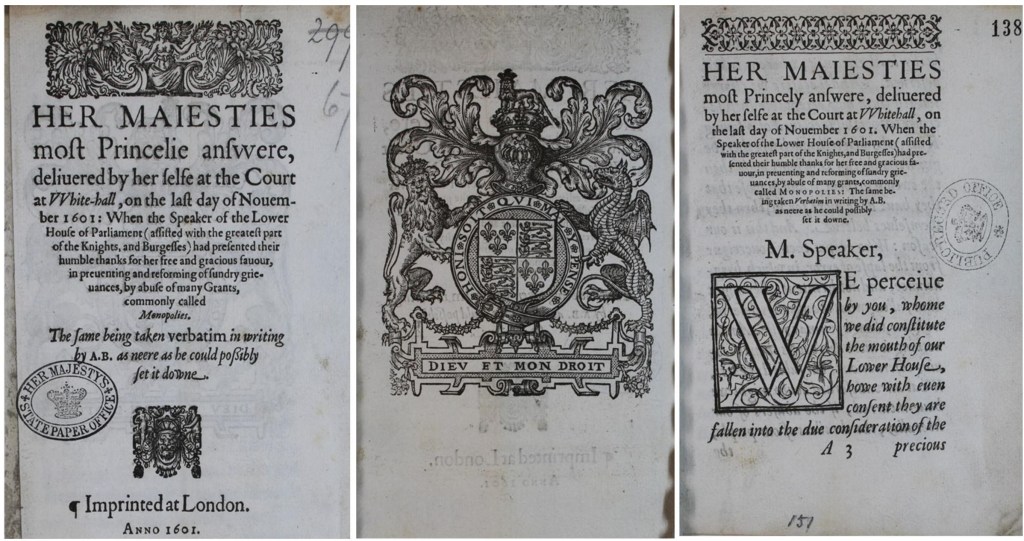
A Golden Speech from Elizabeth 1 relevant for today

On the 30th November , 1601, the First Queen Elizabeth went to Parliament and addressed 141 Members.
She had been on the throne for almost 50 years and unbeknown to all present it would be her last visit to Parliament.

The Speaker and other members thought that she would address Parliament about a number of economic concerns. In the event, her words were on an entirely different topic.

She was to die in 1603, handing the Throne over to James 1st (6th of Scotland). In the intervening period she never addressed Parliament again.
The 1601 speech has become known as the ‘Golden Speech’, not least because, in it, she tried to show how much she loved the English people. There are two particular passages relating to this:

The Queen opened with these words:

Mr Speaker… I do assure you there is no prince that loves his subjects better, or whose love can countervail our love. There is no jewel, be it of never so rich  a price, which I set before this jewel: I mean your love.  For I do esteem it more than any treasure or riches; for that we know how to prize, but love and thanks I count invaluable. And, though God hath raised me high, yet this I count the glory of my Crown, that I have reigned with your loves. This makes me that I do not so much rejoice that God hath made me to be a Queen, as to be a Queen over so thankful a people.

She ended with these words:

 I know the title of a King is a glorious title, but assure yourself that the shining glory of princely authority hath not so dazzled the eyes of our understanding, 

To be a king and wear a crown is a thing more glorious to them that see it than it is pleasant to them that bear it. For myself I was never so much enticed with the glorious name of a King or royal authority of a Queen as delighted that God hath made me his instrument to maintain his truth and glory and to defend his kingdom

There will never Queen sit in my seat with more zeal to my country, care to my subjects and that will sooner with willingness venture her life for your good and safety than myself. For it is my desire to live nor reign no longer than my life and reign shall be for your good. And though you have had, and may have, many princes more mighty and wise sitting in this seat, yet you never had nor shall have, any that will be more careful and loving.

That description of Queen Elizabeth the First about herself are doubtless true but hearing them and then reading them on the day of Her Majesty’s funeral make them all the more poignant. They are sentiments so easily applicable to our late Queen Elizabeth and more, but they need no speech from her in Parliament or anywhere else. The above Photograph released yesterday, says it all.

What we have witnessed over the 12 days since Queen Elizabeth died on September 8th is a tremendous outpouring of love, in words, in deeds, in tributes, through what is now known as ‘The Queue’ where people from all over the United Kingdom and beyond queued for hours on end, day and night to file reverently passed her coffin.
The services, processions, ceremonies and times of quiet reflection all add up to an enfolding of love for a Royal Family in deep mourning and for a United Kingdom in grief.

 I can happily use the word ‘myriad’ to describe the  love we have for our 70 years of a ministry of love which is simply amazing. Her faith, her words and deeds, her concern for us has done so much to  teach us the meaning of love and service, of joy and duty, of letting light flood into our society, especially when we are at our darkest. Well might we apply Queen Elizabeth First’s words to our own Queen and know its truth.

Never have we had, nor shall have, any that will be more careful and loving.

[Mr G]