Tag: Mr G.

Mid-Summer Wort

Today, the Christian church keeps the festival day of St. John the Baptist.
There is another feast day later in the year when we mark his beheading at the hands of King Herod. Today, however, it is a joyful day, possibly helped by the fact that in the Northern Hemisphere it is Mid-Summer!

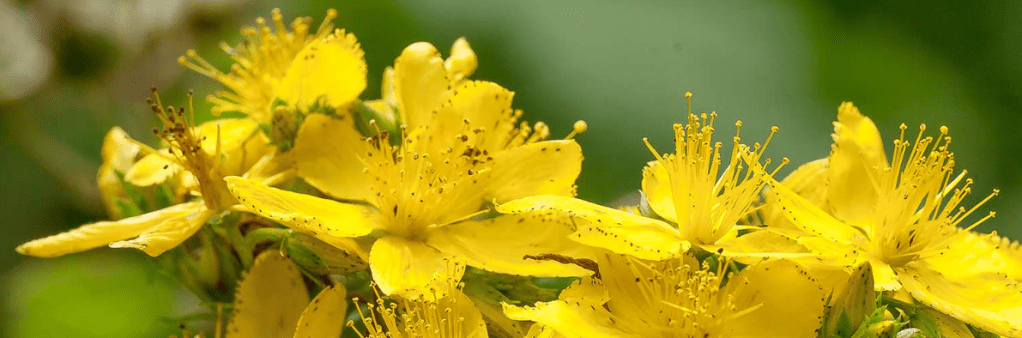
One of the things that marks this as a special time for all sorts of people is that it is also associated with a special flower, The Hypericum, or to give it its posh name, Hypericum perforatum. A native of Europe but now flowering in many other places worldwide (except for Siberia and other cold extremes),it is a bright flower marking bright summer. The dominant colour is vivid yellow, its petals often decorated with black dots. It generally has five petals with five smaller leaf-like sepals below them.

Hypericum is made up of two words from Greek – Hyper  meaning above and eikon meaning picture. This may well date back to a custom, in earlier times, of hanging the flower over an Icon (sacred picture) in the home.

This really introduces us the other name for this plant which is St John’s Wort.There is a direct association with St John the Baptist in the flower itself. It has been suggested that the five petals form a halo, a symbol of saintliness. The red juice which is released when the stem is crushed, represents the blood of the martyred saint.

St John’s Wort is also known for its healing properties and in various forms is a wort or salve (0intment). In earlier times it was used, therefore to ward off evil spirits; safeguard against sickness, protect against the bad things in life. This made the plant special in the nature of healing and it is still  offered as an alternative medicine. It is however toxic to some animals and even humans so should be used carefully and advisedly.
Its power and that of St John the Baptist, is, however feted in an anonymous 14th Century Old English poem:

St Johns wort doth charm all the witches away.
If gathered at midnight on the Saints holy day.
And devils and witches have no power to harm
Those that do gather the plant for a charm.
Rub the lintels and post with that red juicy flower
No thunder nor tempest will then have the power.

The ministry of healing,  offered by John the Baptist to the people who heard his message was a more powerful salve. He was known in the Gospel as the Forerunner the one who prepared the way of Salvation through God’s Son, Jesus.This Salvation is God’s healing of a broken and unloving world and Jesus his beloved Son His Salve,  is the ointment of God’s Saving Love.
John the Baptist led the way to Jesus through his baptism of Repentance, a Baptism which Jesus enhanced through his own life and ministry, death and resurrection. It is possible to say that it is in Baptism that we receive the Healing of God, the Salve which invites us to partake of the Salve of eternal life.

Another title by which St John the Baptist is known is that of Friend of the Bridegroom.
He knew Jesus through a life lived in friendship with God. Friendship brings its own healing and when we are in friendship with God we are touched by the salve or Wort of his love and friendship for us.

Often when we visit friends we take them flowers. Receiving flowers can brighten and change the direction of our day and even our life. Giving them is even better! The love behind them is better still.

St John the Baptist offers us not St John’s Wort but the love and friendship of the  giver, the Lord, our SALVE-ation, who loved us a into being created us to be bright with His image.

[Mr G. Nativity of St John the Baptist. 2025]

Sheer Love

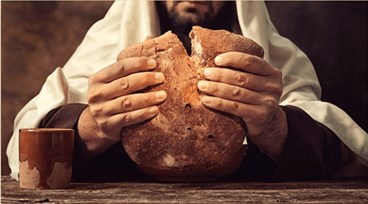
Yesterday, the Christian Church celebrated the  feast of Corpus Christi. This is the time  we gather to give thanks that at the Last Supper, our Lord Jesus gave us this memorial of his Passion. Through this sacrament he brought us its saving power until the end of time.In this Sacrament he feeds God’s people and strengthens us in holiness, so that the family of humankind may come to walk in the light of one faith, in one communion of love.

Both statements express a profound understanding of the Eucharist and, in some way, point us to the appeal of this Sacrament to the Church and to the life and journey of Christians. This journey is a pilgrimage of Love in response to the Sheer Love of God.

This Pilgrimage began in the story of the Church at the Last Supper on Maundy Thursday. This is a day of mixed solemnity, of festivity and leave-taking; of fellowship and parting; of instruction and acts of service.Overshadowing it is the Trial, Passion, Crucifixion and death of Jesus.
Only after Easter did it begin to make sense and the Eucharist take a rightful and central place in the Church.

Which is why, on the first free Thursday after the Easter Season, the Church keeps this Day of Thanksgiving for our Lord’s gift of this Blessed Sacrament, and its place at the spiritual heart of the Christian Community.

And for you and you, and you….

And why do we do this?

Luigi Santucci, an Italian novelist who wrote a remarkable book about Jesus, Wrestling with Christ,  tells  it like this.

Do this, our Lord tells us.
And we do – gladly!

On behalf of our Lord Jesus, those who are privileged to be a part of God’s continuous reaching out in Love, His priests, offer not just the Lord’s Supper but all that follows as a result.
What follows for priests is a constant ministry of trying to make God REAL for others. This was a key mantra of Sidney Evans when he was Dean of King’s College, London.

I have not always succeeded but I do know that We all make God REAL for others when we make ourselves REAL to God at the moment God reaches out and is REAL to us in out of sheer love, not least in this Most Holy and Blessed Sacrament.

In some lovely words of Fred Kaan, in his hymn put peace into each other’s hands, I see this Realness of God’s Love in action especially in two verses which centre us on the Eucharist.

Receive, Revere , Respond, Make Real.
The World needs that from us.

Amen

[Mr G. a sermon at St. Mary-at-Latton. Corpus Christi 2025]

[][][] Dom Gregory Dix, The Shape of the Liturgy, a study of development was first published in 1945.
A new edition was published in 2015.

{}{}{} Wrestling with Christ, by Luigi Santussi was published by Harper Collins in 1972 both as a hard-back but also in paperback. Previously owned copies are often available. Try Abe Books

[][][] Fred Kaan, minister, pastor,hymn-writer and poet. The quote comes from his moving hymn: Put Peace into each other’s hands.
it is often sung. He wrote many hymns which are devotional poems.
A Collection of his hymns (Hymn texts of Fred Kaan) was publishd by Stainer and Bell
(Hope publishing company in USA) in 1985. It is available as a previously owned copy
and is well worth hunting for it because it contains Fred’s fascinating story which includes an account
of his early life in the Nederlands, a time which spanned the German Occupation.

{}{}{} The Quote from Queen Elizabeth the First is well known and is proof that she was her father’s daughter!
At least in the respect that she inherited King Henry VIII’s grasp of Christian Theology.


Our Common Home

Hay bales in a Normandy field. Photo by Mr.G.

The time between September 1st and October 4th (The feast of St. Francis) is used by many Christians, other believers and organizations concerned about our Planet, as a time of meditation on Creation, our part in caring for it, and the dedication our lives anew to God who we celebrate as Creator and Sustainer of life

The photo of the Hay bales seems to express something of the beauty of the earth and gives me joy.  The bales were typical of the countryside of Normandy where I recently spent some time. Gathering in the hay and bind it in round bales was going on in many fields and farms. I was pleased to see that the bales were tied naturally and not, as is so often in England, bound in unsightly black plastic.

Rural Communities rarely have an easy time of it, so I am not moaning.   As well as farming and managing woodland, farmers often bear the brunt of the general failure to care for our planet. We dump on the rural communities a responsibility for caring about ecology and promoting climate change as well as nurturing the land to provide food and having consideration for their animals. Meanwhile, many enjoy the delights of the countryside, free of charge, even insisting that maintenance and trouble free access is our right and we expect the farming community to maintain it so that we might not feel responsible. A generalization, I know, but it contains truth.
Many of us know that blaming others for things that go wrong or which don’t achieve our aims is an excellent way of ducking out of our own responsibility! Yet we don’t fool anybody, not even ourself.

Equally importantly is our concern for those in our world who are without food or water. We have a duty of care for the people who live in poverty and destitution either through crop failure; the inhumanity of war; or in our own country where people are reliant on Food Banks or through meals provided for children who otherwise go hungry.

There are big issues around our stewardship of God’s creation and climate change but if we do just little and responsible things like random but heartfelt acts of kindness to others, especially the poor and needy, then the world becomes a better place.
I am constantly being drawn back to something Saint Ambrose said:
“It is not from your own possessions that you are bestowing alms on the poor, you are but restoring to them what is theirs by right. For what was given to everyone for the use of all, you have taken for your exclusive use. The earth belongs not to the rich, but to everyone. Thus, far from giving lavishly, you are but paying part of your debt.”

 Here is a prayer we might consider saying, though it is uncomfortable!

A Prayer based on Psalm 102:5 (offered as a resource from the Churches)

“Future generations will never forgive us if we miss the opportunity to protect our common home.
We have inherited a garden; we must not leave a desert for our children.”
Joint statement from Pope Francis, the Ecumenical Patriarch Bartholomew
and Archbishop Justin Welby of Canterbury.

[Mr G]

Start your prayer there…

Photo evening calm in the Lake District. Gill Henwood

Begin your prayer there… these words were written some years ago from the Nuns of West Malling in a little book of meditations. They are both simple and profound.

When my friend, Gill Henwood, sent me the photograph from the Lake District which she named, ‘Evening Calm’,
I thought the words from West Malling `fitted the view.

PS – not forgetting Mr G’s cat Pagli, the sponsor of this Blog.

[More photos from Gill soon.]

?