Tag: Mr G

By the Hollow Way

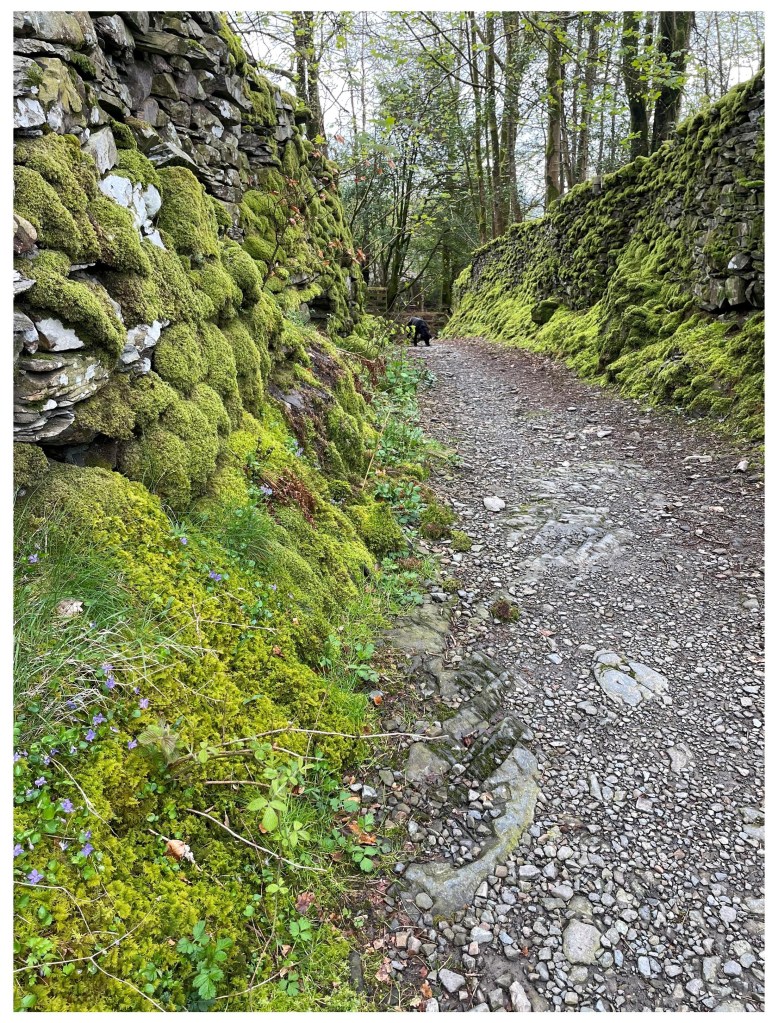
This is a photo taken by my friend Gill Henwood of a Sunken Lane’ in the Lake District.

Gill tells me that this one has dry stone slate walls and floor with mossy banks and ivy. She says that “further up are greater stitchwort, and a huge bramble thicket that promises bramble jelly in the autumn! Happy nesting birds  are all around, singing.”

Another name for a Sunken Lane is Holloway or hollow way, which comes from the Old English  “hola weg”.  It’s a road or track that is significantly lower than the land on either side. Such ways can be found all over the world and they are generally ancient routes for the carriage of trade, travelling and sometimes battle roads along which troops moved. Some date back to Roman times and beyond.
Many are overgrown with nettles and briars and most are disused except by local people or country walkers.

Today they can offer a unique and integral look of the English landscape, providing a glimpse into a time and way of life long gone. They give us information about those times, about the way of life then, or geological information and how the paths have evolved into habitats for wildlife. They also bring pleasure and interest to the walker.

Spiritually, they can offer a physical and contemplative meditation about pilgrimage to God and the Heavenly Kingdom as well as a visible lesson of what the Bible teaches us about walking the ‘narrow way’. Whilst they can offer a warning about keeping on the straight and narrow, they also show us the beauty and joy of doing so.  There is so much to enrich our lives if we don’t rush headlong by, getting caught up in frantic pace and demands which often come to nothing. It was St John of the Cross who said:

“God passes through the thicket of the world, and wherever His glance falls He turns all things to beauty.”

Walk, breathe, pause, notice, pray, become!

[Mr G]

Hear, my child, and accept my words,
   that the years of your life may be many.
I have taught you the way of wisdom;
   I have led you in the paths of uprightness.
When you walk, your step will not be hampered;
   and if you run, you will not stumble.
Keep hold of instruction; do not let go;
   guard her, for she is your life.
Do not enter the path of the wicked,
   and do not walk in the way of evildoers.
Avoid it; do not go on it;
   turn away from it and pass on.
For they cannot sleep unless they have done wrong;
   they are robbed of sleep unless they have made someone stumble.
For they eat the bread of wickedness
   and drink the wine of violence.
But the path of the righteous is like the light of dawn,
   which shines brighter and brighter until full day.

Proverbs 4:10-18

Daughter of the Wind

Wood Anemone photographed by Gill Henwood in the Lake District.

Wood Anemone…. A little story.

According to the poem at the beginning of the Book of Genesis, God completed the creative action on Planet earth after six days of total activity.
Genesis informs us that on the 7th day, God rested.
But rest rarely means inaction, especially for God. There is no way that The Maker of everything can either unmake nor stop the inbuilt process of evolving, developing, deepening, the love which God had poured into all that was made.
You see, in order to ‘make’, God had to use the very essence of being to do this and that same essence, being God, is never absent.
That’s a quick way of saying that God is always God and always making things in his and her own image!
God broods over creation like a father and a mother, holding it in being, trying to save it from harm, and guiding with all encompassing ‘love’. That’s the work chosen by God, Father, Son and Holy Spirit.

But none of that needed to be explained on that first Sunday morning. Later, God would invent and make some very clever people called ‘theologians’ who could mull over everything that God has made and decide whether it is good or not so good. They will helpfully disagree on this which makes it very simple for us to ignore them, or become one of them. (tongue in cheek remark!)
On that first Sunday morning, God wasn’t prepared to get too involved in all that. He was resting. I suppose, being, God it wasn’t the forty-winks kind of rest that we know it to be now. It was a creative rather than restorative rest.

As God the Father rested, God the Son pointed up at the lovely stars and noticed that, appropriately, one of the stars had six points, one for each day of creation. In fact, many people would give it the name of The Creator’s Star.
These 6 ‘pinpricks’ touched the darkness and so it wasn’t as dark as it would be without them. In fact, the light had a bright and luminous beauty which simply shone amazingly.

As God the Father, watched this, God the Holy Spirit allowed inspiration to flow.
Earlier, a joint effort had created things like paper, pens and pencils, paint and ink and paint brushes. So God the Spirit set to work.
Gently, the pencil floated over the paper as God thought what to make of the stars with six points drawn on the  paper.
What  had emerged was a flower, robust but also vulnerable. It would live amongst the trees and in the Spring, it would shine with a brilliant  light.
Ah!, thought God. This little flower will become part of something very special.

God knew that one day it would be necessary for some extremely Good News to be announced and the Son of God would make it.
The plan, still to be unfolded, would involve the Son in a supreme act of love though as with all acts of self-giving, it would come at a price.
So, in using the little flower to be part of the message of hope and joy to lighten a dark world, God knew that it would perhaps not live very long because as we all know, when we light a candle, as it burns to give us light, it dies.
But in the case of the little white flower, there would be no permanent death because death merely continues a journey of life but in another place. Well, almost, because what the flower leaves behind is a root system which means it will come alive on earth again.

God loved the little flower and as the Son held it up, the Spirit breathed on it and it danced. It moved as if in the wind, so God said that it would be known as  ‘wind flower’.
The Spirit then pronounced the Name which would be ‘Anemone’  – Daughter of the wind.

Jesus loved the white colour because it would be the Easter colour of Resurrection and the anemone would live in forests and woodlands because that would remind people of the wood of the Cross. It would therefore suggest to the people who saw it that through the love of God poured out from the Crucifixion, the world would be a brighter, lighter, more joyful place. It would be a world able to celebrate hope and beauty and love again. The little white flower would remind people of this

… and the little Wood Anemone? Having done her job she would rest a little until next year.


[Mr G]

with thanks to Gill for the inspiring photograph.

Waymarks of Faith

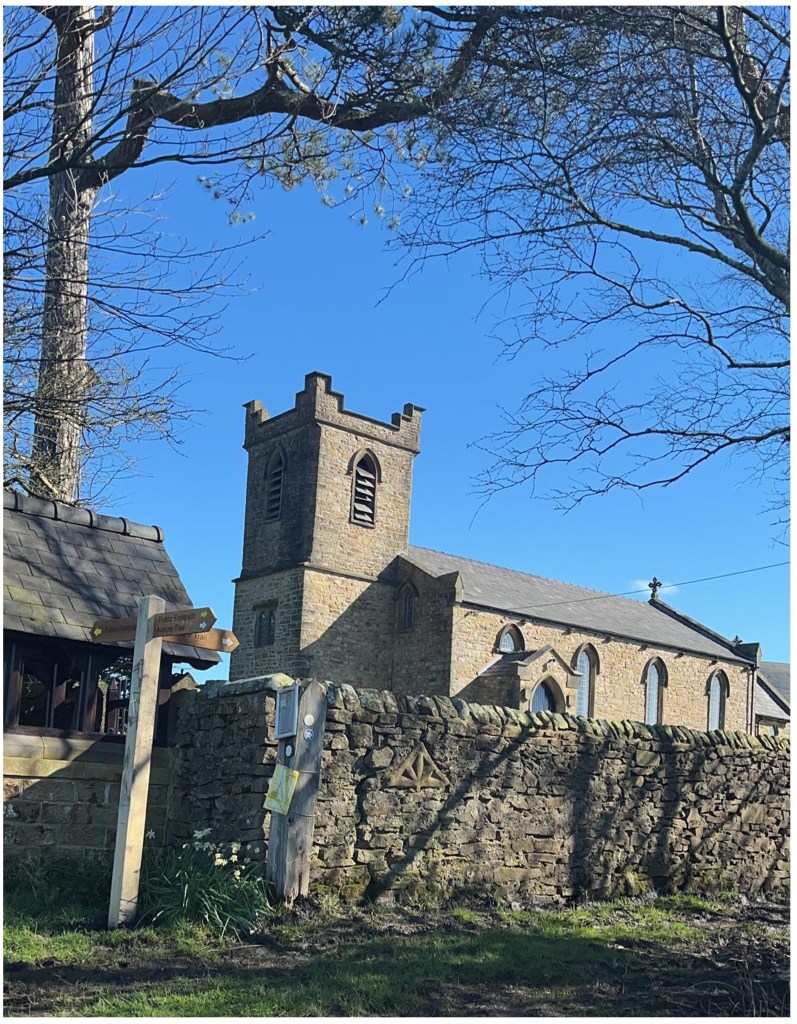
St Eadmer, Admarsh-in-Bleasdale. Photo: Helen Smith

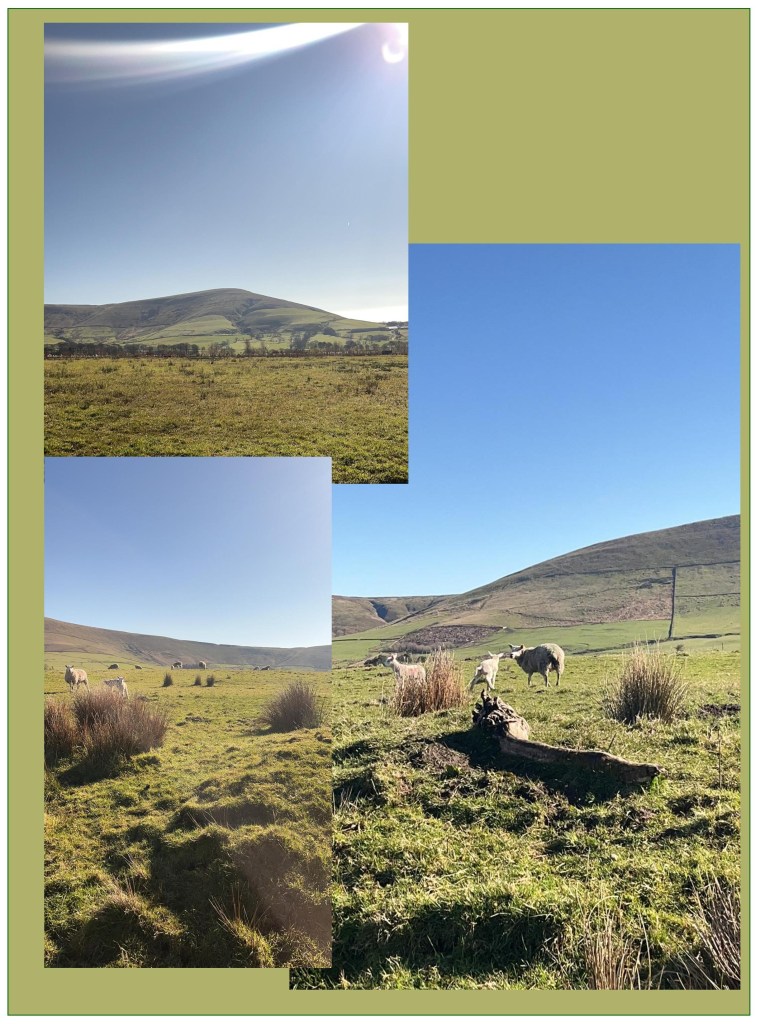
This delightful church at Bleasdale (or to be correct, Admarsh-in-Bleasdale) is overlooked by Parlick and Fairsnape Fells in North Lancashire. Both are in the Bowland Area of Natural Beauty. The Church has a unique dedication – that of St Eadmer.

It has baffled many as to who he was and for a long time it was thought that he was the secretary to St. Anselm of Canterbury.( An Eadmer wrote Anselm’s biography.)
Investigations proved inconclusive until another Eadmer was discovered.
When the Body of St. Cuthbert was carried by the monks of Lindisfarne to safety from the Vikings, the journey was long and arduous. Indeed, with rests it took a very long time. It involved a stay in Chester-le-Street and a journey over the Cleveland Hills now known as the Lyke Wake Walk or Coffin Walk.

The final part of the journey is to be found in a ‘History of the Church in Durham’ by a medieval monk, Symeon.
He describes the arrival of the shrine at a place on the east side of what is now the city of Durham. The vehicle on which it rested could not be moved and the bishop directed his monks “that they should solicit an explanation of this sign from heaven by a fast of three days, which should be spent in watching and prayer, in order that they might discover where they should take their abode along with the holy body of the father”. This was done and Simeon goes on to relate that “a revelation was made to a certain religious person named Eadmer, to the purport that they were required to remove the body to Durham and prepare a suitable resting place for it”.
This was done and as a result, ultimately, one of the greatest Norman Cathedrals in the world was built.

What all this has to do with the Church in Bleasdale is sheer conjecture. It may well be bound up with the fortunes of a local family, the Parkinson’s, who came to live at Fairsnape Fell and who were Christian folk. The Chapel at Admarsh fell into decay and it was rescued and restored by the Parkinson family. It was my conjecture that linked Bleasdale with Northumbria and Durham.
The Fairsnape Parkinsons claimed descent from the Featherstonehaughs of Featherstone Castle in Northumberland then in the diocese of Durham. When they were looking for a dedication for their renewed church, it is reasonable to suggest that they looked to their Mother Church of Durham which was the last resting place of the remains of St. Cuthbert of Lindisfarne.
Possibly the Parkinson family felt that they shared the vision of Eadmer to build a church albeit a small and modest one.

Like so much of our history as a nation, facts are often shrouded in the mists of time and our stories are a mixture of truths, myths, poetic license and reasonable conjecture after sifting and weighing up the evidence.
What we do know is that in this beautiful corner of Lancashire, there has stood a church which has been cared for and used for a long time and has fed people with the nourishment of the Gospel.
An agricultural community works what is often a harsh land and with a changing lifestyle. Farming is not what it was nor is church life. The local Church of England School which provided an amazing education to children from the area sadly closed its doors in 2019. The village hall, however, still caters for a quaint but satisfying social life. Lancashire Hot Pot Suppers were, in my 10 years ministering there, a treat beyond measure and where else could you end each evening’s entertainment with a rousing rendition of the National Anthem, played lustily on the hall piano!

Worship still takes place in the serene church and placing oneself in God’s hands means lives continue to be consecrated.
This morning, my friend Helen send me the photo along with others of the fells. It opened up memories but also I was reading about the state of the Church of England as recorded in The Guardian  newspaper. It’s radicalism often tries to engage its readers with negativity about Christianity, when it isn’t busy with its other preoccupation, that of undermining the Monarchy!
This isn’t an easy time to keep churches going in small, rural places and logic might well suggest that we should close more of them down and reorganise ourselves into bigger and more manageable units. A large local Scout camp often uses St Eadmer’s as a shelter when their night hikes are interrupted by rain. Where would they go?

For the faithful Christians who find faith and God’s love in their little church, this is more than an act of survival. It is an act of belief and a witness in a God who converted a world with a motley crew and goes on doing so still.
Each of our churches are ‘waymarks’ – cairns- on our way to heaven.
We lose those pointers and the sharing of discipleship at our peril.
We may say that we have to be realistic but thankfully, the Parkinson family of Bleasdale and other places like them,  including, and especially, today, didn’t understand a realism which was fatalistic and devoid of hope and determination to claim divine footsteps to heaven. Cairns are built when wayfarers add a stone or a pebble. The Way to Heaven needs not so much stones as visionary people.

Father, as you gave Eadmer the vision to build a church to your glory:
and kindled that vision anew in the hearts of those
who built the Church in this land,
so guide all who meet you in our places of worship,  
to go on building your Church in the hearts and lives
which are wholly dedicated to you. Amen

[Thank you to Helen Smith for sending me the photographs
and thus reminding me of the importance of the waymarks of faith in our journey of life]

Parlick & Fairsnape Fells – photos by Helen Smith

Living Manuscripts

A long time ago now, I picked up a copy of St. John’s Gospel which had on the cover: Remember, you may be the only copy of the Gospel someone will ever read.
There is such truth in that.
We receive the Good News of God in many ways, but we learn the story, the ‘adventure of God in Jesus’,often by being introduced to it by someone for whom the words of the Gospel have become ‘real’. As the words above suggest, we are copies of that Gospel.
The New Testament is an open-ended book. We are still writing it with our lives.

Christians are just observing, once again, Holy Week, the time when we refresh our lives with all that Jesus means to us and all the love of God he shows to us. It is also a time of re-offering our own lives back to God so that we can be used in the service of the Gospel.
In that re-offering we are, as it were, taking up our pen of faith and dipping it into the love of God.

Manuscripts of the Bible, and especially the Gospel accounts were beautifully produced in the early Church. The Book of Kells in Dublin; the Gospel made at Lindisfarne and so many others are examples of how the Good News of Jesus was celebrated in written form. Missionary monks in Britain would usually travel with a copy of the Gospel. This was their preaching book. The more embellished and wonderfully decorated copies were written because of a deep love of a saint. The Lindisfarne Gospel was made in honour of St. Cuthbert. Of course, most of all, they were signs of a deep love for God, for Jesus.
As with Icon writing, (painting), they were deeply instilled with prayer.
Through prayer and skill the manuscripts became expression of the faith of those who made them.
All acts of love for God are truly genuine when we put our whole being into them.

A medieval monk preached a sermon in Durham Cathedral in which he used the tools that are needed to make a manuscript as spiritual aids to help us put ourselves into our witness to God.
This is part of what he said:

“The Parchment on which the manuscripts are written is pure conscience;  The knife that scrapes the skin making it smooth for writing is likened to the love of God, the awe with which we hold him as he, like the knife in the hand of the skilled manuscript writer, scrapes away all that is within us which turns us away from God and prevents us truly loving him.  The pumice that smoothes the skin is the discipline of heavenly desire and the chalk which whitens it signifies an unbroken meditation of holy thoughts.  The ruler for the lines of text is the will of God and the straightedge is devotion to the holy task.  The quill with its end split in two for writing represents the love of God and love of neighbour and the ink is humility itself.  The colours used by the illuminator is a reminder of God’s grace and wisdom which colours our lives. The writing desk is the tranquillity of the heart and the writing place is a contempt of worldly things as the holy work lifts us to a desire for heaven.  The model or exemplar for the work is Jesus Christ.

The monk who wrote this allegory used the everyday things needed to produce a beautiful manuscript for God’s glory as aids for his spiritual journey in copying the Gospel for others to read it.
It is a reminder to us that it is in the ordinary things that we can find God.  Teresa of Avila called this, God walking among the pots and pans.  Making connections between the ordinary things in our lives and Gods  can help us in our praying. 

This prayer written by a lady on a Celtic Retreat I led, makes this connection between the material and spiritual:
 
Vellum, parchment, stone, wood and skin
all marked by the writer to convey the word of God.
Yet God, in mystery, appears to fleshly hearts, made pure,
writing upon these the very word of God,

that they can be read of human –
true icons of Christ.
The Word, made flesh, dwells with us.

The Christian Holy Week pilgrimage brings us closer to the love God shows us through Jesus.
As we pray through our journey we are being invited by God to become living Manuscripts of His love for the World.
It certainly needs to read it.