Last weekend we kept the annual Remembrance for those who died/gave their lives for their country in both the First and Second World Wars. Increasingly, and sadly, we have added further conflicts for our remembrance, since 1945. From Aden to Afghanistan (and now in Europe and the Middle East) the battle for peace and justice continues to need both our prayers and our participation.
Last weekend, at the UK Festival of Remembrance in the Albert Hall, London, there were deeply moving moments as, through the medium of television, we joined in thanksgiving for all who in the armed forces, the support groups who worked with them, and the Merchant Navy contended against evil. In different ways, all of us were involved. This included those who worked in the munitions industry and in farming, as well as others in reserved occupations in civilian life.
One group, however, has rarely got a mention beyond being classed with the ‘civilian services’.
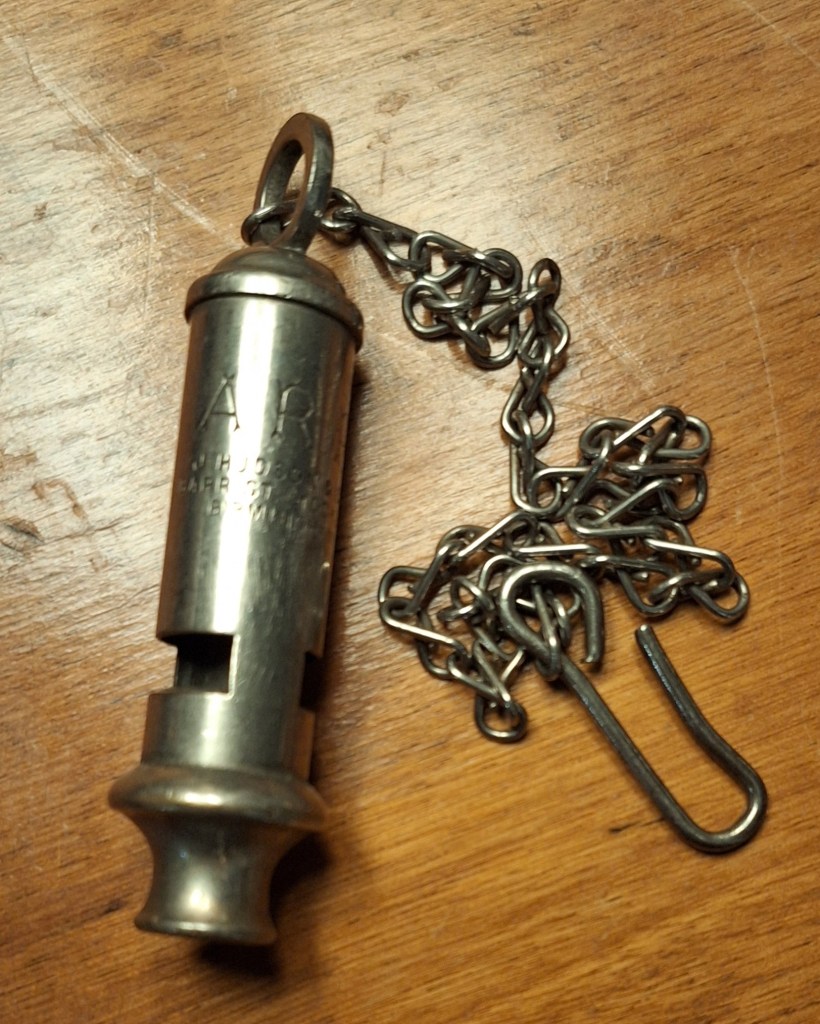
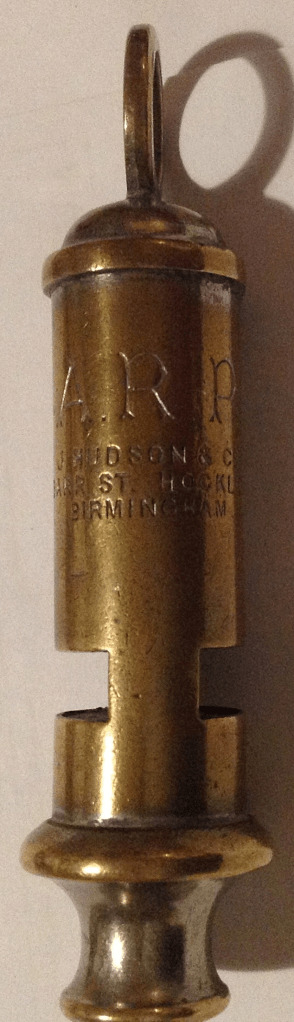
As I looked for the family medals, I came across a ‘whistle’ with the inscription ‘A R P’. I was immediately reminded of ‘Auntie’ Annie, who, though unable to join the Army, could at least do her bit. The letters ARP stood for Air Raid Precaution and the whistle was a vital part of the equipment given to those who ‘volunteered’ as Wardens.
The main role of an ARP Warden was to protect people during air-raids when enemy attacked by dropping bombs, especially on our cities.
After the bombings began in 1940, in what is known as the ‘blitz’, ARP wardens became important and necessary members of our communities, especially in highly populated areas.
They received prior warning of the raids and shepherded the population into shelters, either purpose built or designated such as the London Underground.
They were also in charge of making sure that the ‘black out’ was observed, checking that every light was switched off or blocked with heavy curtain. This was to ensure no naked lights could be seen by the enemy. After the bombing, wardens led the rescue of any caught in the rubble, trying to reunite families and seeking those who were on their own. The wardens would also try to find temporary shelter for those made homeless. All this, as well as tending the injured with First Aid and even helping to put out any fires alongside fire-fighters.
The Whistle was provided to alert people of an incoming raid. Most were made in Birmingham by J. Hudson & Co, in brass and then chrome-plated. The company also made police whistles and in order to distinguish them, the ARP whistle was given a less sharp and shrill sound. An ‘Air Raid Warning’ pamphlet produced by the government in 1939, explains:
‘When air raids are threatened, warning will be given in towns by sirens, or hooters which will be sounded in some places by short blasts and in others by a warbling note, changing every few seconds. The warnings may be given by the police or air-raid wardens blowing short blasts on whistles.‘
As in the photo above, the letters ARP were engraved on the body.
All in all, in some areas particularly, being an Air Raid Warden was a very demanding and dangerous job and many communities relied on their service. Most of those who became Wardens were part-time and voluntary and over 7,000 were killed during raids in the 2nd World War.
It has been estimated that over a million Wardens served over the whole period of the war. One of them was Annie Chiverall whose ARP whistle is in my possession.
Winston Churchill said, in 1940, that “it was not only soldiers who were engaged in battle but the entire population, men, women and children”. Those who served in as ARP Wardens responded to that call to serve alongside so many in the Civilian Services. They deserve a recognition for what they did and why they did it. It is often said that wars begin and prosper where, in the face of tyranny, good people do nothing. Dear ‘Aunty’ Annie was a good person who did her bit and more.
I hold them in loving remembrance and share in a peace and a justice that they worked for and know that this isn’t something confined to times of war. It is now and it is always.



 Mr G's Ponderings