Tag: poet

A Ray of Light in darkness

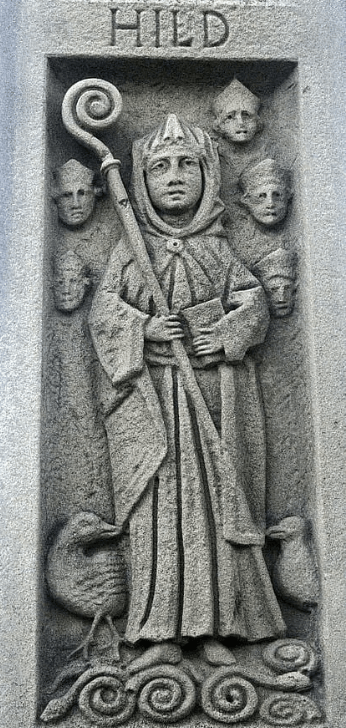
St Hild, detail from a monument to Hilda of Whitby.

This week, the church keeps the feast of St. Hilda (or to give her the Anglo-Saxon name, Hild). 

She was born into the Northumbrian royal family and for the first 33 years of her life led a very different life to the one God was to lead her.
For that call God used the voice of St.Aidan of Lindisfarne. He was the monk from Iona who brought the Gospel to the North East of England and in his monastery on Holy Island he trained up Anglo-Saxon boys to become Missionaries to many parts of England as well as the Scottish borders.
Part of Aidan’s mission plan was to establish religious power houses, monasteries from which further missions could be launched.
These religious houses were built on Prayer and cemented by the Gospel of Jesus Christ as well as translated into Christian Service.

One day, in obedience to God’s plan, Aidan summoned Hild to meet him on the banks of the river Coquet south of Bamburgh.
Here he told her God’s plan for her. She was to establish a religious house, first at Wearmouth and then on the Headland at Hartlepool. From there she was to go on to established her most famous foundation at Whitby (Or Strines at it was then known).
It was to be a ‘double’ monastery in that two monasteries were built side by side, one for men and the other for women.
Hild was to be the Abbess of both.
As Abbess she ruled over both monasteries and was, in effect, the head.

This may surprise some but Aidan belonged to the Church of the West which we call Celtic but which was really Irish. In Ireland women had equality of status with men and particularly in the Church.
Aidan saw no reason why this equality should not be established in England too.
It was only later when the Church of Rome grew in strength that this practice was challenged.

The Venerable Bede, to whom we owe much of the story of Christianity in Britain, and who, if pressed was more generous in his comments about Roman practice, recognized Hild’s specialness and greatness.
He wrote of her:

“All who knew abbess Hilda, the servant of Christ, called her Mother because of her wonderful devotion and grace; she never ceased to give thanks to her Maker or to instruct the flock committed to her care.
Not only was Hilda an outstanding example of holy life to all who were in her monastery, but she also provided an opportunity for salvation and repentance to many who lived far away, and who heard the happy story of her industry and virtue.”

Under her guidance the Abbey at Whitby grew in stature, capturing her devotion to Christ and the gift of holiness showered upon her by God.
Her advice and prayer was sought after by ordinary folk as well as those of royal birth. She compelled all who were under her instruction to devote so much time to the study of the holy Scriptures and so much time to doing good works that many came to have an enriched and deep faith.
She was also, because of God’s Providence, the right person in the right place at the right time.
It was at her abbey at Whitby that the Church met for an important Synod in 664AD. It brought together Roman and Irish Christians who had differing views on issues such as the date of Easter, the way Baptism was administered, who could ordain and other matters. Hilda favoured the Celtic/Irish view of things but the Roman view prevailed.
This caused a big rift in the Church and it fell to Hilda, along with her friend St. Cuthbert, to try and reconcile the various factions.
To the degree that she was quite successful shows her, not only, to be a person of generous spirit but also one who had a gift of diplomacy.
Hilda, who had sided with the Irish, kept her cool, and she set about healing the divisions which split the Church.  With quiet diplomacy, authority and fortitude, she brought the wounded church to some kind of healing from which it was to move forward.
Perhaps because of this she has been described as a ray of light in darkness.

One of the qualities which disciples of Christ are encouraged to seek and use are the gifts that God gives us.
We are all called to support and encourage each other to grow in discipleship by discovering and offering our gifts to God and his people.

An example that we all have gifts but need others to encourage us to find and use them, comes from something Hild did.
It concerns a cowherd called Caedmon, who though not a monks, worked at the monastery and shared its life.
One day he was heard singing. His voice was angelic.
Hild heard of it and sent for him. She encouraged him to write songs that were formed from verses of the Bible.
Soon Caedmon was singing the Scriptures and so edified others. He was encouraged by Hild to use his God-given talents. He became a monk and he was England’s first poet.
Little of his work remains today – just six lines – but his prolific outpouring was well chronicled.
Hild brought out the image of Jesus Christ in people because she lived in God’s brightness.

Today, she Is offered to us as a beacon in our own darkened world and, at times, church. When we are up against it in both world and church, Hild reminds us of a deeper truth and of a greater world. A world where Angels dance and sing; a world where those who die are loved by the Lord into eternal life; a world where we have a joyful witness to carry out. Hilda served this world but her heart was always in another world. Her soul belonged to God and it was in God’s presence that she continually lived. The novelist T H White once wrote that :   There is another world and it is in this one.
By which is meant that we are surrounded by the world of God which constantly embraces us and holds us in love.
We don’t have to search for this world by looking up but by feeling it around us. We touch it in prayer; we hear its voice in Scripture; we are fed by it in Worship and we celebrate it in each other.
That is what gave Hild the impetus to serve God and to touch hearts and lives with his Love.
She also shows us a very important truth, often forgotten, that in the eyes of God we are all equal and we are all part of his inclusive love.
We are tasked to discover what that means in a world which acts differently, where lies are easily told and truth is discarded and which uses words rather than actions – e.g. what can we least get away with in global gatherings; A world where refugees are used as pawns and for political ends, a world which defames people of colour and people of differing gender, and a world which still treats women abominably.

I wonder what Hild would do in our world?
I expect she would have sharp words and strong opinions but she would carry these in love, in prayer and in care to God, with repentance for our shortcomings but with a depth of hope in her heart that, despite everything, God’s world will continue to break through and make everything new.

But I suspect she would want each of us to join in making real the vision of a world ruled by Love, Care and kindness.
A world she discovered for herself is found in God alone.

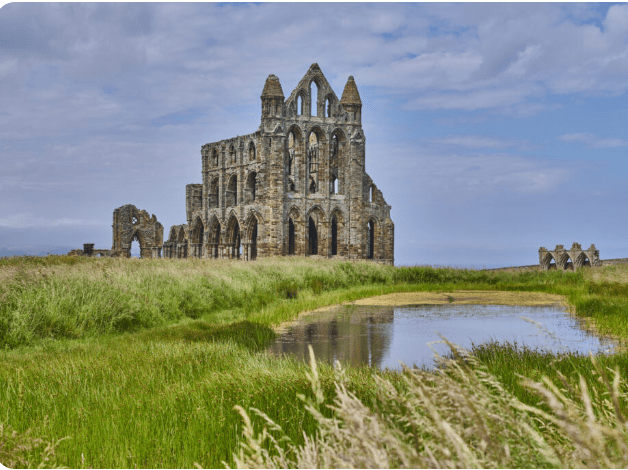
The Abbey ruins today at Whitby.
There is an Anglican religious community nearby.
There is a lively and faithful parish church in Whitby and
other Christian congregations.

[] [] [] The Statue of Hild pictured above includes coiled ammonite fossils
at St Hilda’s feet – a reference to a legend in which she turned snakes
which plagued Whitby, into stone.
The image was made available by Wilson44691, uploaded by Arienne King
and published on 20th April 2019. The Copyright holder has made the image available and licensed
in the ‘Public Domain’ and specifically made it available for copying purposes.
[Mr.G]

Brian Patten, Poet of Human Nature

On October 2nd, it was National Poetry Day in the UK. Even the Archbishop of York took part by reciting a poem on his internet postings. Wisely, he chose to recite a poem by our Poet Laureat, Simon Armitage, who is a Yorkshireman.

The day was observed just a few days after the death of one of my favourite and influential poets, Brian Patten. He died on September 29th.
We shared the same birthday year and month and I was privileged to meet him in the 1970’s not long after his first published poems, Little Johnny’s Confession. I have my signed copy along with several others he also signed.
He had already made a name for himself through an anthology of poems which he shared with Roger McGough and Adrian Henri. ‘The Mersey Sound’ earned them the title, The Liverpool Poets, and it keyed into a remarkable time in that city’s life which began with The Beatles, Cilla Black and all who played at the Cavern Club. The vibrancy of Liverpool is legendary, especially  because so much emerged from characters formed from hardship, poverty and in the face of an under-dog mentality conferred upon it from elsewhere. It is a city of broad culture, amazing architecture and deep humour. The Liverpool poets captured all that and their stated aim to make poetry accessible to all bore great fruit.

Brian Patten was to go on to write poetry which addressed the human condition with humour and with a sense that, at heart, it is love which holds things together. Sometimes this love is mixed with loss and with a searching that gives impetus to our exploring. So, Brian would say that it is often in times of stress people turn to poetry, including many who have dismissed it as, ‘not for them’.
He also said that “poetry helps us to understand what we’ve forgotten to remember. It reminds us of things that are important to us when the world overtakes us emotionally.”

In the 1970’s when I was attempting to deal with what direction my life was seeking to take, including wrestling with what my vocation might be and who I am as a person, it was the poetry of Brian Patten which became one of the anchors in a time of uncertainty.
So I discovered in his collection, The Irrelevant Song, a poem which told me that It is time to tidy up my life! At a pivotal time of personal change I read:

Into your body has leaked this message.
No conscious actions, no broodings
have brought the thought upon you.
It is time to take into account
what has gone and what has replaced it.
Living your life according to no plan,
The decisions are numerous and
The ways to go are one.

The whole poem contained a huge message for me as it addressed inner thoughts, issues and feelings that I had deliberately not dealt with. At the end of the poem I was directed that You must withdraw your love from that which would kill your love.
That came to mean for me the distractions, the claims on me that was wasted in Irrelevance! Time to get serious in my intentions. Otherwise I would discover the power of hurt which leads to self-hate. I was reminded that tenderness is the weapon of one whose love is neither perfect nor complete.
The way forward then was to cultivate that tenderness and kindness, that would set me on a journey towards discovering more and more the power of love. It didn’t take long for me to discover that seeking perfection in love leads to God.

What I discovered in the poetry of Brian Patten was really two things.
One was that poetry has a way of reaching into the heart and soul of life and revealing new meaning. Brian’s style was partly playful and hints of Liverpool humour abound but there is a seriousness which I cannot ignore. It directly touches my very being with challenge and with a call to become more true to oneself.
The other thing I discovered was the power of words and, in their use, the responsibility  that brings. So much pain is caused by the misuse of words! Deliberate hurts thrown into peoples’ lives. There is a warning in Brian’s poem, Having taken to necessary precautions, (Notes to the Hurrying Man p.23)
“Flowers won’t cover the hurts, the half-inch deaths
we pile up; a rose the size of two fists
won’t cover a pinprick of hating.
Dreams larger than ourselves we killed,
not wanting our smallness measured against them…”

So, in another poem, “The Astronaut,” (Little Johnny’s Confession) he suggests,
We will take a trip
to the planets inside us
where love is the astronaut.”

It is this profound insight, which takes me towards an understanding of a poet who began life in poverty and turned loneliness into aloneness and who through experience used words to express the almost inexpressible, which has drawn me to him and helped me on life’s journey.

Photo: National Gallery

Not separated by death…Roger McGough spoke of being laid low by his friend’s death adding, “RIP – Rest in Poetry”
May he find love and joy in the poetry of heaven and in God who gave him the words.

[Mr G ~ 4th October 2025]

The Poet who couldn’t be silent.

Osip Mandelstam was one of the most important and inspiring Russian poets in the 20th century. He was born in Poland but moved to St Petersburg where he was educated.
He was introduced to me in one of Bishop Richard Holloway’s books. He was writing about how ideas for sermons develop and he likened the process to the way Osip approached his poetry. According to Nadezhda Mandelstam, Osip’s wife, in her memoirs Hope against Hope and Hope Abandoned, Mandelstam he began his poetry process by listening to the ether and the words came to him. He acted as a midwife bringing those words to birth. Quite often, he didn’t write them down. He recited the poems to his wife who acted ‘like a Dictaphone.’ This Process , minus the dictaphone, is not dissimilar to that of writing a sermon, hence the illustration by Richard Holloway.

As well as learning that insight, I brushed against the poetry itself and the revelation of his life. It has been written of him that he had a prophetic understanding of the suffering  of the twentieth century ‘which he transformed into luminous poetry. The same commentator said of him that he was, ‘childish and wise, joyous and angry, complex and simple. He was outspoken and brave which bordered on foolishness. He was unhappy about the way Russian Society was developing under Stalin and he felt a prophetic need to use his poetry to warn people of how dangerous it all was.
Needless to say, he became a person of interest to the authorities and he suffered persecution at a time when the dictator, Stalin, was growing in power.
In view of this, it was probably unwise to write a poem, a lampoon about the dictator. In  May 1934 he wrote, of Stalin,

It was, of course, the most dangerous thing he wrote. When he chanced to meet his fellow poet, Boris Pasternak, he recited the poem to him. Pasternak was filled with dread and fear. Stalinism had eyes and ears everywhere. It was even suggested that the very pavements had ears! Russia was fast becoming a heinous dictatorship. Pasternack immediately told Mandelstam, “I heard nothing, Strange and terrible things are happening right now, You said nothing!”

Though the poem remained unpublished, the authorities, proving Pasternack right, got wind of it.
Stalin began to play with Mandelstam as a cat plays with a mouse.
He was arrested, interrogated, tortured and labelled a subversive to the State.
He was imprisoned in Moscow and then exiled to the provincial city of Voronezh. Here and previously in Moscow, he was at his most creative. The Voronezh and Moscow notebooks, published still today are the outpourings of the poetic genius of a man who perhaps sensed he had little time but with much to say.

Eventually Stalin’s insecurity got the better of him. Like so many dictators,  he fed only on hatred, fear, lust and an inner weakness which needed power to sustain it. It is hard to get into the inner being of such a person. Perhaps poets manage it because so many who challenge society do so through the medium of poetry (alongside art and music). A generalization, I know!
At the age of 48, in a transit camp in the east, he died of a ‘heart attack’, His body was dumped in an open grave, identified only by a tag marked on his big toe with his prison number. Stalin could rest, at last. easy in his bed! Or could he?Nadezhda took up her pen. Osip would be remembered. His words would be read, quoted, pondered over. His creativity would be celebrated. His desire for justice, light and peace would be struggled for.
Stalin? Only the suffering he inflicted is remembered. Who he was as a human being was never fully known whilst he was alive and certainly is not of interest now.

This week, along with many, I am thinking of another Russian. He was 47 when he died. There are similarities in his story and that of Osip Mandelstam. Not least that what he stood for lives on through his wife, Yulia.  Osip Mandelstam / Alexei Navalny cannot be silent and nor  must we.

One day people will forget Putin. Dictators fade away but those who stand up against them for goodness, kindness, generosity and love. They will always matter. So Mandelstam wrote:

Having deprived me of seas, of running and flying away,
and allowed me only to walk upon the violent earth,
what have you achieved? A splendid result:  
you could not stop my lips from moving.

[Osip Mandelstam. May 1935]

Maya Angelou said that birds sing because they have a song. Mandelstam & Navalny have much still to sing to us.

[Mr G]

From Mr G: There are quite a number of translations of the poem, the Stalin Epigram. The one here is from Against Forgetting, edited by Carolyn Forché, translated by W.S. Merwin and Clarence Brown, published by W.W. Norton & Co. Copyright © 1989 by W.S. Merwin.

The photo of the Robin is from the collection left to us by my friend Joyce Smith. A remembrance that she was one of those who never failed to sing of God’s love.

Manger and Cross

The Ballad of the Cross
Theodosia Garrison

My friend Jonathan sent me a present of a poem as an Epiphany gift.
It is named The Ballad of the Cross and is by Theodosia Garrison.

Though she wrote quite a number of poems and a few sacred songs, not a great deal is known about her.
She was born in Newark, New Jersey in 1874 and she married Frederic Faulks but continued to write under her maiden name.
She was on the staff of Life Magazine, resided in New Jersey and was a friend of the American poet, Ella Wheeler Wilcox. She died in 1944.
There are hints about her in a number of places but, apart from her published poetry being still in print, not a great deal more.

The poem Jonathan sent me is connected with today’s feast of Epiphany though it is called the Ballad of the Cross. The reason for this becomes evident at the end but, as a spoiler, it makes the connection between with the Crib/Manger of Christ and the Cross of Christ (hence the title). It reminds us that God’s work of Incarnation reaches its fulfilment in the Easter of Christ – his death and resurrection.

Here’s the poem.

Melchior, Gaspar, Balthazar,
Great gifts they bore and meet;
White linen for His body fair
And purple for His feet;
And golden things—the joy of kings—
And myrrh to breathe Him sweet.

It was the shepherd Terish spake,
Oh, poor the gift I bring—
A little cross of broken twigs,
A hind’s gift to a king—
Yet, haply, He may smile to see
And know my offering.

And it was Mary held her Son
Full softly to her breast,
Great gifts and sweet are at Thy feet
And wonders king-possessed;
O little Son, take Thou the one
That pleasures Thee the best.

It was the Christ-Child in her arms
Who turned from gaud and gold,
Who turned from wondrous gifts and great,
From purple woof and fold,
And to His breast the cross He pressed
That scarce His hands could hold.

’Twas king and shepherd went their way—
Great wonder tore their bliss;
’Twas Mary clasped her little Son
Close, close to feel her kiss,
And in His hold the cross lay cold
~Between her heart and His!

Comment on the text

The reference at the beginning of verse 2 to the Shepherd Terish,  may be simply a reference to the earlier visit of the Shepherds to the manger The origin of the name may be Persian, which could link it with the Magi who are believed to have come from the East – as in the carol, Three Kings from Persian lands afar. This is my conjecture. There are no notes  from Theodosia to help.

The second  is about the word ‘gaud’ (gaudy) in verse 4. It means something like a ‘trinket’ or ornament. Maybe jewels which would link into the ‘wondrous’  gifts of the Magi. This is followed by an obscure reference to ‘Purple Woof and fold. This is her second reference to  the colour ‘purple’. (see verse one,line four)
Purple in biblical times and also in the days of the Roman and Byzantine Empires is the colour of Kingship, and Royalty. As a mixture of red and blue, it is an expensive dye and therefore rare.  In the beginning of the poem it is one of the ‘great gifts’ from the Magi,‘and purple at his feet’.
This is the garment signifying  both king and  God. It is also linked with the theme of the poem because after his trial, Jesus was mocked by being dressed in a purple (kingly) robe. It is translated ‘scarlet’ in many Bibles but in the Greek it could be translated ‘purple.’ The important thing here is about the Kingly association between the babe of Bethlehem and his subsequent Crucifixion.

The word ‘woof’ and its link with ‘fold’ are connected with cloth. Woof here is the same as ‘weft’ – threads in a garment running crosswise as the warp runs lengthwise.
What Theodosia is saying is that though these costly gifts and fine garments are for a King and a God, the baby Jesus, turning away from them, indicates a very different destiny and throne.
The gift of twigs given by the Shepherd, became the Cross Jesus held in his tiny hand and pressed to him. This simple, inexpensive gift reminds of the carol,In the bleak Midwinter; ‘What can I give him, poor as I am’. The Shepherd’s gift is returned to us by Jesus as the true gift God gives to us. For now, as the Magi and the shepherd leave, the cross ‘lay cold’ until its time.

The Wood of the Manger and of the Cross are brought together as instruments of our salvation.

[Mr G]

Theodosia Garrison