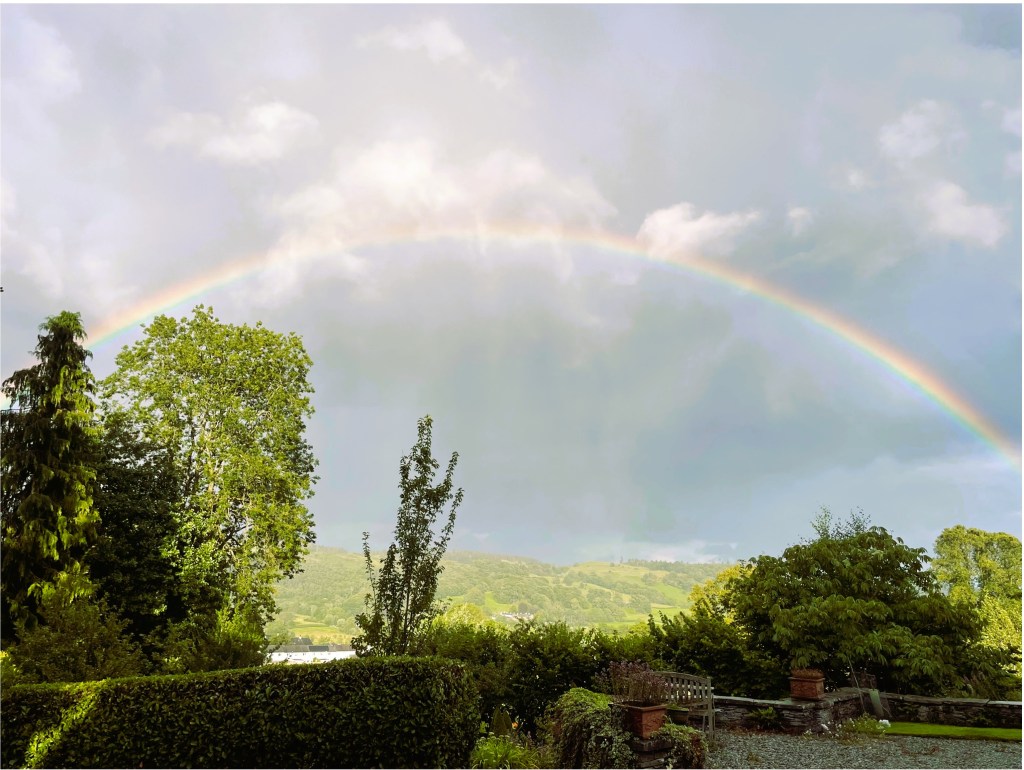
Rainbow after the rain. Storm Floris passes over the Lake District and leaves a rainbow behind.Photo by Gill Henwood.
My friend Gill Henwood has been reflecting on Midsummer life in the Lake District, Cumbria. She sent me her reflection in the form of a poem with a P.S. about Nature at work. When she sent it, we were all awaiting the August Summer Storm christened by the weather people as Floris. The North of England, the whole of Scotland and the Western Isles as far as Orkney are bearing the brunt of it, but already things are improving in Cumbria. Gill invites us to ponder on the beauty, stillness and calm, which can so often follow a storm. This is not just true of Nature but also in our own lives too. Sometimes we are buffeted about by what life throws at us but God is always near, ready to throw his rainbow cloak of love in a great arc over us. We do, however, like Elijah in 1 Kings 19, be still to hear and know God is there for you. Here’s Gill’s poem:
AFTER THE RAIN. Gill Henwood
The winds are soughing In the beech tree canopy. Sound ripples away As the waves on a beach.
Lichens reach into the air Dewdrops and sun A rich garden Growing on the stump.
Badgers have clawed Bark for grubs, Dragonflies shimmer Past, in the sun shafts.
Life is renewed The seasons turn again After rain, the sun. After storms, the calm.
And throughout, the still small voice.
1 Kings 19:11-13
P.S. The dragonfly, emerald and gold, dazzled me. S/he flew on but, having stopped, I looked. Noticed. A miniature garden on the decaying tree stump. Was s/he a fleeting messenger? “Remember, it’s Lammas…”. The farmer was baling the hay last night at 10pm, headlights on the tractor, collecting the bales before overnight rain. First fruits, in the sheep-dwelt fells: the grass harvest for winter feed. And for all the local creatures of hedges, dry stone walls, woods and tarns: plentiful seeds, berries, nuts, leaves. A harvest festival is quietly underway.
[Lughnasad is the Celtic name for Lammas, time of the ‘first fruits’ of harvest. (Newgrange website) Lammas is the Christian Festival on August 1st when we give thanks for Harvest that is coming and offer to God the gifts of the Land.]
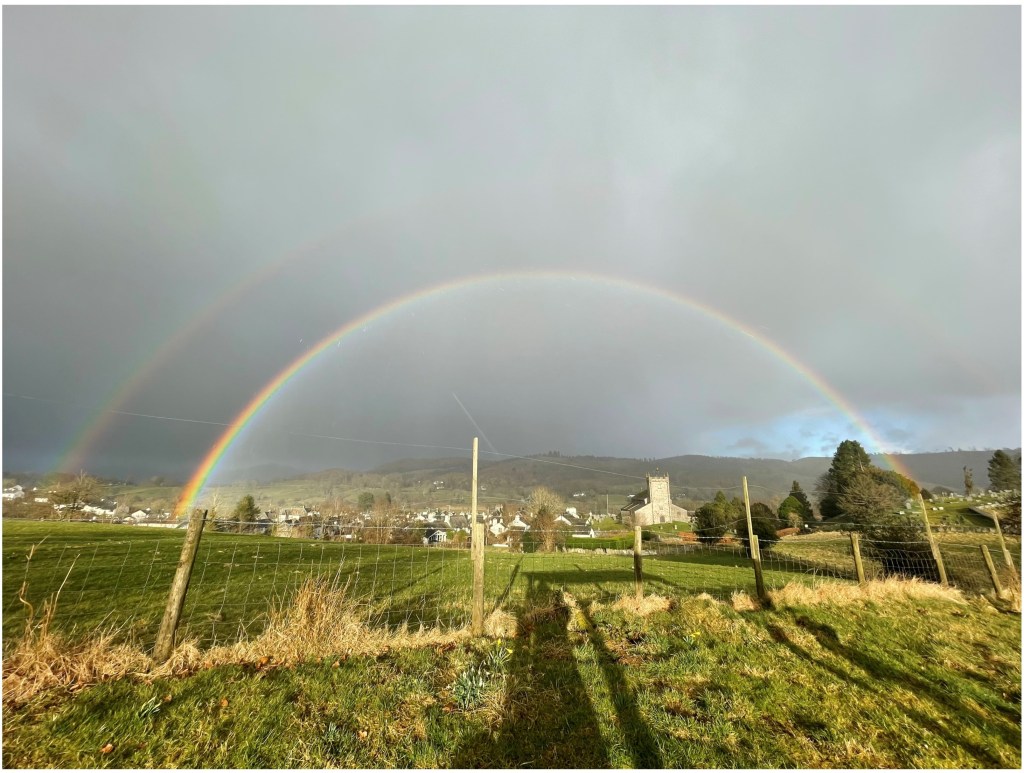
My friend Gill Henwood sent me this photograph today of a double rainbow over Hawkshead in the Lake District. It brought to mind a Lenten Prayer which tells of the mystery of God and the revelation of creative power. The rainbow is an amazing example of that! There is another message which is pertinent to the season of Lent which is a contrasting of the beautiful awakening of Spring and the celebration of new life with the negativity of human life right now. Though we are a key part of creation (though by no means all of it!), there is a wonder and breathtaking beauty all around us of which we could so easily miss. It is only when we recognize and pay homage to God our creator that the hope of the earth springing to vibrant life becomes new joy for us. The darkness of human deeds is eclipsed when we put our trust and faith in God who re-creates us and the whole world, from within.The whole earth cries ‘Glory!’ We are bidden to join in.
The prayer-poem is by Ruth Burgess and Chris Polhill from their collection of Lent and Easter resources, ‘Eggs and Ashes’, published by Wild Goose Publications (Iona)
[Mr G}
Mysterious God, morning, noon and night reveal your creative power; around us the whole earth cries glory. Your presence beats in our blood, children of creation! Yet we go on our way, deaf to the larks above the track, looking down into the mud and not up into the clear sky. And even then, we miss the myriad small signs of hope: the crocus opening its heart to the sun, colours of sea-washed stones, rainbows in the midst. we despair so easily. We say: ‘where is God in all this?’ and we deny it has any meaning. We say: ‘God is dead.’ We cannot find or feel the pulse of your life in us. We put our shaky faith in things we have made, we give cringing power to the institutions. we give up on ourselves, saying ‘We are no good’. we live in ways that says: ‘There is no God.’ And the song of creation turns to dust and ashes on our lips. Forgive us. Dust we are – and to dust we shall return.
But, in Jesus, you chose to share our human frailty, to enter into our mortality in all its mystery, to redeem this handful of dust. We are yours – and to you we shall return. Amen.
~ Ruth Burgess & Chris Polhill ~
Crocus at No.18. Photo: Mr G
{Wild Goose Publications give permission for non-commercial use of material from ‘Eggs & Ashes’, copyright Ruth Burgess & Chris Polhill. The full collection together with many other excellent resources and publications are available from Wild Goose Publications, the publishing arm of the Iona Community. Please visit their website for further details.]
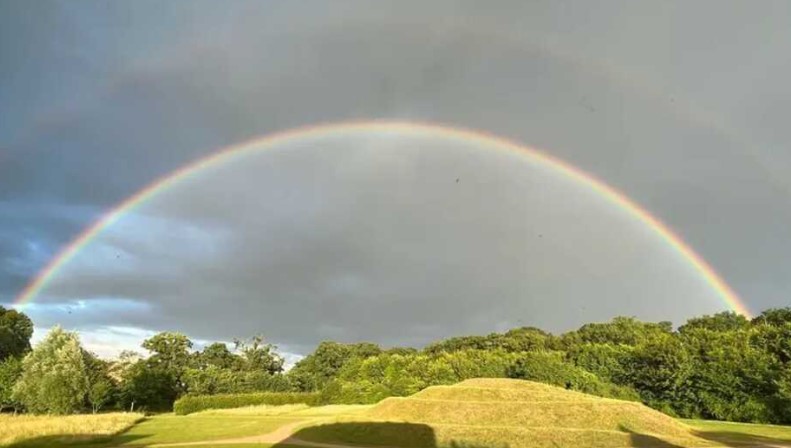
Rainbow over Telly Tubby Hill Newhall, Harlow. posted by Steve Townsend on his Facebook page.
Pride
After the rain we trooped with rainbow flags past buildings spotlit by the sun against the dark smudge of loaded clouds.
A straggling, motley bunch, we gathered in solidarity to share, to encourage and to remember.
As we listened to rallying words of inclusion and love and the diversity of creation, a seven-hued arc flamed against the charcoal sky – each colour distinct, yet joined in song, without need of borders or hard edges.
Making our song, against the dark clouds of hate and menace, more vivid and more resolute.
poem by Piers Northam after a gathering in Harlow to mark the end of Pride month 30 June 2022
Thoughts on Genesis 9: 8-17 from Piers Northam Licensed Lay Minister at St. Mary-at-Latton, Harlow
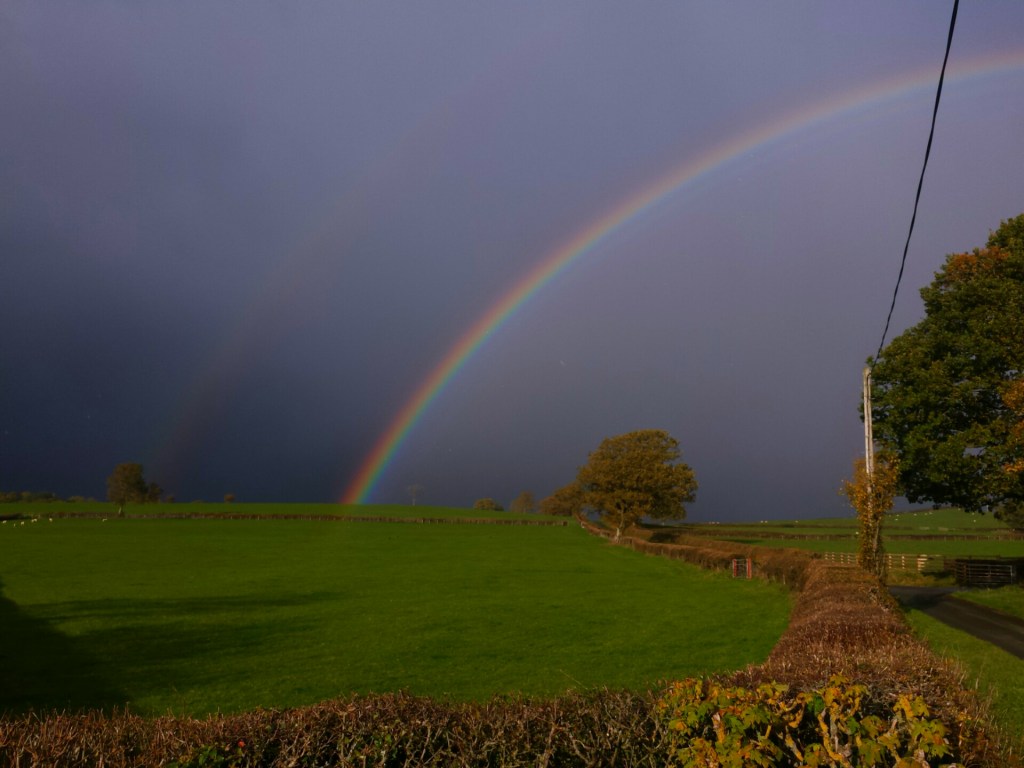
I can never resist commenting on a rainbow if I see one. They’re wondrous things, aren’t they? And it doesn’t seem to matter if we’re nine or ninety, they still stop us in our tracks and invite us to marvel. I remember once, many years ago now, driving through a very heavy rainstorm in France and turning a corner to see perhaps the most intense rainbow I have ever seen, bright and vivid against a background of thick, dark threatening clouds; a blaze of glory in the assault of the storm. We stopped the car to take a photo, but actually that image is vibrant in my mind’s eye – along with the wonder and the excitement of what we saw.
Of course rainbows have become prominent symbols of late – not least because they have been adopted as the symbol of the NHS and we have seen drawings stuck up in people’s windows; badges and the like. Originally Gilbert Baker devised the rainbow flag in 1978 with eight colours as a symbol of pride for the gay community – the colours speaking of diversity and the various elements of life. Over the years the flag has been adapted, the number of colours reduced and changed slightly and variations adopted to draw attention to different groups. Its meaning has been broadened to include concepts of social justice. The rainbow badge was originally adopted by the NHS to show greater understanding and inclusivity for LGBTQI+ people; but it also speaks of being mindful of the various discriminations that people live with and over time it has evolved into a symbol of wider inclusivity; of an acknowledgment of the rich diversity of life and human experience and of the NHS’s role in responding to that sensitively and generously. And during the pandemic, of course, it’s also become a symbol of our collective support for each other.
But in the story of Noah that we heard read to us just now, there are further connotations to the rainbow. Here it stands as a symbol of hope and life after the forty days and nights of the Flood which wiped out all living beings other than those carried in the safety of the Ark – it speaks of release from hardship and confinement: of hope for the future. And our reading from Genesis tells us that the meaning of the rainbow is one of Covenant – of a solemn and immutable promise that God makes with us. Actually, if you listen carefully, of the covenant that God makes with every living creature of all flesh that is on the earth… ‘When the bow is in the clouds, I will see it and remember the everlasting covenant between God and every living creature of all flesh that is on the earth.’
So often, when we read again a familiar passage of Scripture, things pop out that we haven’t noticed before, and here, I was struck by the insistence that this covenant is made ‘with every living creature of all flesh’. The phrase comes up three times in the passage we heard and God spells it out even further at the beginning: As for me, I am establishing my covenant with you and your descendants after you, and with every living creature that is with you, the birds, the domestic animals, and every animal of the earth with you, as many as came out of the ark.’
When Noah takes all the different species into the ark to save them from the floor he is fulfilling his proper role as a steward of God’s creation; caring for and keeping safe the beauty and diversity of that creation; the finely balanced ecosystems that exist.
As we embark on the season of Lent, this reading helps us to ponder two questions – which Jane Williams suggests are appropriate questions for us to consider in Lent: ‘What are we for?’ and ‘What [or who] do we depend on?’
So what are we for? Well Noah – as the representative of humankind – is fulfilling his God-given role as the steward of God’s creation. And it’s a role that includes all living creatures – not just the domestic animals that are going to be of some specific use to him. As we watch programmes such as David Attenborough’s ‘A Life on our Planet’ we need to remember the proper interdependence of all life forms and the way that we plunder the natural world so greedily and wantonly. Part of what we are for is to work with God to care for the life-sustaining world that we have been given to live in. And who do we depend on? Noah’s story reminds us that we depend on God for everything – for it is through God’s mercy that Noah and his family survive and come through the flood safely.
In our Gospel story we see Jesus faced with similar questions as he withdraws to the wilderness. In following the Spirit’s promptings he makes time and space to ponder what his calling is and to rely on his Father’s mercy; to make himself vulnerable and to depend on his Father. Again, this is a familiar passage – although, as is typical of Mark, it’s pretty pared back, with few details – but three phrases did catch my ear: ‘The Spirit immediately drove him out into the wilderness.’ ‘He was with the wild beasts’ and ‘the angels waited on him.’
In this time of Lent we need to allow the Spirit to drive us; we need to be open to the Spirit’s insistence as she drives us into the wilderness – a place where we have time and space to ponder; to go deep; to listen… There’s an urgency and a vitality to the Spirit’s prompting here that we need to open ourselves up to because it’s important to be addressing those questions: ‘what am I for?’ And ‘who do I depend on?’ To find again our place in the world and our relationship with God.
So Jesus followed the Spirit’s insistence and went alone into the wilderness ‘where he was with the wild beasts’. I’ve always thought of the wild beasts as being a threatening part of the story – a symbol of the harsh surroundings that Jesus find himself in. And in part that’s true. But seen in the context of Noah’s story and the Covenant that God makes with every living creature of all fleshthat is on the earth, we might take it that Jesus is in his – and our – rightful place in the midst of creation; alongside the wild animals and reptiles and birds with whom we share in God’s rainbow promise. It’s a strong reminder of how we are all interlinked.
And then that final phrase – ‘and the angels waited on him’. Hitherto, I’ve rather dismissed that phrase – it doesn’t seem sufficiently Lenten really, does it? Bit too comfy perhaps. A trifle ‘Wilderness Lite’… But actually, is it not a reminder that even in the most desperate and isolated of situations we are not alone; that God cares for us; sending his angels (in whatever form they may take) to be with us? I think many of us will have witnessed or experienced examples of this in recent months. Taken in this way, the wilderness – the Lenten wilderness – reminds us of our rightful place in the world and of our rightful relationship with the Father. It gives us space to ponder and explore what God might want for us; what he is calling us to; but it also reminds us that in all we do, we are reliant on God.
One last thought. As I imagined the rainbow, two things occurred to me – first, that each colour needs the others to be complete – the one bright light is refracted by the rain into the colours of the spectrum: but take one away and the rainbow is incomplete; the rainbow dissipates without inclusive diversity. But also, beyond the colours that are visible to the eye are those that we can’t see – infra red at one end and ultraviolet at the other. And I am sure there’s much more hidden glory beyond in both directions. In our creed, we profess our faith in things ‘visible and invisible’ for we believe in the things God reveals to us, but also in the hidden workings; the hidden glories that we cannot perceive…
Promise, covenant, hope, inclusivity, diversity, interdependence and the glories of creation – both visible and invisible – there’s a lot bound up in that seemingly simple symbol. May your time in the Lenten wilderness give you space and time to ponder all these things – and may you glimpse a rainbow or two along the way.

 Mr G's Ponderings