
Every so often, astronomers astound us with yet another discovery in space.
On December 11th we received news that NASA’s James Webb space telescope has captured an image of what our galaxy was like as it was forming. The telescope, the most powerful ever built, is orbiting in space free from hindrance by the Earth’s atmosphere. This makes its images more pure and more accurate.
The particular image that has excited astronomers shows 10 balls of stars of different colours which has led space scientists to liken it to baubles on a Christmas tree.
The real significance of the image is that it’s the first time it has been possible to witness the stars assembling to form a galaxy which holds clues of how our own galaxy, the Milky Way came into being.
It’s rather good that we have news of our Universe which is positive just when various sections of humanity are trying their hardest to destroy our bit!
Much more will be gleaned from this discovery which continues to add to the knowledge we have of our own universe. In many ways the Universe is a mystery but each new discovery adds to our enlightenment.
Perhaps in that respect it is mirroring God who created the Universe and even found time to create us! God is a mystery who constantly reveals himself to us especially, Christians believe, through Jesus Christ but also through our gifts, knowledge, skills and talents.
Sometimes God’s revelation is accompanied by some celestial event like a bright star.
Writers in the Bible tell us of many constellations. Individual stars are mentioned. In the Book of Job there is a beautiful conversation between God and Job (in chapter 38) where God asks Job where he was when the Lord laid the foundations of the earth. The writer shows the depth of ancient knowledge when he asks whether Job can bind the chains of Pleiades or loose the cords of Orion.
The star of Bethlehem referred to in Matthew’s Gospel as the one leading the Magi to the Christ child has also led many scientists into the realms of speculation. As far as the Bible is concerned this is the star which heralds Christ’s birth.
The theme of light which is signified by such stars is central to Advent because it speaks to us of the expectation of God coming to light up the world with his new presence in Jesus Christ. This is the Love of God beginning the process of transforming the world with light.
Not surprisingly, when the Church leaders chose December 25th *** for our celebration of Christmas it was the time in the West at least, when the world is at its darkest. It was also the time of the pagan Winter festival and early Christians preferred to overlay pagan religion with new Christian meaning. Sweeping pagan practices away would merely drive them underground. Changing their meaning and adding new depth made for a more permanent and ready acceptance of the, then, new faith. Good missioners always start where people are before helping them into new understanding.
It may well be that the pagan solstice was subjected to a pincer movement because December 13th is the feast of St Lucy whose very name means Light (and from which we get the word lucid – to make clear)
Lucy was a 4th century Christian who fell foul of an attempt by the Roman Emperor to re-establish worship of the old gods. She was betrothed to a man who expected a decent dowry. Instead of which she gave her possessions to the poor. The angry suitor denounced her to the authorities and she was put to death for her faith in 304AD. Because her martyrdom was in December her festival quickly became associated with Christmas.
Probably, the main reason why Lucy became associated with Light overcoming darkness is because the final act of torture was that her eyes were gouged out, plunging her into complete darkness physically. Yet the physical darkness was itself overcome by the brightness of her faith. She had within her the love and light of Christ and her enemies couldn’t quench that. That encouraged other Christians facing persecution. The light of her faith pointed believers to Jesus, the one true light who was coming into a darkened world with hope and new life. Christ Jesus, who in the final book of the Bible is called the Bright Morning Star, fills all our lives with light. That is both the hope and the witness we must bear in a deeply darkened world.
Maybe we can look to the people of Scandinavia who understand more than most about darkness at the heart of Winter. St Lucie’s day is an important feast not only because of her own overcoming of darkness but because of the physical darkness in Scandinavia at the time of the Winter Solstice ~ the darkest day of the year. In the old Calendar, December 13th, her feast day, was at that time. She became a symbolic example of light conquering darkness. This is why, in Scandinavia, the feast incorporates a celebration of light involving processions in which girls chosen in communities to represent the saint in wearing a crown of candles (possibly battery operated these days!) and accompanied by others including boys known as star boys.
This deserves an article of its own but the underlying reason is that St Lucy was light in a dark place and her faithfulness to God was an example from which others could draw strength and inspiration.
Never is this more needed than today!
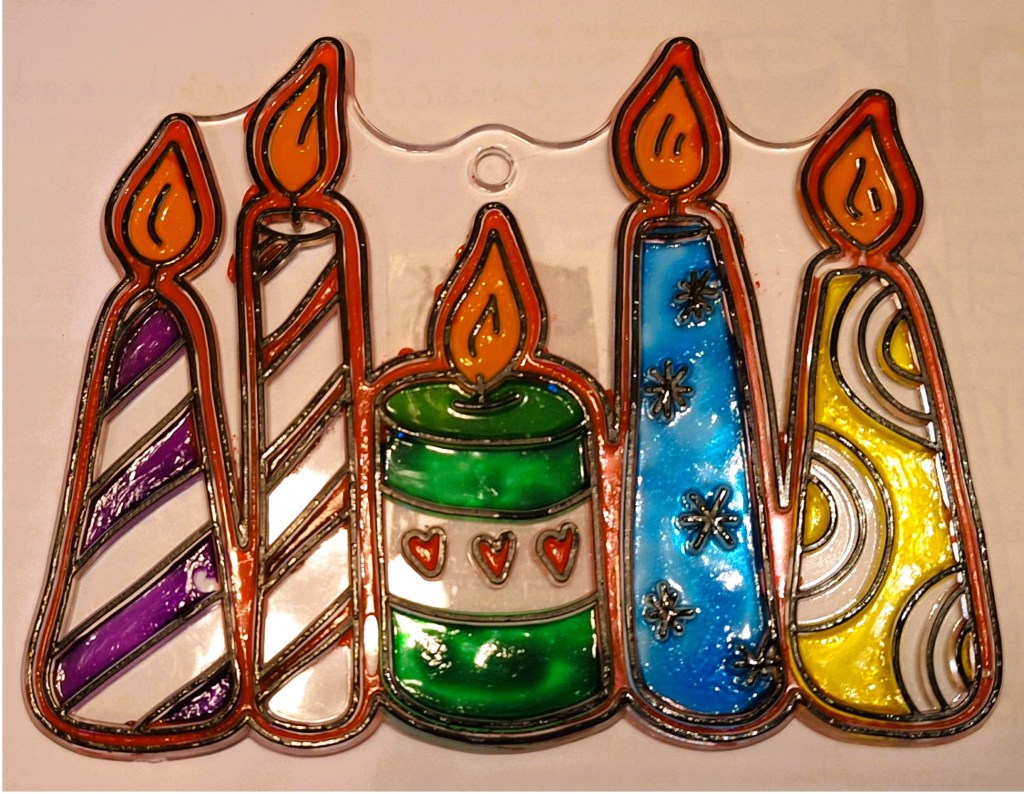
The night treads heavily
in places unreached by sun,
the shadows brood
in the dark places of our world,
where human deeds are black.
St Lucy comes,
bearing lighted candles,
heralding the light of God,
the Christ-child who comes anew
at Christmas.
Let us be ready to greet Him
with the joyful light of goodness
and of peace.
[adapted by Mr G from a traditional song from Sweden)
*** The Orthodox Church follows a different Calendar and keeps Christmas on January 6th
[Mr G]
 Mr G's Ponderings