Tag: T S eliot

For the beauty of the earth.

Langdale Pikes from Grizedale Forest, Lake District. Photo by Gill Henwood

My friend Gill Henwood has sent me the photo posted above. It is  a view of Langdale Pikes from Grizedale Forest, in the Lake District.
There is a certain broodiness about it with its different shades of light and dark which is rather in keeping with the extremities of weather at present in the UK.
The Lake District is a microcosm of our weather patterns and it is always wise, when walking in the Lakeland hills, to have a healthy respect for what Nature offers us. At one level we may call it fickle in that the conditions often change quickly. In another sense, it is a reminder that Planet Earth, and therefore its weather, is not something we can control. Sadly, we are messing things up with our human attempts at superiority over everything on earth.
The current preoccupation with the Northern Lights and with rare sightings of spectacular comets, along with other special things such as solar flares, remind us that these amazing displays from the cosmos are not of our making. They tell us, in fact, how small we are in the Universal scheme of things.
Unfortunately, the human race isn’t very good at learning lessons and applying them with humility to our borrowed and temporary life on earth. It was the poet T.S.Eliot who coined the phrase, humankind cannot bear very much reality so perhaps we shall continue to destroy the earth – and, of course, each other!

It would be good, therefore, if the human race might wake up to itself and accept that, as tenants with a life-span lower than many trees, a bit of humility might not go amiss.
As T. S. Eliot puts it in in his poem East Coker, “The only wisdom we can hope to acquire is the wisdom of humility: humility is endless.”

A large part of the lesson of humility can be found in contemplating the gifts God gives us through Creation. How can we not look at the scene depicted in the Gill’s photo above and be unmoved by what nature is trying to tell us about the Planet which is our home for the time being.
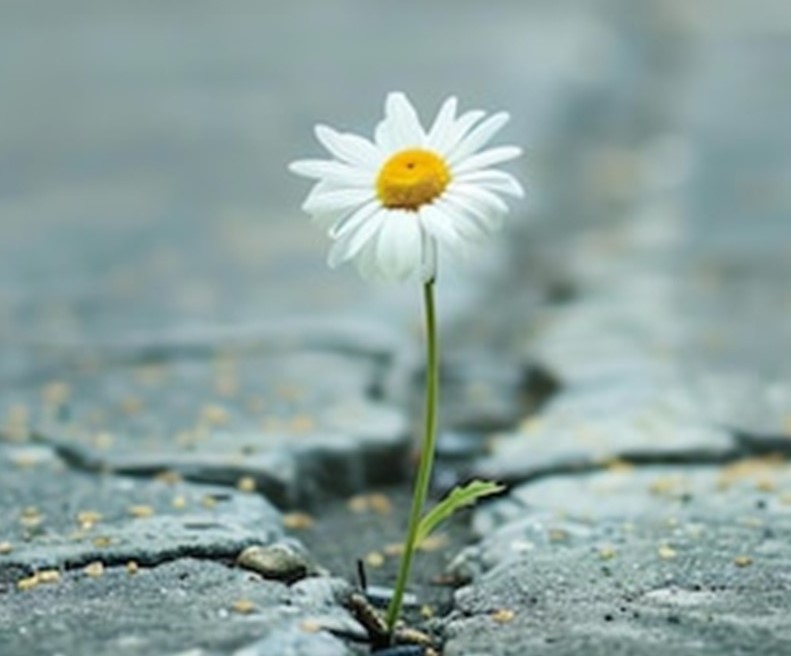
The light shimmering on the hills and the blue sky quietly folding itself around the clouds offers us a message of hope. It is just as true of a tuft of grass or a tiny flower pushing aside the tar of an urban footpath.
When the warmongers of the Middle East and  the Russian invasion of Ukraine come to an end, they will leave desolation but it won’t be long before a blade of grass or a microscopic flower spring to life.
Gill’s photo gives me hope. I have added a few words from a lovely hymn by Folliott Sandford Pierpont. He sat on a hill near Bath and was exhilarated by the beauty of creation which was laid out before him. Inspired by what he saw, he was filled with gratitude to God and he wrote his hymn in thanksgiving.

That too is another clue coming from Gill’s photograph ~ thanksgiving.
When we give thanks for Creation and for God who created it, we find ourself in a different place from lordship, conceit and self-centredness. In fact, thanksgiving, turns our attention towards others, towards providence and therefore towards God as Creator.
The photo is filled with the promise. of light and that is a source of joy and hope. If none of this means anything, then perhaps another thought might help – remember the Dinosaurs!

[Mr G] 14th October 2024
– Walter Rauschenbusch

Humility

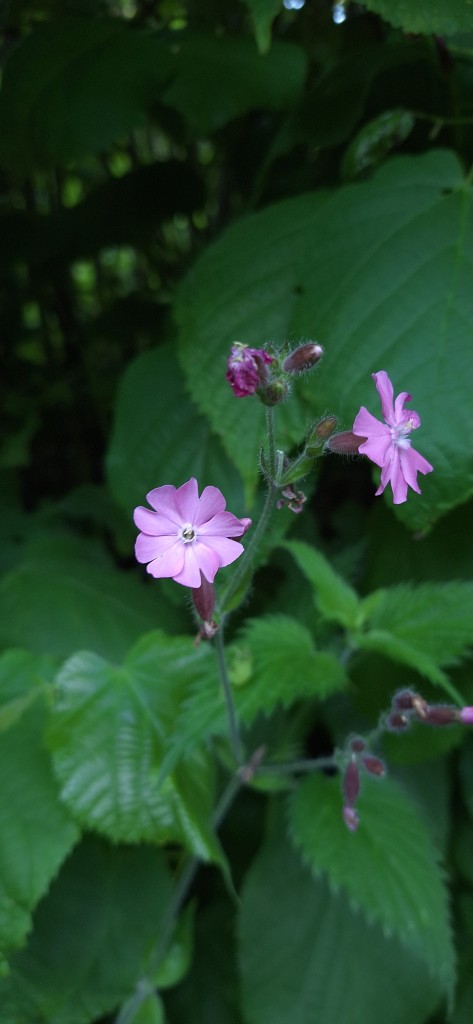
Little flower made by God. Photo Mr. G.

All those who exalt themselves will be humbled and those who humble themselves will be exalted  (Luke 14:11)

In his poem, East Coker (one of the 4 Quartets), T S Eliot said:
“The only wisdom we can hope to acquire is the wisdom of humility. Humility is endless.”

Earlier this week the current writer of the Church of England’s Daily Reflection, Chine McDonald, was reflecting on the passage from St Luke’s Gospel (14: 1-11). The section included a story Jesus told about guest at a dinner who grabbed the superior positions at the table. Jesus suggested that if more important people came, the host might have to  ask the others to take a lower seat. That would not only be embarrassing; it would be humbling.

Humility was the subject of Chine’s reflection and is at the heart of the story Jesus told. The passage ends with the quote above.
My further reflection brought to mind the quotation from Eliot’s poem.
It comes just after Eliot says, Quiet voiced elders have deceived us. Do not let me hear of the wisdom of old men but rather of their folly. The only wisdom we can acquire…is Humility.
Humility  and its practice as humbleness is often mistaken for the kind of grovelling we find in Uriah Heep in Charles Dickens’ novel, David Copperfield. In one episode, Heep was ringing his hands and wiping them on his handkerchief. It was a gesture of how he wished to present himself to David Copperfield as what he described as being “a very umble person” He went on to reiterate. “I am well aware that I am the umblest person going, said Uriah Heep, modestly; “let the other be where he may. My mother is likewise a very umble person. We live in an umble abode…

Taking pride in false lowliness is not what Jesus was speaking about.
Humility before God is not, as is so often presented, about feeling a complete lack of worth. It is not about making us feel bad about ourselves.  It’s actually the reverse. It’s about recognising that all the potential we have, all the gifts we can offer, all the love we can share, all the joy we can bring, all the things we can achieve – owe their origin to God. And we are called to use our lives and all God has given us, in His service.
Humility is about recognising and celebrating that.

Jesus was, however cautioning us against another false trait, opposite of the one taken by Uriah Heep, of thinking ourselves better than others. This leads to a view that some of us have rights and privileges over others. Our view of humanity then becomes warped. It leads, ultimately to nations trying to lord it over others. We do not have to look far to know what I mean but before we sweep our vision towards the Holy Land or Ukraine, let’s not forget to look nearer to home at the boat people, refugees, the poor and homeless.
Chine McDonald in her reflection widens the story Jesus told. She says, “Jesus words reflect the nature of the Kingdom of God. This is a place where the usual rules do not apply. What applies, she says, is humility because we are dealing with the upside-down nature of God’s Kingdom.

By contrast, she says, “We live in a world where we are asked to measure ourselves against others; where we pride ourselves in our achievements and what we have, whether that is family, a great job or great car – are what matters.” 

Jonathan Sacks, the late Chief Rabbi,in his book To Heal a Fractured World,  makes the point that no one ever speaks in praise of someone who died, about the car they drove, the house they owned, the clothes they wore, the exotic holidays they took. He says that  the things we spend most of our time pursuing turn out to be curiously irrelevant when it comes to seeing life as a whole.
After death, he says, “what was important was the kind of life people led; the qualities they showed; the good things they shared in; the responsibilities they took within community life; who they were as people.”

Chine McDonald places this in context by saying that the Kingdom of God is a place “where human wisdom is replaced by divine wisdom. It is a place in which the status quo cannot be assumed. It is a place of newness and wholeness, where we see things as they should be.”
The way to inhabit this Kingdom is to embrace the kind of humility which translates into seeking the well-being of others; of putting service of others before self; of behaving towards others with respect and love, no matter who they are or the circumstances of their life; of encouraging others and being generous towards them; and to be examples of hope and gentleness. Most of all, of course, it is about embracing the Will of God for us and for others.

[Mr G 14th June 2024]

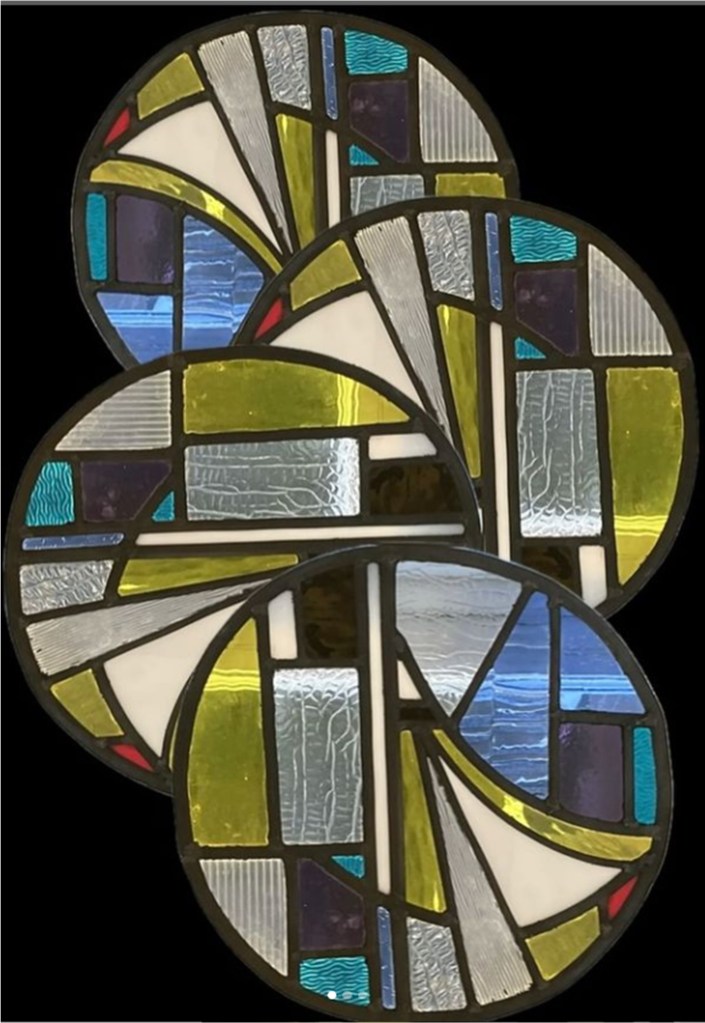
‘She smiles into corners …’

Art/glass sculpture by Kay Gibbons, photo by Kay

Kay muses on the moon
…’She smiles into corners…’

Half-past three,
The lamp sputtered,
The lamp muttered in the dark.
The lamp hummed:
‘Regard the moon,
La lune ne garde aucune rancune,
She winks a feeble eye,She smiles into corners.
She smoothes the hair of the grass.
The moon has lost her memory.

from ‘Rhapsody on a windy night, by T S Eliot.
[Poetry Society version]

Last year my Artweeks theme was lunar imagery in TSEliots poem ‘Rhapsody on a Windy Night’.
This piece is titled ‘She smiles into corners….’
I imagined the moon traversing the night sky and illuminating the dark landscape beneath…patchwork fields , spines of mountain ridges, outstretched branches reaching skyward to stroke the face of the moon , ripples in the sand on the shoreline ..
..hidden corners on the dark canvas awaiting the radiant moon to dispel shadows and ‘smile into corners..’
Through colour and abstract form , through cornered shapes and spaces I have attempted to curate Eliot’s words into a glass recreation.

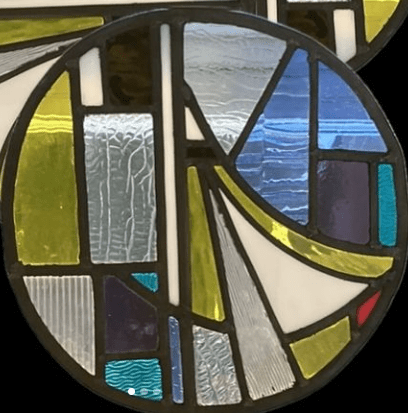
(detail)

{for more from Kay visit her instagram site – kaygibbons_art.glass.sculpture

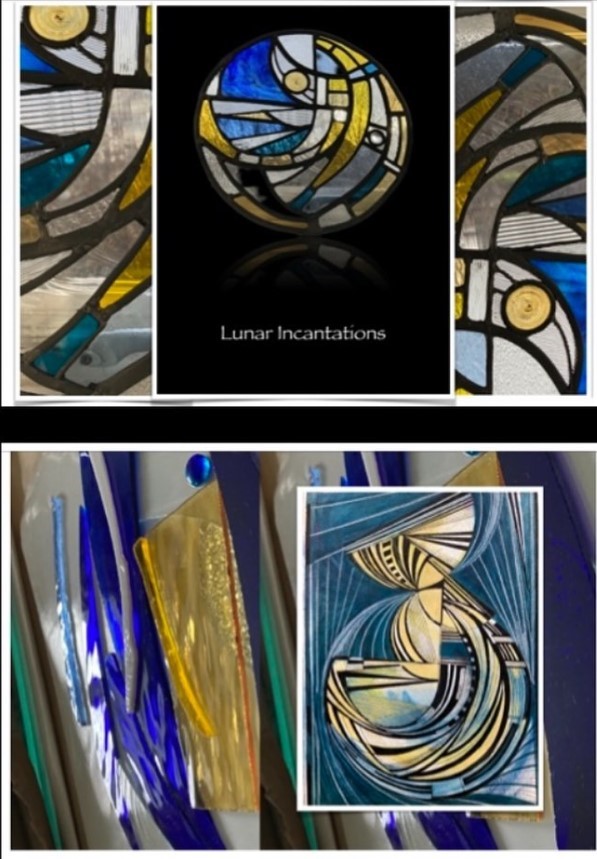
Lunar Incantations

Kay Gibbons exhibition Bampton. Photo Mr G

LUNAR INCANTATIONS
An artist’s response to lunar imagery in T S Eliot’s  poetry.

Last week, I went with my friend Julia to an art exhibition in Bampton, West Oxfordshire. It was arranged by the West Ox Arts as part of the Oxfordshire Arts Week.
The reason for our visit was that our mutual friend Kay Gibbons was one of the exhibitors and we wanted to support her. It was also an opportunity to look at high quality art by talented exhibitors in a beautiful and open surroundings.

Kay is a multidisciplinary artist, working often, though not exclusively in sculptured glass.
Her current exhibition is  called LUNAR INCANTATIONS, an artist’s response to lunar imagery in the poetry of T S Eliot.
(we have already posted some of this work on my blog).
Here is what Kay has written about this.

“How wonderful it is to be weaving word and image together in my Art weeks exhibition on display
at the West Ox Arts Gallery in Bampton where I am exhibiting with other talented artists from Oxfordshire .
My artistic journey has been one of ‘ebb and flow’ responding to and being determined by the directional pull of circumstance and opportunity. Similarly with the moon as it journeys through its different phases .

During lockdown I became reacquainted with the poetry of T S Eliot .It inspired me to create small watercolour paintings and drawings often incorporating calligraphy . With Artweeks looming I was inspired to bring together my love of creativity with Eliot’s poetry and of the moon to explore the Lunar imagery in T S Eliots poem Rhapsody on a Windy Night .
I have interpreted this using glass and also calligraphy .
My exhibition is innovative, colourful and lively.

With this we agree and my friend Julia has written a comment:

Glorious drive across the Chilterns at the weekend to meet my Instagram hero @kaygibbons_art.glass.sculpture and her wonderful exhibition at @westoxartsgallery on opening day. I was inspired by Kay’s freedom and humour which plays out through her abstracts and her evocative interpretation of a TS Elliot poem in leaded and copper foiled pieces, and exquisite water colour and pen work. Thank you Kay for the laughs and hugs and reigniting my love for colour, transparency, and stained glass “

Needless to say, we were both tempted to buy a piece of art.

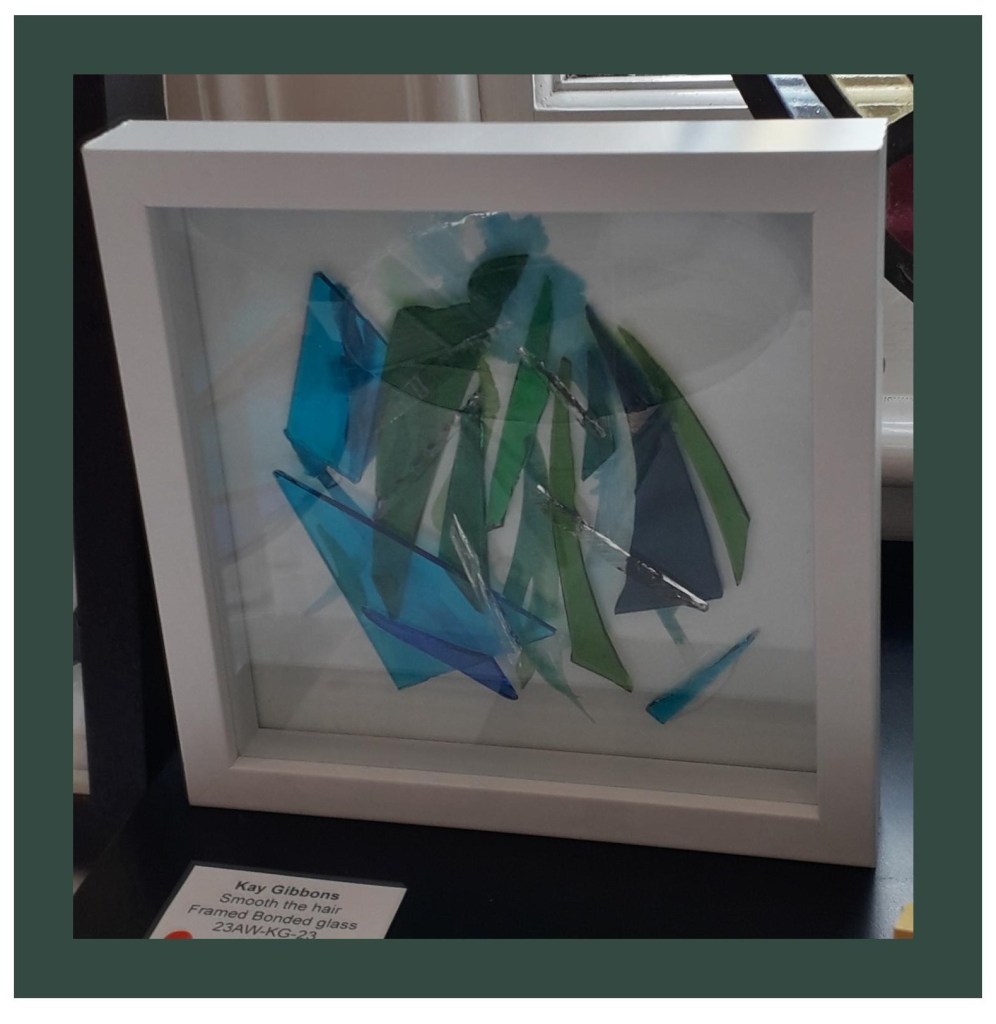
In love with this little glass abstract which is coming home to me at the end of the exhibition.

photo: Mr G

Mine is a present for someone so I am keeping it under wraps for now.!

Kay’s art has shone a light into the soul of the world with her combination of visual and the poetic. T. S. Eliot deserves illustration and a new way of entering into his depth of meaning. Equally, to watch an artist develop and explore life through shape and colour and faith is exciting. It shines a light into my soul as it does in any who encounter and sit with her work.
So much in life is depressing and frightening, not least because of power struggles which ultimately destroy everything in their wake. So we need a way to lift the Spirit and point us away from destruction to creativity and love. Art, Music, creative writing, photography, caring for the natural world are, in themselves incantations, cries to a better way. Incantation is word derived from Latin and means to ‘enchant’, perhaps even to cast a spell. It is associated with magic but poetry has its own meaning of what that means. Often to say something is magic is to point to a new experience of brilliance.  Allowing a creative act to work on your own creative spirit can easily be experienced as something magical, amazing, beautiful and, if we let it, life enhancing.It turns us from despair to hope.

Kay understands the way in which art speaks to the soul, to the heart of our being. For me, of course, this is about taking me right to the heart of God.

Photo: Kay Gibbons

“The joy of art is that we all see different stories in the one canvas – the one piece of glass, the one mural and so it goes .”

Exhibiting at WestOxArts GalleryBampton 29 April-3 June
as part of Oxfordshire Artweeks.

Not many will be able to go but you can discover more of Kay’s work on Instagram.
kaygibbons_art.glass.sculpture

[Mr.G.]