Tag: Vocation

A Faithful Priest

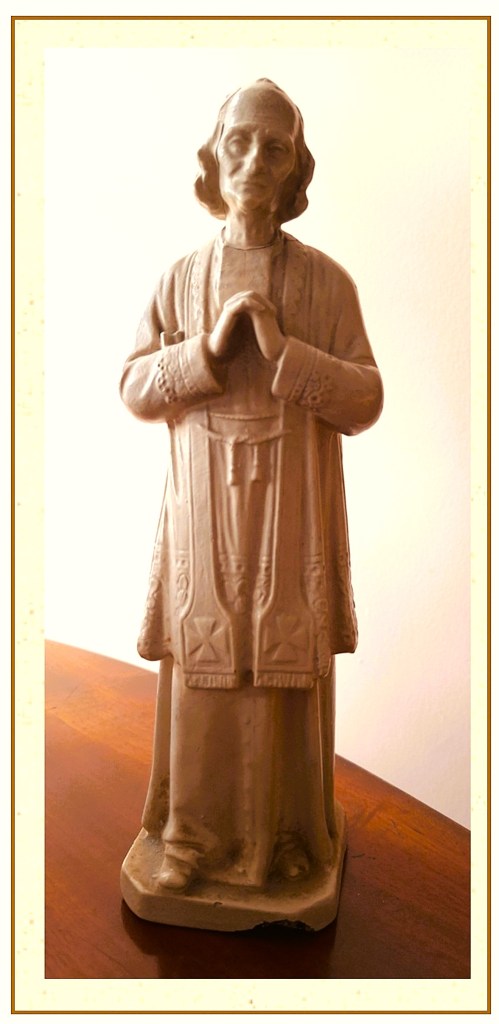
Simple statue of St John Vianney. Photo Mr G.

One of my most treasured possessions is a plain plaster statue of a French parish priest known universally as the Curé d’Ars—so named because for over 40 years he served the parish of Ars-en-Dombes. 

John-Marie Baptiste Vianney (whose feast day we keep on August 4th) was brought up in a peasant farming family near Lyons. He was born in 1786 and as a child of farmers he was given very little formal education.  Yet, by the time he was 20 he had heard God’s call to ordination and had begun to study for the priesthood.
He found study very hard and on more than one occasion his superiors thought to end his time in the seminary. However, they noted his devotion to God and a quality of holiness which far outweighed academic ability. They saw a young man whose heart God had touched.

He was ordained and after a curacy he was appointed the Parish Priest of a backwater village—Ars. He went there in 1818 and remained until his death in 1859 on August 4th.  Very quickly he gained a reputation for being a preacher and people began to flock to hear him. At the same time he became known as a priest who could give wise and gentle counsel to souls in distress.
Very soon people began to consult him and to bare their souls to him.

The trickle of people became a stream and then a torrent. Many came to him  to receive both God’s forgiveness and  wise counsel.
All was rooted in personal prayer and devotion.  He would preach a sermon daily at 11am and then spend many hours  in hearing confessions and giving spiritual direction. He was often moved to tears by the things people told him and he brought to them the comfort born out of someone who understood human weakness and the power of God’s love.

He was offered more important jobs in the Church and he also struggled with a call to the monastic life but he stayed where God had put him and in so doing put the little village of Ars on the map—not only in his own day but for all time.

Not surprisingly, after his death, he was declared a Saint and he became known as the Patron Saint of Parish Priests. As an example of the devotion and service priests are called to emulate, this is hardly surprising.
The simple statue I have, unadorned by paint, is a reminder of what priesthood means.
Here’s one of my favourite sayings of his:

Speaking of the difference between private and public prayer, he said: 

Private prayer is like straw scattered here and there : if you set it on fire it makes a lot of little flames. But gather these straws into a bundle and light them and you get a mighty fire, rising like a column into the sky. Public prayer is like that.”

[Mr G. August 4th 2026]
Year of Saint Francis

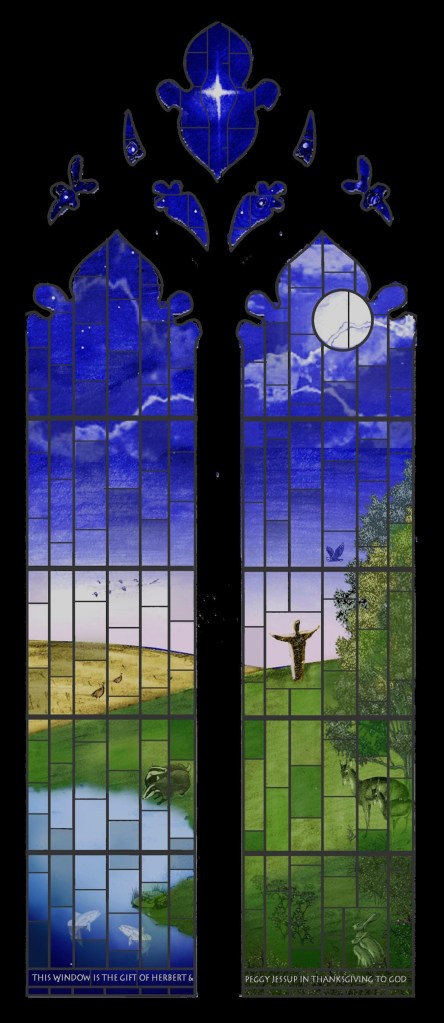
St. Francis Window, Transfiguration Chapel @ the Parish Church
of St. John the Baptist, Epping. Design picture by Piers Northam.

Pope Leo has proclaimed, this week, a year of Jubilee for Saint Francis to commemorate
the 800th anniversary of his death.The year will run from now until January 10th, 2027.
The Pope encourages the faithful to use this time to follow the example of St. Francis as
models of holiness and witnesses of peace.

Here is a poem I wrote in 2023 about St. Francis.

[Mr G. revised January 2026]

St Francis and the rich man.

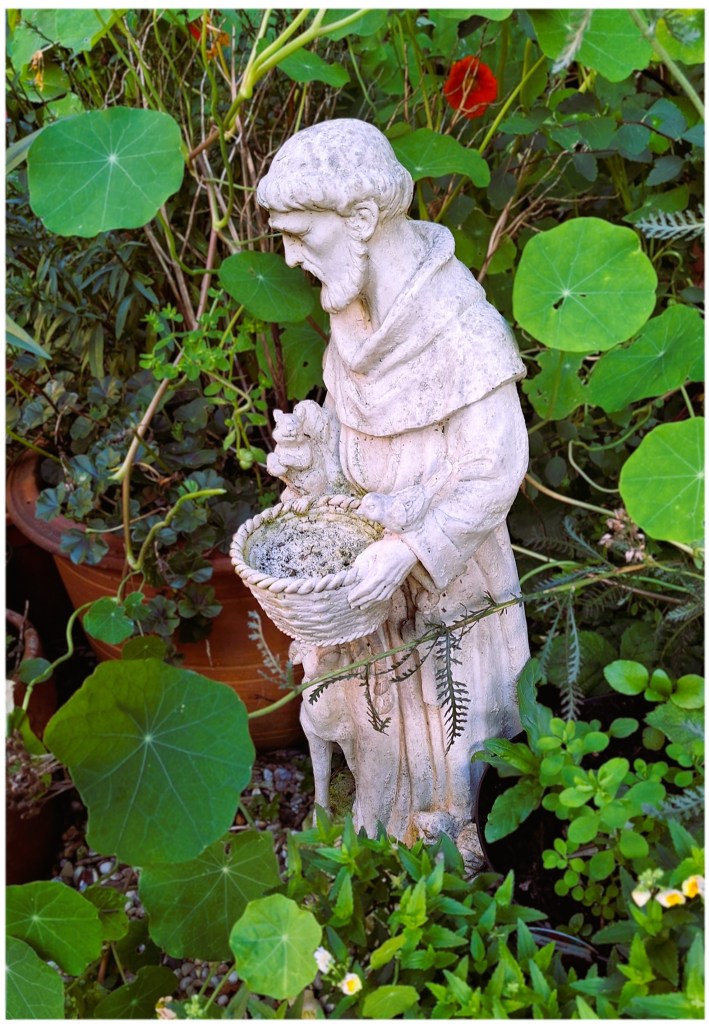
St Francis in the garden of Number 18. Photo, Mr G.

Yesterday, October 4th, Christians remembered St. Francis of Assisi.

Many people know of him and stories about him. There is the famous story about how he cared for a leper who was shunned by everyone because of his disease. Another popular image was of Francis feeding the birds and so he has become synonymous with the care of animals. At this time of year, the Church of England and other groups help us to think about Animal Welfare and, through a Creation Season, Nature generally.
Francis is also famous for his preaching and missionary work, including drawing people to live a more simple and dedicated life in the love and service of God.

One story about his comes from a collection of stories, The Little Flowers of Saint Francis. Collected and published in the Middle Ages, it captures and presents a spirit which is truly Franciscan. It was translated into Italian by an unknown Franciscan friar, from a much larger work. It has 53 short chapters .
The Little Flowers sheds  a light on the way Francis and his Companions (with St.Clare and those who prayed with her), paved the way for an imitation of the Franciscan way of life, witness and spirituality which continues to enrich both church and world today.
Here’s a story from the collection.

Francis and a companion once visited the home of a rich man, late in the evening. The nobleman welcomed them with open arms and, we are told, received them as if they had been angels of God, with courtesy and devotion.
The man embraced them, washed their feet, wiped them and humbly kissed them. He kindled a fire, made ready the table with much food and served it with a joyful countenance.
He then prepared beds and offered many gifts. In the morning, he provided fresh clothing. He told them that if the brothers needed clothing, he would always pay for it. He professed that he was ready to provide for all their needs. He could do this willingly because of all that God had provided him. He willingly would give of this to the poor.
When Francis left him with great rejoicing he held the man in his heart and in his prayers.The man, had done such a lovely thing also rejoiced and prayed for Francis.

Francis knew however that there was more. He had looked into his eyes and had not rested until he saw into his soul.
He said to his companions “He would make a good friar. He is so grateful and thankful to God and so kind and courteous to his neighbour and to the poor.”
He reminded his brother that courtesy is one of the attributes of God who gives us all we need and is courteous and kind and loving towards us. These things he found in the man’s soul – the divine imprint.
Francis determined to return again soon to his house.

When Francis re-visited the area, he called on the man again.
First, he knelt in prayer at the gate.
The man saw him and rushed down the drive to kneel besides Francis.

God was speaking to both their hearts and Francis lifted him up, and ‘in fervour and gladness of heart embraced him and kissed him devoutly giving thanks to God,’ who had brought to him a new friar.
The man asked, ‘what do you command me to do, my father? Lo I am ready to do your bidding and give all that I possess to the poor and thus, no longer held back by worldly things, to follow Christ with you.’
And so he did.

The nobleman had given out of the generosity of his heart and his means when Francis first visited him. He gave so much for the mission of Jesus Christ being carried out by Francis and his companions. But for him, there was something missing. Something he still had to give. The only gift that God truly wants from any and all of us. He gave himself. He joined Francis in his work. He gave his life, heart, his soul.

Make of this story what you will!

[Mr G]