Tag: Bible

For the beauty of the earth.

Langdale Pikes from Grizedale Forest, Lake District. Photo by Gill Henwood

My friend Gill Henwood has sent me the photo posted above. It is  a view of Langdale Pikes from Grizedale Forest, in the Lake District.
There is a certain broodiness about it with its different shades of light and dark which is rather in keeping with the extremities of weather at present in the UK.
The Lake District is a microcosm of our weather patterns and it is always wise, when walking in the Lakeland hills, to have a healthy respect for what Nature offers us. At one level we may call it fickle in that the conditions often change quickly. In another sense, it is a reminder that Planet Earth, and therefore its weather, is not something we can control. Sadly, we are messing things up with our human attempts at superiority over everything on earth.
The current preoccupation with the Northern Lights and with rare sightings of spectacular comets, along with other special things such as solar flares, remind us that these amazing displays from the cosmos are not of our making. They tell us, in fact, how small we are in the Universal scheme of things.
Unfortunately, the human race isn’t very good at learning lessons and applying them with humility to our borrowed and temporary life on earth. It was the poet T.S.Eliot who coined the phrase, humankind cannot bear very much reality so perhaps we shall continue to destroy the earth – and, of course, each other!

It would be good, therefore, if the human race might wake up to itself and accept that, as tenants with a life-span lower than many trees, a bit of humility might not go amiss.
As T. S. Eliot puts it in in his poem East Coker, “The only wisdom we can hope to acquire is the wisdom of humility: humility is endless.”

A large part of the lesson of humility can be found in contemplating the gifts God gives us through Creation. How can we not look at the scene depicted in the Gill’s photo above and be unmoved by what nature is trying to tell us about the Planet which is our home for the time being.
The light shimmering on the hills and the blue sky quietly folding itself around the clouds offers us a message of hope. It is just as true of a tuft of grass or a tiny flower pushing aside the tar of an urban footpath.
When the warmongers of the Middle East and  the Russian invasion of Ukraine come to an end, they will leave desolation but it won’t be long before a blade of grass or a microscopic flower spring to life.
Gill’s photo gives me hope. I have added a few words from a lovely hymn by Folliott Sandford Pierpont. He sat on a hill near Bath and was exhilarated by the beauty of creation which was laid out before him. Inspired by what he saw, he was filled with gratitude to God and he wrote his hymn in thanksgiving.

That too is another clue coming from Gill’s photograph ~ thanksgiving.
When we give thanks for Creation and for God who created it, we find ourself in a different place from lordship, conceit and self-centredness. In fact, thanksgiving, turns our attention towards others, towards providence and therefore towards God as Creator.
The photo is filled with the promise. of light and that is a source of joy and hope. If none of this means anything, then perhaps another thought might help – remember the Dinosaurs!

[Mr G] 14th October 2024

– Walter Rauschenbusch

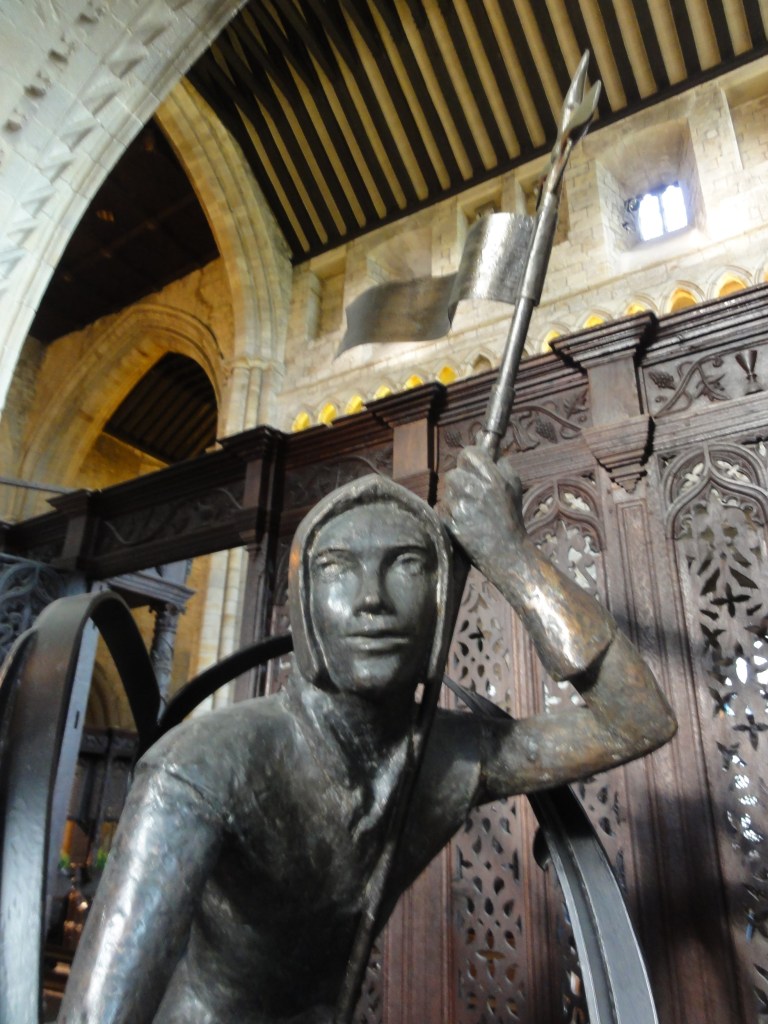
Of Angels.

St. Michael ~ detail~ Statue carved by Josefina de Vasconcellos
~ first exhibited in Manchester Cathedral in the winter of 1991
~ now it is on permanent display in Cartmel Priory, in the Lake District.
photo by Mr. G.
Therefore with Angels and Archangels …

At almost every Eucharist Christians pray: “Therefore with angels and archangels and with all the company of heaven, we proclaim your great and glorious name.” The picture is of our being part of a great company, invisible but near, who worship Almighty God without ceasing. At this point in the Eucharist we are at what the Celts call a ‘thin place’ when the barrier between earth and heaven is opened to those who have faith to see it. That can be very helpful when we are missing departed loved ones but we are also reminded that our worship is caught up in a greater praise. We, as it were, plug in to a current of worship which is forever flowing and for ever being proclaimed. But for many, angels belong to myth and one wonders what is going through many Christian minds when they reach that point in the Eucharist. Despite the fact that Holy Scripture is crammed with references to angels and they play a significant part in the Christmas and Easter stories, it is easy to dismiss them.
It is also rather arrogant because it assumes that God who is the great creator of everything on earth, is incapable of creating any other order of being than we can actually see. Yet we continue to explore space for other forms of life—assuming, naturally, that what we will find will be ‘human’ life! As we seem to be making quite a mess of our own planet it might be better if we hoped any life form found might not be human! The writer of Psalm 8 praises creation and puts humanity in its place:

“When I consider your heavens, the work of your fingers,
the moon and the stars that you have ordained,
What are mortals that you should be mindful of them;
mere human beings, that you should seek them out?
You have made them little lower than the angels
and crown them with glory and honour.


Though human beings have dominion (or stewardship) of creation on earth we are ‘lower than’ angels. They have a special place in God’s scheme of things—as Defenders in the cosmic battle between good and evil; as messengers of God’s word to humanity as in the Annunciation; as healers and as guardians. Jesus himself spoke of angels in this way saying that God’s little ones have their Guardian angels and he, himself, knew of their ministrations at the end of his wilderness experience. If Jesus believes in angels, who are we to dispute their existence and their part in God’s plan?

[St Michael’s Day is September 29th]

[Mr G]

Meeting God in Scripture

Thoughts on Bible Sunday   

When I was at Junior School I remember John Garnett telling our teacher that he had just completed a reading of the entire Bible. He was quite smug about it and I suppose for an eleven year old boy it was quite an achievement. Not to be outdone, I decided that I also would read the Bible from cover to cover. I set off eagerly through the pages of Genesis and Exodus and all went well until I got to Leviticus when, sadly, I abandoned the project. Trying to read the Bible from cover to cover as a way of beating John Garnett rather missed the point of why we read the Bible. I know that now!

When we read the Bible and especially when we pray its pages we enter into a loving relationship with God. As Christians, we are part God’s story and it remains a continuous story of God’s Love Affair with His people – with us! We don’t read the Bible in order to chuck quotes at others, still less to prove some argument or opinion we hold – though sadly the Bible has been used and continues to be used by people in just such a way.

The Orthodox spiritual leader, Kallistos Ware, wrote that:
The real purpose of Bible Study is to feed our love for Christ, to kindle our hearts into prayer and to provide us with guidance for our personal life. The study of words should give place to an immediate dialogue with the living Word himself  – with God, with Jesus Christ.

To be reminded that the sacred words of the Bible lead us into an encounter with Christ is very important. We are in relationship with a Living God, and not just a book. An Orthodox Saint, St Tikhon, said that Whenever you read the Gospel, Christ himself is speaking to you. And while you read, you are praying and talking to him. This conversation must never be rushed.

A friend of mine once said that we should read the Bible in digestible bits rather than indigestible chunks! Modern translations of the Bible helpfully divide the text up into sections rather than chapters and one section at a time can be enough to feed our praying..

Today, we keep Bible Sunday and it is a reminder of how very important the Word of God revealed in  Scripture is for our life of faith. How can we tell God’s story and be part of that story if we neglect the Bible? I love this quotation from Richard Carter, Associate Vicar for Mission at St. Martins-in-the-Fields, London. I offer it as a little Ponder Point.

“Sometimes, you just have to read the Bible with your heart.
It’s not a theory, it’s not an argument, it’s not a weapon, it’s not words.
It’s the Word made flesh.
It’s God’s love deeper and wider and more expansive than your dreams.”

[Mr G]

A Fragment on a Fragment

Today, (October 25th) the Church of England keeps Bible Sunday.
For Christians, hopefully, every day is Bible Day! Yet it’s good to be reminded of the importance of reading God’s story in order to be shaped by it and then to tell it.
The word ‘Gospel’ means Good News. In Greek the word for Gospel is ‘Euangelion’ which can be seen as the root of ‘evangelism.’ The Gospel writers are known, collectively, as the 4 Evangelists.
Quite simply evangelists ‘tell’ the Good News of Jesus Christ, in words but also in deeds and in seeking to live lives shaped by Jesus and therefore to grow in His likeness. St. Paul’s favourite phrase is ‘en Christo’ – ‘in Christ’. I understand he uses it 64 times. The Word of God which is both Jesus and the words of and about him are what move people to grow in prayer (relationship with God) and holiness (growing in God’s likeness).

Every Christian is called to be an evangelist – one who, in the words of 1 Peter 2:9, proclaims the mighty acts of him (God) who called you out of darkness into his marvellous light.

We discover these mighty acts of God in the Bible which is why Bible Sunday is such an important day. We become part of God’s mighty acts when the Bible infuses our lives with God’s love. It is the story of that love.

The earliest access we have to the New Testament story of God’s love is to be found – wait for it! – in Manchester!
In my late teens and early twenties I discovered how God’s love for me was touching my heart. I was a young civil  servant working in Manchester and one day I found myself on Deansgate where there is a beautiful building that, externally, could double up as a Cathedral. Internally even more so – though devotees of Harry Potter may believe that it is actually ‘Hogwarts’! There is a rumour!

In reality it is a neo-Gothic structure which was built as a library and opened to the public in 1900. It was founded by Enriqueta Augustina Rylands in memory of her husband, John Ryland. Today it is part of the University of Manchester.

Exciting though the building is, my first visit revealed something even more exciting. Within it there is the earliest known New Testament document. It is a small fragment of the Gospel of St. John. It is on papyrus and it measures 8.9 x 6.0 cms. It is displayed so that you can view both sides. On one side there are seven lines from John 18:31-33 and on the other the end of seven lines from John 18: 37-38. The fragment was found in Egypt in 1920 and it has been dated by experts as between AD 100  and AD150. It may have come from a copy not long after the Gospel itself was first written. It was purchased on the Egyptian market in the 1920s by Bernard Grenfell but it was 1934 before it was transcribed and translated by Colin H Roberts. It is classified as ‘Rylands Library Papyrus P52’ Scholars have had great fun musing over it, dating it, and discussing it: why was it written, when was it written and for whom? sort of questions.

But, you know what, there is something even more important about this fragment. When I stood before it all those years ago, I experienced a thrill and a sense of awe. Here I was in front of the Word of God which was written to tell me how much He loves me. I was faced with this truth in a unique and very special way.

It was only a fragment but it brought me to Jesus in a deeply personal way. Like an Icon which reveals its subject in an intimate way, I was drawn, through this fragment, into an intimacy with Jesus which was both simple and profound. This fragment became something which fragmented my soul and allowed Jesus to slip in. For me that’s its real significance.

It’s why the Bible is so very important – both Testaments for Christians, Old Testament for Jewish people and, because it has echoes within the sacred Koran, it has its place in Muslim spirituality too.
For those who want to know God it is essential.