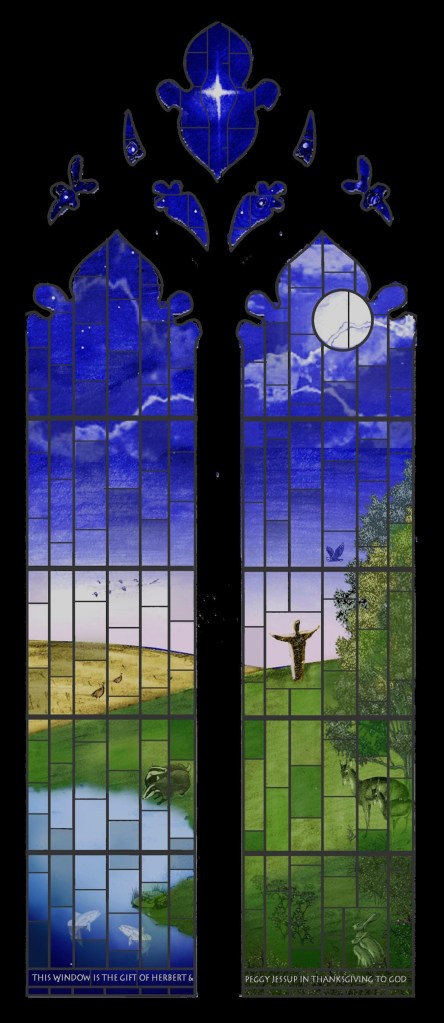
St. Francis Window, Transfiguration Chapel @ the Parish Church of St. John the Baptist, Epping. Design picture by Piers Northam.
Pope Leo has proclaimed, this week, a year of Jubilee for Saint Francis to commemorate the 800th anniversary of his death.The year will run from now until January 10th, 2027. The Pope encourages the faithful to use this time to follow the example of St. Francis as models of holiness and witnesses of peace.
Here is a poem I wrote in 2023 about St. Francis.
Dearest Francis, You were led from your raucousness and debauchery. As leader of the pack they gathered around you, your followers, attracted by a charisma that lit up their lives. Of course, your pockets held the wealth which made living as free spirits so easy. You took it all for granted. The centre of your life was within you, focusing on that self which has ruined so many.
But another Charisma sought your energy. Different followers waited to be your disciples. Different values, to be ripened by true joy. Perplexed, perhaps that you were losing direction, uncertainty gripped that carefree heart and nothing satisfied.
From the centre of things, you were called to the margins, where your destiny would discover you. Kneeling, questioningly, in the dereliction of Damiano’s chapel, You were led to examine your own crumbling life. In the midst of your despair, Jesus spoke to you,
“Francis, rebuild my Church.”
At first, a physical task, drawing others to your side as only you could, but there was so much more to come. You did not always get it right. None of us do. That is why God comes among us often, casting his grace over us, like rose petals at a wedding.
It is said that, near death, Jesus gifted you with stigmata, scars, wounds of Christ, as marks on your own body. But you had received these on your heart long ago, when you walked as a companion of Jesus. The Way of the Cross gave you Stations of prayer by which you were able to shepherd poor, unloved, uncared for humanity; vulnerable animals; dancing birds, whose capricious flight was a sign of God’s joy. And you did not forget the rich, who more than most need to walk with you, into heaven.
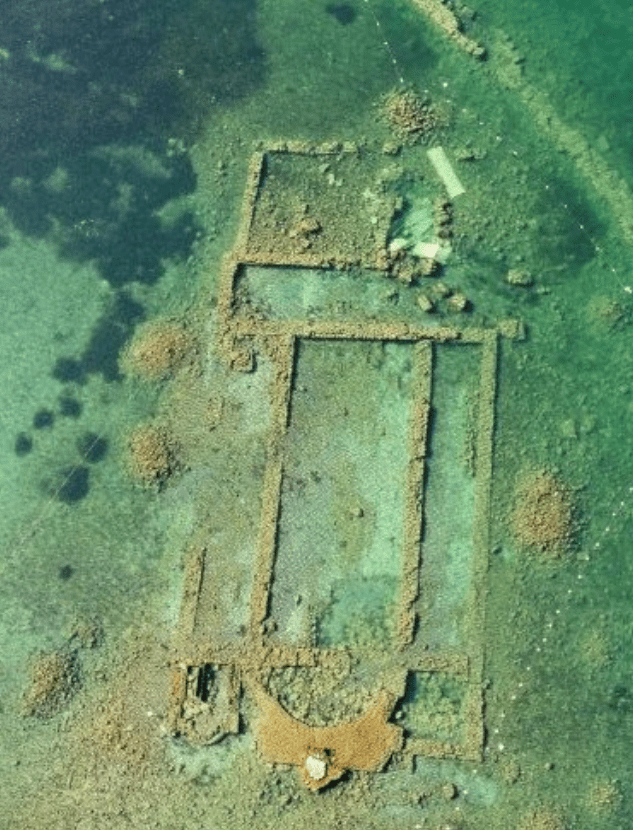
Basilica of Saint Neophytos is the name of the underwater basilica in Lake İznik, modern-day Turkey. This was where those who gathered for the Council of Nicaea .
The Telling of our Faith.
Over the past weekend, the Christian Church has been celebrating one of the most important anniversaries of our faith, the 1,700 Anniversary of the First Ecumenical Council which was held in Nicaea, (now Iznik) in what is now Turkey. Until 325AD, the Christian Church was established in various centres of mission but, as it grew, it was also dealing with persecution on a large scale from those who did not want the Christian faith, rooted in the life, witness and teaching of Jesus Christ to succeed. Whilst we have never been free from persecution nor strangers to martyrdom, the period until the 4th century was particularly one where many Christians were put to death or tortured for their faith. In the 4th Century, under the reign of Emperor Constantine, things changed. His mother, Helen(a) had become a Christian during a time in the Holy Land and her faith influenced her son. Though he did not immediately become a Christian himself, (though he died one), he declared that Christianity would become the official religion of the Roman Empire. Peace and stability came to the Church.
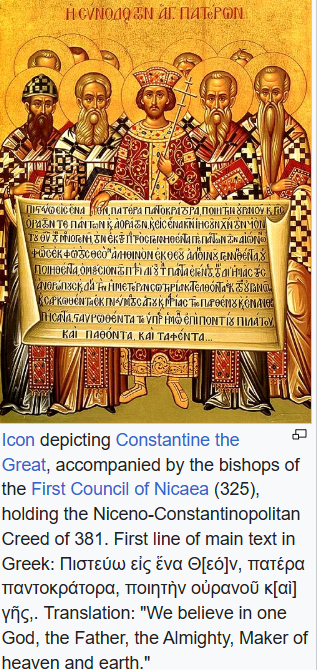
Except, not quite! When people are up against terrible suffering, persecution and death, there is a unity which concentrates everyone on survival and on being loyal to what they believe. It brings with it its own high level of support for each other. There is no time or freedom to concentrate on anything but holding each other together, caring, loving and sustaining each other in mutual hope and encouragement. When danger passes, the personal relief can sometimes give people the opportunity to face issues of disagreement which trouble them and can produce division. That is what happened and the church faced differences in practice and custom caused by not being able to worship and prayer together. Things like the date when the Church observed Easter and other practices needed to be dealt with but the Church was facing its biggest ever challenge at Nicaea. At this moment in the story of the Church the biggest and most important question of our faith had to be faced: Who is Jesus? Under its new found peace, Christianity had to face the question about the nature of Jesus. Followers of a theologian called Arius maintained that Jesus was a created being, who whilst a good man and infused with the vision of God, was not God. More than anything else before or since this view threatened to destroy the church. The fierce debate it created division amongst Christians and everything we stand for was in danger of falling apart. So concerned was Constantine that the Christian faith he had chosen to bring stability and harmony to his Empire was itself in grave crisis, that he called together Christians leaders at Nicaea. This was the first Synod or gathering and here the question about who Jesus truly is, was debated. The Council rejected the teaching of Arius and affirmed the total belief that Jesus is one in substance with his Father; that both are God together with the Trinitarian belief that the Holy Spirit is part of a three-fold God. At Nicaea, the Church set out our belief in a ‘Statement’ or ‘Creed which became, at one level the ‘Constitution of the Christian Faith. Though it was refined and deepened at the Council of Constantinople in 381AD and again at Chalcedon in 451, it has become the ‘foundational statement of the Christian faith’ and it forms an essential part of our expression of personal and corporate belief to be recited by the whole Church, Roman Catholic, Orthodox, Anglian, Methodist, every Sunday. Essentially it is summarized by the acclamation often made in worship.
This is our faith. We believe in One God, Father, Son and Holy Spirit.
Pope Leo gathered last weekend gathered with 27 other Christian leaders to celebrate the 1700th anniversary in Nicaea, modern-day Iznik, Türkiye. Pope Leo thanked Patriarch Bartholomew I, Ecumenical Patriarch of Constantinople, for his “great wisdom and foresight” in calling for Church leaders to celebrate this important anniversary together. He spoke of the power of the Nicaean Creed to “invite Christians, even today ,to ask ourselves who is Jesus Christ for us personally,“ especially when there is a risk of reducing Jesus Christ, “to a kind of charismatic leader or superman, a misrepresentation that ultimately leads to sadness and confusion.” The Pope went on to point out that reducing Jesus to an intermediary between God and humanity, and therefore not Divine, ignores the reality of the Incarnation.”“But if God did not become man, how can mortal creatures participate in His immortal life?” asked Pope Leo. “What was at stake at Nicaea, and is at stake today, is our faith in the God who, in Jesus Christ, became like us to make us ‘partakers of the divine nature’.”
He went on to say that, because the Creed was professed by all Christian Churches and Communities, “it is of fundamental importance in the journey that Christians are making towards full communion. Faith in one Lord Jesus Christ, the only Son of God, born of the Father before all ages…consubstantial with the Father (Nicene Creed) is a profound bond uniting all Christians.”
For me, reciting the Creed grounds my faith in Jesus who, in his birth, life, teaching, death and resurrection, speaks to me of the immensity of God’s Love, for me personally; for each other;and of my love for God; and of the power of that love to embrace all. Telling the story of what God, the Holy Trinity has done for us and goes on doing, and speaking it prayerfully at the heart of worship is a tremendous experience of belonging and believing which holds us in a deeply inclusive and profound relationship and so becomes the prayer which speaks from the heart of our living faith in God.
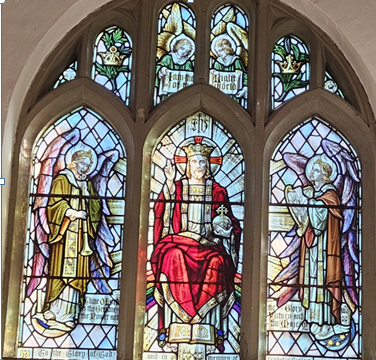
Christ the King window, St Eadmer’s Church, Admarsh-in Bleasdale, Forest of Bowland, North Lancashire. The dedication to Eadmer is thought to be unique in the United Kingdom and possibly the world. Eadmer is probably the name of a monk who, during a Vigil called to determine where Saint Cuthbert’s body should be laid finally to rest, received a vision from God that his Shrine Church should be built at what is now Durham. Those who established the Church at Bleasdale where a family who came from Hexham which at the time was in the Diocese of Durham. The window is a Triptych with Christ in glory taking up the centre panel (above). The window was made by Abbot & Company of Lancaster in memory of Isabella Bullock and was installed on 5th November 1925, 100 years ago. (Photo: Robert Gardener, former churchwarden)
Christ our King in Glory reigning.
This week, the Christian Church celebrates the Feast of Christ the King, the last week of the Church Year, which begins again on Advent Sunday.
The title, Christ the King in glory reigning is a theme found in a number of hymns. Specifically it is the title of a hymn by Canon Patrick Appleford to which was given the tune Sunderland, written by Father Geoffrey Beaumont CR. Both were members of the Twentieth Century Music Group which sought to give the church new hymns in contemporary style with new words and tunes. The hymn Christ our King in glory reigning is rarely sung now but its title celebrates the universal sovereignty of Jesus Christ combined with a longing for God to reign over the world He has created, as a Kingdom filled with Justice, Love and Peace.
This is a Kingdom which contrasts deeply with how much of the world regards kingship. It is a rule of self-giving love rather than one of domination or control. It is a rule of gentleness. It is also a reminder to us that God rules in glory. That glory is expressed in worship not just on earth but especially in heaven. This state of living close to God in His nearer presence is experienced together with all who have entered fully God’s Kingdom and who form a great myriad of beings which include Angels and Archangels, Saints and Holy Ones; all who form what the Eucharist calls the whole company of Heaven and of which we are part. We are citizens of a Kingdom which calls us to live by the values shown to us by Jesus. These values are not as many in our world understands them. The foundations of God’s Kingdom are holiness, justice, freedom, peace and love. To be citizens of such a kingdom means to have far more radical and differing values than those often found in the world around us.
To establish this Kingdom was costly and totally self-giving. The poet, T S Eliot, has a phrase, Costing not less than everything and that is precisely what it cost Jesus to bring God’s new Kingdom into being. It needed love and sacrifice because God was releasing a new, powerful force into the world. The Kingdom that Jesus inaugurated from the Cross is not a Kingdom as this world understands it. God’s Kingdom is very different. In the face of hatred it brings love; gentleness replaces might; peace instead of strife; mercy instead of retribution; justice rooted in fairness; liberty and freedom in the place of oppression and intolerance; self-giving replacing self-centredness; service to others rooted in humility replacing pride; forgiveness removing blame and generosity overcoming greed.
All this and much more come at a cost but it is one that God chooses to pay in the sacrifice of Jesus on the Cross. There is the throne of God from which he reigns over our hearts and lives. From that very cross He claims us as His own and he asks us to claim each other in love and acceptance and generosity, valuing each other as God values each one of us.
We often speak of Service to God and to each other as hallmarks of the Kingdom. This service is initially one of the heart before it is of the hand. We are called to carry within us the signs of the Kingdom as companions of our High King. We are called to share those signs , the values we follow, and in the words of St Mother Teresa of Kolkata, to share the simple, little things we learn from our King, but with a great deal of love.
I have often been encouraged by a little prayer I came across, written by a new Christian who had just come to faith. His experience of God’s love showed him what he must do.
O Lord, you are King of our spirits. You have issued orders to your subjects to do a great work. You have commanded us to preach the gospel to every creature. We are going on that errand now. Let your presence go with is to enliven and enable us to persevere in that great work until we die. Amen
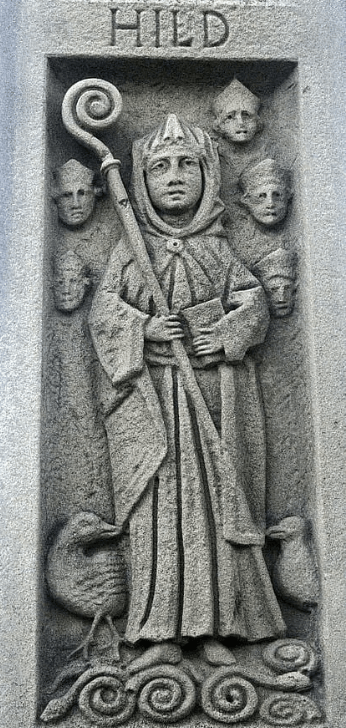
St Hild, detail from a monument to Hilda of Whitby.
This week, the church keeps the feast of St. Hilda (or to give her the Anglo-Saxon name, Hild).
She was born into the Northumbrian royal family and for the first 33 years of her life led a very different life to the one God was to lead her. For that call God used the voice of St.Aidan of Lindisfarne. He was the monk from Iona who brought the Gospel to the North East of England and in his monastery on Holy Island he trained up Anglo-Saxon boys to become Missionaries to many parts of England as well as the Scottish borders. Part of Aidan’s mission plan was to establish religious power houses, monasteries from which further missions could be launched. These religious houses were built on Prayer and cemented by the Gospel of Jesus Christ as well as translated into Christian Service.
One day, in obedience to God’s plan, Aidan summoned Hild to meet him on the banks of the river Coquet south of Bamburgh. Here he told her God’s plan for her. She was to establish a religious house, first at Wearmouth and then on the Headland at Hartlepool. From there she was to go on to established her most famous foundation at Whitby (Or Strines at it was then known). It was to be a ‘double’ monastery in that two monasteries were built side by side, one for men and the other for women. Hild was to be the Abbess of both. As Abbess she ruled over both monasteries and was, in effect, the head.
This may surprise some but Aidan belonged to the Church of the West which we call Celtic but which was really Irish. In Ireland women had equality of status with men and particularly in the Church. Aidan saw no reason why this equality should not be established in England too. It was only later when the Church of Rome grew in strength that this practice was challenged.
The Venerable Bede, to whom we owe much of the story of Christianity in Britain, and who, if pressed was more generous in his comments about Roman practice, recognized Hild’s specialness and greatness. He wrote of her:
“All who knew abbess Hilda, the servant of Christ, called her Mother because of her wonderful devotion and grace; she never ceased to give thanks to her Maker or to instruct the flock committed to her care. Not only was Hilda an outstanding example of holy life to all who were in her monastery, but she also provided an opportunity for salvation and repentance to many who lived far away, and who heard the happy story of her industry and virtue.”
Under her guidance the Abbey at Whitby grew in stature, capturing her devotion to Christ and the gift of holiness showered upon her by God. Her advice and prayer was sought after by ordinary folk as well as those of royal birth. She compelled all who were under her instruction to devote so much time to the study of the holy Scriptures and so much time to doing good works that many came to have an enriched and deep faith. She was also, because of God’s Providence, the right person in the right place at the right time. It was at her abbey at Whitby that the Church met for an important Synod in 664AD. It brought together Roman and Irish Christians who had differing views on issues such as the date of Easter, the way Baptism was administered, who could ordain and other matters. Hilda favoured the Celtic/Irish view of things but the Roman view prevailed. This caused a big rift in the Church and it fell to Hilda, along with her friend St. Cuthbert, to try and reconcile the various factions. To the degree that she was quite successful shows her, not only, to be a person of generous spirit but also one who had a gift of diplomacy. Hilda, who had sided with the Irish, kept her cool, and she set about healing the divisions which split the Church. With quiet diplomacy, authority and fortitude, she brought the wounded church to some kind of healing from which it was to move forward. Perhaps because of this she has been described as a ray of light in darkness.
One of the qualities which disciples of Christ are encouraged to seek and use are the gifts that God gives us. We are all called to support and encourage each other to grow in discipleship by discovering and offering our gifts to God and his people.
An example that we all have gifts but need others to encourage us to find and use them, comes from something Hild did. It concerns a cowherd called Caedmon, who though not a monks, worked at the monastery and shared its life. One day he was heard singing. His voice was angelic. Hild heard of it and sent for him. She encouraged him to write songs that were formed from verses of the Bible. Soon Caedmon was singing the Scriptures and so edified others. He was encouraged by Hild to use his God-given talents. He became a monk and he was England’s first poet. Little of his work remains today – just six lines – but his prolific outpouring was well chronicled. Hild brought out the image of Jesus Christ in people because she lived in God’s brightness.
Today, she Is offered to us as a beacon in our own darkened world and, at times, church. When we are up against it in both world and church, Hild reminds us of a deeper truth and of a greater world. A world where Angels dance and sing; a world where those who die are loved by the Lord into eternal life; a world where we have a joyful witness to carry out. Hilda served this world but her heart was always in another world. Her soul belonged to God and it was in God’s presence that she continually lived. The novelist T H White once wrote that : There is another world and it is in this one. By which is meant that we are surrounded by the world of God which constantly embraces us and holds us in love. We don’t have to search for this world by looking up but by feeling it around us. We touch it in prayer; we hear its voice in Scripture; we are fed by it in Worship and we celebrate it in each other. That is what gave Hild the impetus to serve God and to touch hearts and lives with his Love. She also shows us a very important truth, often forgotten, that in the eyes of God we are all equal and we are all part of his inclusive love. We are tasked to discover what that means in a world which acts differently, where lies are easily told and truth is discarded and which uses words rather than actions – e.g. what can we least get away with in global gatherings; A world where refugees are used as pawns and for political ends, a world which defames people of colour and people of differing gender, and a world which still treats women abominably.
I wonder what Hild would do in our world? I expect she would have sharp words and strong opinions but she would carry these in love, in prayer and in care to God, with repentance for our shortcomings but with a depth of hope in her heart that, despite everything, God’s world will continue to break through and make everything new.
But I suspect she would want each of us to join in making real the vision of a world ruled by Love, Care and kindness. A world she discovered for herself is found in God alone.
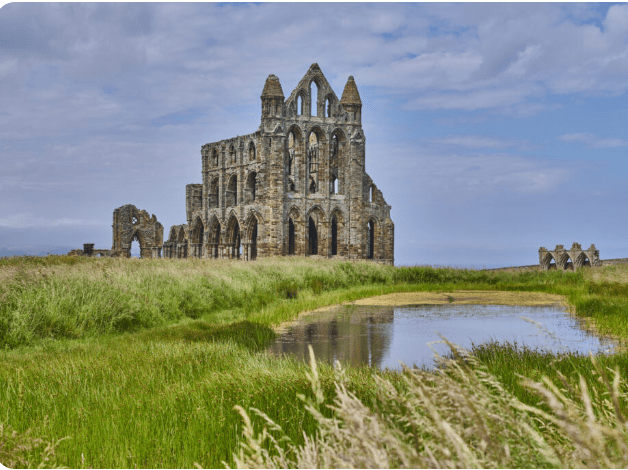
The Abbey ruins today at Whitby. Thereis an Anglican religious community nearby. There is a lively and faithful parish church in Whitby and other Christian congregations.
[] [] [] The Statue of Hild pictured above includes coiled ammonite fossils at St Hilda’s feet – a reference to a legend in which she turned snakes which plagued Whitby, into stone. The image was made available by Wilson44691, uploaded by Arienne King and published on 20th April 2019. The Copyright holder has made the image available and licensed in the ‘Public Domain’ and specifically made it available for copying purposes. [Mr.G]

 Mr G's Ponderings