Tag: christianity

People of the Spirit

A thought on Pentecost Sunday

Gifts given freely

Edith joined a house group I was leading one Lent. The Course was about Prayer and in one session we were encouraged to pray aloud for people and things that concerned us. We were given a week’s notice and just before we were due to meet again, Edith sent for me. She told me that she would have to miss the next session.
She had an anxious and slightly guilty look so I probed a bit deeper. She was scared of praying aloud because she had nothing to pray about. ‘You see, I’m not very spiritual’. I think what she meant was that she wasn’t very pious.
She thought that people had to put on a very posh or sugary voice when they pray believing that you have to speak to the Almighty in a certain way. Edith was too down to earth for that.
So I asked her how her daughter was. She was going through an horrendous divorce. Edith told me all her anxieties and how she hoped God would strengthen her and be with her and the children and so on and so on. At the end I said to her, ’say ’Amen!’’ She asked me what I meant. ‘Well’, I told her, ’you’ve just been praying about your daughter for ten minutes so you might as well say ’Amen’. Edith was no fool and she got it right away. ‘I have, haven’t I?’ 
‘Now come to the group and do it there again, amongst your friends.’ That is exactly what she did and everyone present promised to pray for her daughter. I saw a life lit up with new joy.

Edith didn’t join the rota for the intercessions. She had a much more important job in the church. She made all the purificators and corporals and albs and surplices. She was an amazing seamstress and everything she made for God’s service was made prayerfully. Every stitch carried it’s own moment of praise. ’It’s important to give God the best’ she would say. ‘After all, look what he’s given to us in Jesus. He’s given us so much love and grace. We must give our all to God!’

Of course, as she reminded me, she wasn’t spiritual!
Yet she gave her all to God and that day when she prayed aloud in that Lent Group, she gave a bit more. And it made her happier than ever.  I might just have forgotten to say that she not only made our albs and other linen, she also washed and ironed them! She lots more vestments for the Church—but she wasn’t spiritual!

As we Christians celebrate Pentecost, it’s people like Edith who come to mind because she is an example of those Christians who just use their gifts happily for God and actually don’t realize that they are doing anything more than returning to God the love they have received from Him.
They never think about themselves. They lose themselves in the service of God and others.
I think Edith was one of the most spirit-filled people I’ve ever met.

[Mr G. Pentecost Sunday 2026]

Mr Brock introduces himself

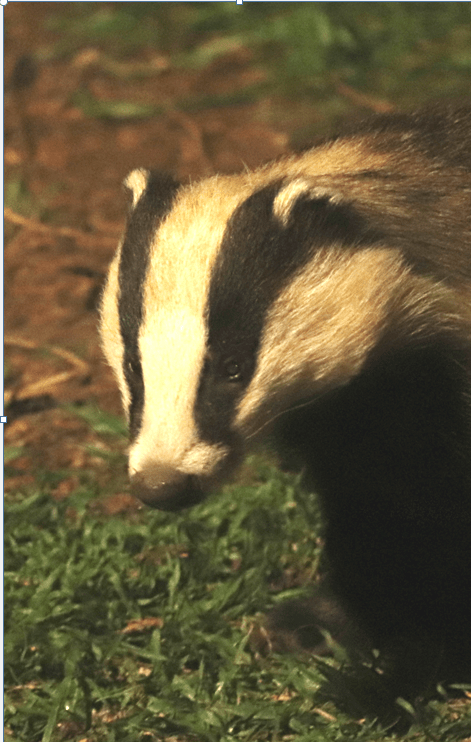
Badger in Latton Garden. Photograph by Revd. Lynn Hurry

The badger was a night time visitor in her garden and Introduces herself.

“ I try not to show my face too often. It isn’t always wise or safe.
As you see I have a rather distinctive face. It’s the broad white stripe that gives it away!
I am told that it serves a purpose. It’s a sign of my knowledge and insight into matters not easily accessible to other animals on earth.

One of my special attributes is my strong jaws. This is very useful because it makes it easier to chew and also, when required, to snap and bite at those other animals who like to throw their weight around.
A much more useful thing is that my jaws help me to habit the mysteries of the Word’, which is a pretentious way of saying how I reveal the ‘magic of storytelling.’

When needed, I give away generously to people, a magical word which is the way I guide people who are looking for beauty, encouragement and a more open mind especially when they seek a differing direction and purpose in life which otherwise deludes them.
I use the word, story’ in a sense of helping others to listen to that inner voice whereby God speaks. I am part of that spirit-filled creation which leads people to embrace courage and independence and so cultivate a tenacity which shows the importance of holding on when running away and hiding would feel much safer.

Drawing from my own characteristics and a tendency to dig deeper into the soil of the earth, I am able to show other members of God’s creation how to embrace untapped potential and take that journey all of us must take if we are to become our true selves under God.

I have this story to tell from the heart of my being and it has inspired a number of important people to use me as a character in their writings.
The late eighteenth century  poet, John Clare,  wrote of me in a poem  entitled Badger. At a time when many humans were cruel to animals, he took my tenacious character and wove it into a poem which emphasizes endurance and resistance rather than then being a victim.
Beatrix Potter, in her Tale of Mr Tod, was less kind of me, speaking of my curiously, earthy voice in a dismissive way. She called me Tommy Brock
By then, I was being referred to as Broc which actually was my Celtic Name and really only meant ‘grey.’.
That nice Mr Graham, who wrote the delightful book, Wind in the Willows, called me a “wise and kind badger” though he did say that I could be bossy at times, by which he meant that I was forthright!

Things are not always what they seem and humans are not the be all and end all of creation. Each of us animals have insights, hopes and loves to offer as we share in shaping Creation. Each of us is made by God and we are Icons of His presence in the world. We are all filled with God’s Spirit and signs of the totality of His loving being. Increasingly we need to see that truth and treat Creation and the Created order in a new and more grateful way, all of us as part of God’s story of pure love.

Many the gifts, many the people,
many the hearts that yearn to belong.
Let us be servants to one another,
making your kingdom come.
(Bernadette O’Farrell)

[Mr G, a visiting Badger and The Revd.Lynn Hurry]
30th April 2026

Year of Saint Francis

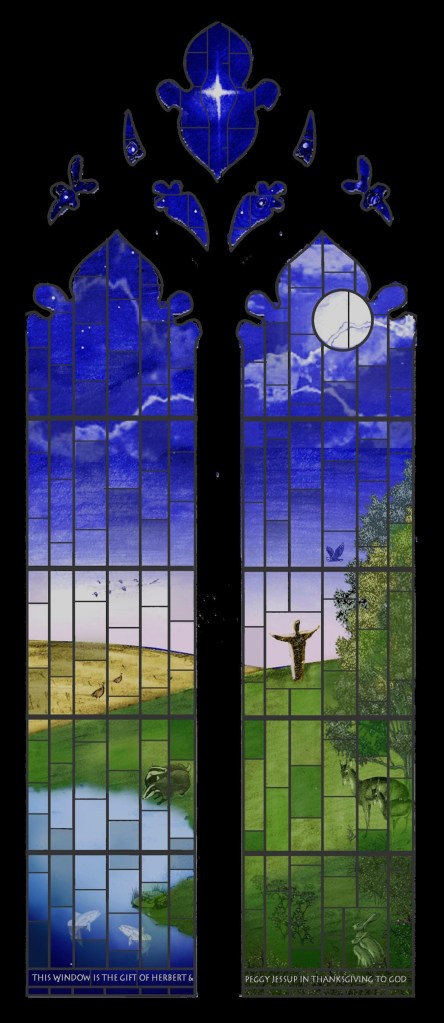
St. Francis Window, Transfiguration Chapel @ the Parish Church
of St. John the Baptist, Epping. Design picture by Piers Northam.

Pope Leo has proclaimed, this week, a year of Jubilee for Saint Francis to commemorate
the 800th anniversary of his death.The year will run from now until January 10th, 2027.
The Pope encourages the faithful to use this time to follow the example of St. Francis as
models of holiness and witnesses of peace.

Here is a poem I wrote in 2023 about St. Francis.

[Mr G. revised January 2026]

I Believe ~ Niceae 1700

Basilica of Saint Neophytos is the name of the underwater basilica in Lake İznik, modern-day Turkey.
This was where those who gathered for the Council of Nicaea .

The Telling of our Faith.

Over the past weekend, the Christian Church has been celebrating one of the most important anniversaries of our faith, the 1,700 Anniversary of the First Ecumenical Council which was held in Nicaea, (now Iznik) in what is now Turkey. Until 325AD, the Christian Church was established in various centres of mission but, as it grew, it was also dealing with persecution on a large scale from those who did not want the Christian faith, rooted in the life, witness and teaching of Jesus Christ to succeed.
Whilst we have never been free from persecution nor strangers to martyrdom, the period until the 4th century was particularly one where many Christians were put to death or tortured for their faith.
In the 4th Century, under the reign of Emperor Constantine, things changed. His mother, Helen(a) had become a Christian during a time in the Holy Land and her faith influenced her son. Though he did not immediately become a Christian himself, (though he died one), he declared that Christianity would become the official religion of the Roman Empire. Peace and stability came to the Church.

Except, not quite!
When people are up against terrible suffering, persecution and death, there is a unity which concentrates everyone on survival and on being loyal to what they believe. It brings with it its own high level of support for each other. There is no time or freedom to concentrate on anything but holding each other together, caring, loving and sustaining each other in mutual hope and encouragement.
When danger passes, the personal relief can sometimes give people the opportunity to face issues of disagreement which trouble them and can produce division.
That is what happened and the church faced differences in practice and custom caused by not being able to worship and prayer together.
Things like the date when the Church observed Easter and  other practices needed to be dealt with but the Church was facing its biggest ever challenge at Nicaea. At this moment in the story of the Church the biggest and most important question of our faith had to be faced: Who is Jesus?
Under its new found peace, Christianity had to face the question about the nature of Jesus. Followers of a theologian called Arius maintained that Jesus was a created being, who whilst a good man and infused with the vision of God, was not God.
More than anything else before or since this view threatened to destroy the church. The fierce debate it created division amongst Christians and everything we stand for was in danger of falling apart.
So concerned was Constantine that the Christian faith he had chosen to bring stability and harmony to his Empire was itself in grave crisis, that he called together Christians leaders at Nicaea.
This was the first Synod or gathering and here the question about who Jesus truly is, was debated.
The Council rejected the teaching of Arius and affirmed the total belief that Jesus is one in substance with his Father; that both are God together with the Trinitarian belief that the Holy Spirit is part of a three-fold God.
At Nicaea, the Church set out our belief in a ‘Statement’ or ‘Creed which became, at one level the ‘Constitution of the Christian Faith.
Though it was refined and deepened at the Council of Constantinople  in 381AD and again at Chalcedon in 451, it has become the foundational statement of the Christian faith’  and it forms an essential part of our expression of personal and corporate belief to be recited by the whole Church, Roman Catholic, Orthodox, Anglian, Methodist, every Sunday.
Essentially it is summarized by the acclamation often made in worship.

This is our faith.
We believe in One God,
Father, Son and Holy Spirit.

Pope Leo gathered last weekend gathered with 27 other Christian leaders to celebrate the 1700th anniversary in Nicaea, modern-day Iznik, Türkiye. Pope Leo  thanked Patriarch Bartholomew I, Ecumenical Patriarch of Constantinople, for his “great wisdom and foresight” in calling for Church leaders to celebrate this important anniversary together.
He spoke of the power of the Nicaean Creed to “invite Christians, even today ,to ask ourselves who is Jesus Christ for us personally,“ especially when there is a risk of reducing Jesus Christ, “to a kind of charismatic leader or superman, a misrepresentation that ultimately leads to sadness and confusion.”
The Pope went on to point out that reducing Jesus to an intermediary between God and humanity, and therefore not Divine, ignores the reality of the Incarnation.”“But if God did not become man, how can mortal creatures participate in His immortal life?” asked Pope Leo. “What was at stake at Nicaea, and is at stake today, is our faith in the God who, in Jesus Christ, became like us to make us ‘partakers of the divine nature’.”

He went on to say that, because the Creed was professed by all Christian Churches and Communities, “it is of fundamental importance in the journey that Christians are making towards full communion. Faith in one Lord Jesus Christ, the only Son of God, born of the Father before all ages…consubstantial with the Father (Nicene Creed) is a profound bond uniting all Christians.”

For me, reciting the Creed grounds my faith in Jesus who, in his birth, life, teaching, death and resurrection, speaks to me of the immensity of God’s Love, for me personally; for each other;and of my love for God; and of the power of that love to embrace all. Telling the story of what God, the Holy Trinity has done for us and goes on doing,  and speaking it prayerfully at the heart of worship is a tremendous experience of belonging and believing which holds us in a deeply inclusive and profound relationship and so becomes the prayer which speaks from the heart of our living faith in God.

I believe!

[Mr G. 2nd December 2025]