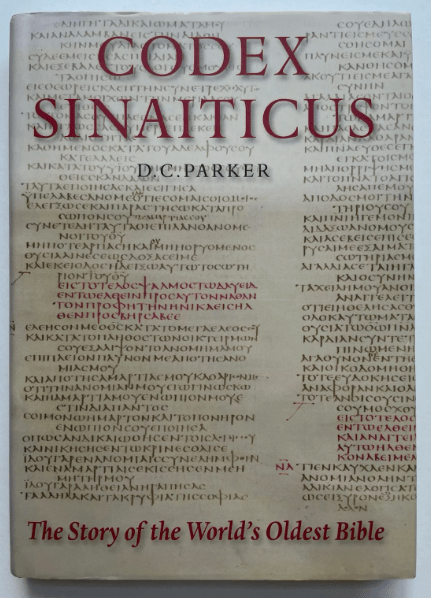
Whenever I visit the British Library in London I try to search out two very special manuscripts ~ The Codex Siniaticus and the Codex Alexandrinus. They are two of the rarest copies of Bible texts in Greek. In the case of Codex Siniaticus it is one of the most important books in the world. It is, arguably, the oldest complete copy of the New Testament that is still in existence, though not all of it is kept in London with a portion still being in Egypt, Russia and Leipzig. However, it has been digitally re-united so a complete copy now exists. From its text (and others which are less complete) all our translations of the New Testament are influenced.
It is also rather beautiful to look at in its handwritten script. To come close to what is the earliest known version of the Gospel of Jesus Christ, lovingly scripted in the 4th century at the monastery of St. Catherine on Mount Sinai, is to come close to the Living Gospel. It is the closest we get to God’s Holy Word spoken by Jesus and the New Testament apostles and evangelists. Yet this is not the only example of the Living Gospel.
I write this on All Hallows Eve or ‘Halloween’ – a night when we try not to think of ghosts and scary things but rather of the Holy Ones of God—the saints whose lives God touched and who became, in the way they lived those lives Living copies of the Good News of Jesus Christ. I think not only of the many saints we commemorate in our Church Calendars but also those whose holiness is known to but a few, though always to God. People who, through the lives and values they have tried to lead and the faith they have proclaimed, been influential and an encouragement to others. Most, if not all, of us who embrace the Christian faith, can think of such people whose nurture of our Christian understanding and practice have laid the foundation of our belief in Jesus Christ and our love for Him. These are the unsung hero’s of our Church. These we remember at All Saints’ tide. But their specialness is not about them being unique. All of us are called to be the Holy Ones of God. We are all called to saintliness and to nurture and grow the faith of others by our example, our prayers and our living out of the Gospel—a Gospel we should know by heart because it is absorbed into our souls. Someone once said that we should remember that we may be the only copy of the Gospel that others may read!
As I keep the Hallowed (sacred) evening on the cusp of All Saints’ Day, I think of those holy ones of God who have made such a difference in my own life with their outflowing of God’s love. They have been the beacons which have illuminated my journey towards God. I am thankful that they were placed in my way to bring God’s heavenly glow to my pilgrimage to heaven. They are also a reminder that, as we can read in the Book of Wisdom (Chapter 3) “The souls of the righteous are in the hands of God.“ That includes all the Saints, and all who, today, are trying to live close to God and who continue to show us the way to God’s Heart.
Sunrise from Lindisfarne over the Farne Islands, St Cedd’s day, October 26th 2025. Photo by Gill Henwood.
October 26th is St. Cedd’s Day:
The little that is known about Saint Cedd comes to us mainly from the writing of Saint Bede in his Ecclesiastical History Of The English People. Cedd was born in the kingdom of Northumbria and brought up on the island of Lindisfarne by Saint Aidan. He was one of four brothers: Chad (originally Ceadda), Cynibil and Caelin being his siblings. The first datable reference to Cedd by Bede makes clear that he was a priest by the year 653. It is likely that Cedd was oldest of the brothers and was acknowledged the head of the family. While he was alive, he seems to have taken the lead, while Chad was his chosen successor. Cedd was sent out from Lindisfarne to take the Gospel to Essex, landing after a sea journey at Bradwell where, today, there is still a Chapel built on the foundation of Cedd’s monastery. As well as this mission, Cedd also established a monastery at Lastingham in the Cleveland Hills. From here he established a mission in North Yorkshire. When he died of the Plague, his brother Chad took over. Today, at Lastingham, the crypt chapel is said to date back to Cedd’s time.
Learning of God from Island Saints.
I come to this Holy place where, when the tide turns, silence and conversation meld into stillness. God is here. His sanctuary, enclosed by the sea, welcomes those who are seeking after meaning.
What am I looking for, here on Lindisfarne, where the spirit of Aidan gathered together those chosen by God, on whom the Saint poured out his soul, his faith, into their waiting hearts?
I sense and seek the company of those who first prayed here through the storms of the sea, the blowing of the winds sweeping over the Headland Heugh, in the strange light of pale day and the fading shadows of eventide. In silence and in prayer; through learning and in listening; by becoming steeped in God’s word; twelve young monks, were inspired to mission the good, Gospel news, of Jesus Christ.
Cedd and Chad, Cynibil, Caelin and companions allowed Jesus to be etched upon their hearts, discovering a love which must be shared. How else would others inhale God’s blessing and love in their own lives and cause a world’s darkness to be bathed and transformed by the dazzling light of God’s Spirit?
And I, kneeling somewhere between the waves and shore of my inner being, must hear anew this call to open the Gospel pages illuminated by God within my soul, that through me also God may mission to others His amazing and saving Love.
Mr. G. St Cedd’s Day 2025.
Dawn over Lindisfarne, taken from Bamburgh by Gill Henwood. St Cedd’ s Day 2025
Today, the Christian church keeps the festival day of St. John the Baptist. There is another feast day later in the year when we mark his beheading at the hands of King Herod. Today, however, it is a joyful day, possibly helped by the fact that in the Northern Hemisphere it is Mid-Summer!
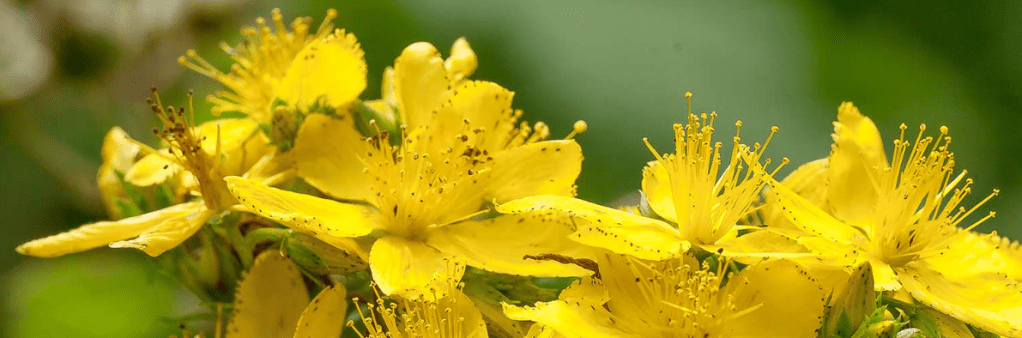
One of the things that marks this as a special time for all sorts of people is that it is also associated with a special flower, The Hypericum, or to give it its posh name, Hypericum perforatum. A native of Europe but now flowering in many other places worldwide (except for Siberia and other cold extremes),it is a bright flower marking bright summer. The dominant colour is vivid yellow, its petals often decorated with black dots. It generally has five petals with five smaller leaf-like sepals below them.
Hypericum is made up of two words from Greek – Hyper meaning above and eikon meaning picture. This may well date back to a custom, in earlier times, of hanging the flower over an Icon (sacred picture) in the home.
This really introduces us the other name for this plant which is St John’s Wort.There is a direct association with St John the Baptist in the flower itself. It has been suggested that the five petals form a halo, a symbol of saintliness. The red juice which is released when the stem is crushed, represents the blood of the martyred saint.
St John’s Wort is also known for its healing properties and in various forms is awort or salve (0intment). In earlier times it was used, therefore to ward off evil spirits; safeguard against sickness, protect against the bad things in life. This made the plant special in the nature of healing and it is still offered as an alternative medicine. It is however toxic to some animals and even humans so should be used carefully and advisedly. Its power and that of St John the Baptist, is, however feted in an anonymous 14th Century Old English poem:
St Johns wort doth charm all the witches away. If gathered at midnight on the Saints holy day. And devils and witches have no power to harm Those that do gather the plant for a charm. Rub the lintels and post with that red juicy flower No thunder nor tempest will then have the power.
The ministry of healing, offered by John the Baptist to the people who heard his message was a more powerful salve. He was known in the Gospel as the Forerunner the one who prepared the way of Salvation through God’s Son, Jesus.This Salvation is God’s healing of a broken and unloving world and Jesus his beloved Son His Salve, is the ointment of God’s Saving Love. John the Baptist led the way to Jesus through his baptism of Repentance, a Baptism which Jesus enhanced through his own life and ministry, death and resurrection. It is possible to say that it is in Baptism that we receive the Healing of God, the Salve which invites us to partake of the Salve of eternal life.
Another title by which St John the Baptist is known is that of Friend of the Bridegroom. He knew Jesus through a life lived in friendship with God. Friendship brings its own healing and when we are in friendship with God we are touched by the salve or Wort of his love and friendship for us.
Often when we visit friends we take them flowers. Receiving flowers can brighten and change the direction of our day and even our life. Giving them is even better! The love behind them is better still.
St John the Baptist offers us not St John’s Wort but the love and friendship of the giver, the Lord, our SALVE-ation, who loved us a into being created us to be bright with His image.
Yesterday, the Christian Church celebrated the feast of Corpus Christi. This is the time we gather to give thanks that at the Last Supper, our Lord Jesus gave us this memorial of his Passion. Through this sacrament he brought us its saving power until the end of time.In this Sacrament he feeds God’s people and strengthens us in holiness, so that the family of humankind may come to walk in the light of one faith, in one communion of love.
That’s quite a big statement and certainly more fulsome that that of Queen Elizabeth I who, of the Eucharist, said: His was the Word that spake it, He took the bread and brake it, And what that Word doth make it, I do believe and take it.
Both statements express a profound understanding of the Eucharist and, in some way, point us to the appeal of this Sacrament to the Church and to the life and journey of Christians. This journey is a pilgrimage of Love in response to the Sheer Love of God.
This Pilgrimage began in the story of the Church at the Last Supper on Maundy Thursday. This is a day of mixed solemnity, of festivity and leave-taking; of fellowship and parting; of instruction and acts of service.Overshadowing it is the Trial, Passion, Crucifixion and death of Jesus. Only after Easter did it begin to make sense and the Eucharist take a rightful and central place in the Church.
Which is why, on the first free Thursday after the Easter Season, the Church keeps this Day of Thanksgiving for our Lord’s gift of this Blessed Sacrament, and its place at the spiritual heart of the Christian Community.
Dom Gregory Dix, in his monumental study of the Eucharist and Liturgy, The Shape of the Liturgy. reminds us of this Ever since the Last Supper on Maundy Thursday, throughout the ages and throughout the world, the Eucharist has been done, in every conceivable circumstance…. He goes on the give a picture of this in a list which begins : There has been no better thing than this to do for kings and Queens at their crowning and for criminals going to the scaffold; for a bride and bridegroom in a little country church… for a sick old woman afraid to die; for a schoolboy sitting an examination … in thankfulness for recovery from illness… on the beach at Dunkirk…by an old nun on the fiftieth anniversary of her vows; furtively by an exiled bishop who had hewn timber all day in a prison camp near Murmansk; gorgeously for the canonization of Mother Teresa……. to which I may add: For an old priest at his funeral after years of Godly Service; for Marion who painstakingly taught the faith to a would-be Christian; and Mollie, a lover of Christ who received Holy Communion moments before death; For a dear friend, returning from a Cathedral in the early morning after Confirmation by her bishop; for a student trying to make sense of his father’s death and finding comfort and nearness to him in the bread and the wine: for a retired Archbishop who delighted in celebrating the Eucharist in a College Chapel, looking forward to a breakfast of sausage and beans; and for Mary whose faith sang out joyfully in hymns in in housekeeping for her Vicar; for an autistic child ,eagerly holding out his hands to receive the holy wafer, eyes filled with laughter and wonder; for a South African Dean who in the days of Apartheid was imprisoned for giving Communion to black and white people, who in a cell where he was given even no water, celebrated a spiritual Eucharist with nothing but his memory of words he sensed a world at prayer for him; for Girl Guides gathered around a cauldron of Guiness Stew at camp after receiving simple Holy Communion; For Ishbel who, having looked after her deeply ill sister all through the night, knelt in the chapel each morning to receive Communion before rushing off to teach the little ones in the Cathedral Song School through lessons tinged with laughter and fun; along the woodland trail of the Camino, people knelt and prayed; in peoples;’ homes in Holy Week; and for those circling the altar at a family Service; and those renewing vows of faithful ministry at the Chrism Mass on Maundy Thursday; Splendidly for thousands and thousands of those who waved off a Pope on his way to Heaven; and for a elderly lady in simplicity by an armchair at a Home Communion; at a hospital bed, at the profession of a Nun and a Lover of God….
And for you and you, and you….
and all who gather, week by week and month by month, on a hundred successive Sundays, faithfully, unfailingly, across the Parishes of Christendom, the Church has celebrated the breaking of the bread and the sharing of the cup. (Dix)
And why do we do this?
Luigi Santucci, an Italian novelist who wrote a remarkable book about Jesus, Wrestling with Christ, tells it like this.
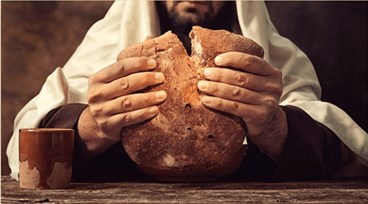
At this point I see Jesus’s eyes wandering around over the remains of the bread on the table-cloth and then shining with ineffable inspiration: this, this would be his hiding place. That’s where he would take refuge. That night they would not capture him in his entirety….So he stretched out his hand over the already broken bread, broke it into smaller bits raising it into the air. This is my body, it’s been given for you
He would hide himself in that bread. But He would not remain hidden. Whenever we gather around the table of the Eucharist Jesus goes on revealing himself to us. This amazing miracle which began in a point of time goes on endlessly and week after week, day after day, we gather with Jesus, as it were on the hillside and he feeds us. In the Upper Room our Lord seeks and finds a way not simply by which we shall remember him as we remember our first lover or first car – but how we can re-member, call to mind and heart and spirit, just how much he loves us – and how, because of that love, he wants to be with us – feeding us with the food of eternal life. He enfolds us in his arms of mercy, in his embrace of sheer love, freely and joyfully given.
Do this, our Lord tells us. And we do – gladly!
On behalf of our Lord Jesus, those who are privileged to be a part of God’s continuous reaching out in Love, His priests, offer not just the Lord’s Supper but all that follows as a result. What follows for priests is a constant ministry of trying to make God REAL for others. This was a key mantra of Sidney Evans when he was Dean of King’s College, London.
I have not always succeeded but I do know that We all make God REAL for others when we make ourselves REAL to God at the moment God reaches out and is REAL to us in out of sheer love, not least in this Most Holy and Blessed Sacrament.
In some lovely words of Fred Kaan, in his hymnput peace into each other’s hands, I see this Realness of God’s Love in action especially in two verses which centre us on the Eucharist.
As at communion, shape your hands into a waiting cradle; the gift of Christ receive, revere, united round the table.
Put Christ into each other’s hands he is love’s deepest measure; in love make peace, give peace a chance and share it like a treasure.
Receive, Revere , Respond, Make Real. The World needs that from us.
Amen
[Mr G. a sermon at St. Mary-at-Latton. Corpus Christi 2025]
[][][]Dom Gregory Dix, The Shape of the Liturgy, a study of development was first published in 1945. A new edition was published in 2015.
{}{}{}Wrestling with Christ, by Luigi Santussi was published by Harper Collins in 1972 both as a hard-back but also in paperback. Previously owned copies are often available. Try Abe Books
[][][] Fred Kaan, minister, pastor,hymn-writer and poet. The quote comes from his moving hymn: Put Peace into each other’s hands. it is often sung. He wrote many hymns which are devotional poems. A Collection of his hymns (Hymn texts of Fred Kaan) was publishd by Stainer and Bell (Hope publishing company in USA) in 1985. It is available as a previously owned copy and is well worth hunting for it because it contains Fred’s fascinating story which includes an account of his early life in the Nederlands, a time which spanned the German Occupation.
{}{}{} The Quote from Queen Elizabeth the First is well known and is proof that she was her father’s daughter! At least in the respect that she inherited King Henry VIII’s grasp of Christian Theology.



 Mr G's Ponderings