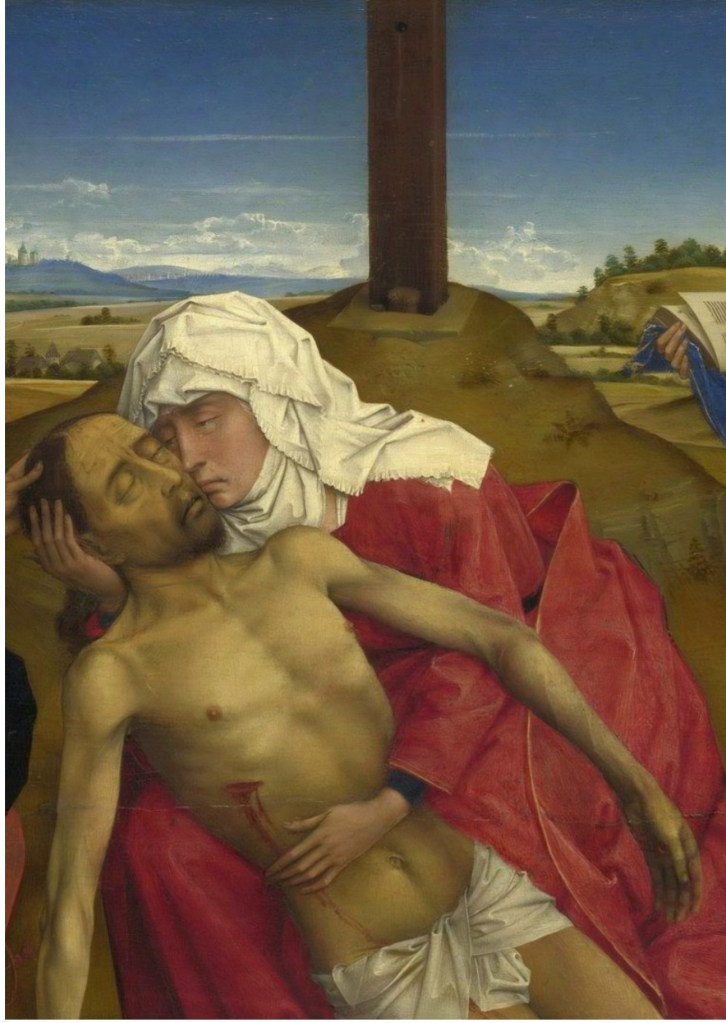
Their eyes never leave you, together confronting the agony as you are pinioned to the cross and crucified.
Three long hours.
Their presence is unwavering, their gaze unflinching, though a sword pierces their own anguished hearts.
Among them, the one who endured the agonies of bringing you into the world: who cradled the infant you. Now you are held in her gaze, her eyes fixed on you as she stands close by. Soon she will cradle your stiffening, lifeless body.
Where others have faltered and fled, these are the ones who remain, their presence, all that is left to give: a wilful resistance, a faithful standing by, a harrowing witness.
Here, at the foot of the cross, is true strength, true devotion: a love that is unsparing and never turns away…
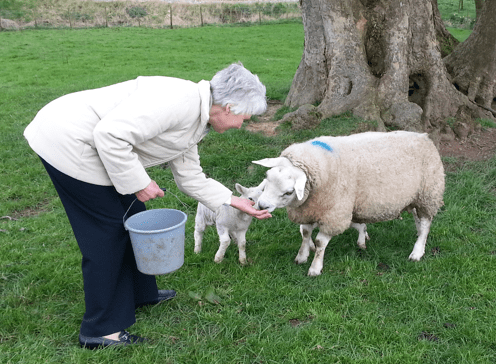
Cygnets watched over by parent swans. Hatfield Forest, Essex. Photo by Mr G
A Reflection about Mothering Sunday by Piers Northam.
There is a Neopolitan saying about cockroaches Ogni scarrafone è bell’ a mamma soja– which translates as ‘every little cockroach is beautiful to its own mother…’ It feels relevant, because the cockroach’s mother looks on her offspring with a eyes filled with love – and that set me thinking about how we are each looked on by God.
As we journey through Lent, I think it’s an important thing to ponder on for ourselves: how does God see us? I mean really see us? I suspect that answers to this question will vary, but they might include the fact that he loves us; that he might also be a bit disappointed in what he sees us getting up to; that he’s forgiving and always willing us to turn back to him; that he’s also forward-looking and sees the potential in us: sees the best that we can be; and that he sees the beauty that we might think is either not there or well-hidden under our crusty, cockroachy exteriors – and so he gazes on us with love and affection – with the gaze of a loving parent.
On Mothering Sunday, that notion of the relationship between parent and child – by which I mean the very best version of that relationship – might have a lot to teach us: it’s bound up in notions of nurturing and feeding us; protecting us; teaching and equipping us for life; perhaps a bit of necessary discipline from time to time, but above all that sense of wanting the best for us; loving us: and that unspoken bond and shared identity… The Bible Readings for Mothering Sunday, from Exodus and from St John’s Gospel, have some other interesting things to say about parenthood:
First there’s the story of Moses’ mother. It’s perhaps useful to remind ourselves of the background to this story: the Hebrews were enslaved to the Egyptians, but they had grown hugely in number and the Pharaoh feared being overrun by them so, in order to keep down the population, he commanded that all Hebrew male children be thrown into the Nile and killed – they were living in dark times. When Moses was born and his mother could no longer hide him, she made a basket for him, sealed it with pitch to make it watertight and hid him amongst the reeds. Here is a mother who can no longer protect her child, so she entrusts him to God, leaving him somewhere she prays he will be safe. And then, of course, Pharaoh’s daughter comes along and finds him – she acts instinctively; taking pity on this defenceless baby. She is aware that he is probably Hebrew – an alien that her society looks down on – but what she sees is a fellow human being: a child in need of care and nurturing whom she goes on to bring up as her own. And then we see the two women working together to raise Moses: his biological mother hired as a wet-nurse to feed him and raise him for a period. Later, she hands him over to Pharaoh’s daughter because she realises that by doing so he will survive and thrive and be safe and well looked after. In her we see sacrifice and trust in God; putting her child’s needs before her own; nurturing him and wanting the best opportunities for him in life. And in Pharaoh’s daughter, we see compassion and generosity; she looks beyond the views of her society, to see a defenceless child and she responds to his need, bringing him up as her own. Both these women think of Moses first and both act in his best interests.
The other little thread here, that is picked up in the Gospel reading, is that motherhood for Pharaoh’s daughter goes beyond blood-ties. Moses is her child by adoption, yet he is treated as her own. And this is what we see at the Cross when Jesus entrusts Mary and John to each other. The beloved disciple takes Mary into his household and treats her as his own – as she does him. In entrusting them to each other, Jesus is asking them to form this interdependent, loving relationship.
It is these relationships that are at the very heart of our Christian faith. Jesus tells us that we are children of his Heavenly Father, who is also our Father – we’re reminded of it every time we pray that great prayer he taught us. And so, by extension, we are to be family to each other – with all that that might entail. As with Pharaoh’s daughter, we are to see beyond the blood-ties of our own families and beyond the borders of race and nationality and to regard each other as beloved brothers and sisters.
But on Mothering Sunday, I think we could push things a stage further. We’ve all heard of sibling rivalry and there’s never a guarantee that we’ll get on with our brothers and sisters. But if we focus on the way that the best parents look on their children, we might find a stronger imperative.
In the 16th century, long before it was subsumed into the Mothers’ Day peddled by the card companies, this Sunday in Lent was a day when churchgoers returned to their ‘Mother Church’ – often the local cathedral or big church, or perhaps the church where they were baptised. In later times, domestic staff who lived away from home, were given the day off to return to their families – and usually to their mothers – and this is where some of the customs that we keep today came from. But that notion of ‘Mother Church’ is an important one, for if we take it seriously, then it tells us something about how the church should be – not a church that fences us out with rules and regulations about who’s in and who’s out, but one that loves and nurtures us. One that, like Pharaoh’s daughter, simply recognises our common humanity – whether we’re Hebrew or Egyptian, black or white, rich or poor, gay or straight or any of the shades and variations in between. Because if we look beyond our cockroachy exteriors, we’re all simply children of God and the Church needs to recognise this and gaze upon us with abundant love – irrespective of who we are or what we look like.
Now I know that for some, the phrase ‘Mother Church’ will evoke notions of an Institution that knows best; perhaps even one that lays down the law and tells you what to think; or one that is too slow to show true love and acceptance to all. And that’s not what the best parenting is all about is it? What I would love to be able to say of the Church of England is that it isn’t entirely like that – and actually, at grass-roots level, I don’t think it is. For me, Anglicanism – in its best form – aims to brings us to maturity: helping us to learn that we are loved by our Father in Heaven so that we grow in confidence; teaching and equipping us; encouraging us to think for ourselves and to learn so that we can grow into adults – or at least mildly sensible teenagers – who have enough nous and confidence to go out into the world and treat our fellow men and women lovingly. That’s what the best parents do, don’t they? They bring up their children confident in the knowledge that they are loved and therefore able to be loving to others; equipped to be good and valuable members of society.
Now I referred to ‘Mother Church’ a moment ago as an Institution, but of course the really important thing is that the church isn’t an institution at all. It’s you and me – we are the Church. So it seems to me that our calling is not just to treat each other as brothers and sisters, with whom we might bicker around the dinner table, but actually to look at each other with the loving eyes of a parent – with all that that entails.
Of course that’s a lot more challenging isn’t it? We’ve got to be like the cockroach’s mother, seeing past the carapace to the lovely little cockroach inside. We’ve got to want the very best for each other – and not just the ones who are like us – Jesus, with his words to John and Mary, blew the whole thing wider from up there on the cross. We need to be like this to the whole of humanity.
I was chatting with a friend in the week who I haven’t seen for quite a while and we were talking about the rather depressing state of the world right now and she said, ‘wouldn’t it all be so much better if we could simply treat each other with kindness?’ I think she’s absolutely right – and I think St Paul would agree:
‘clothe yourselves with compassion, kindness, humility, meekness, and patience. Bear with one another […] forgive each other. And above all, clothe yourselves with love.’[1]
The other day I was telling someone, who didn’t know it, that wonderful story of the Prodigal Son – it’s one of my all-time favourites: I never cease to be moved by that moment when the father, who’s been sitting all day at the front step gazing down the road, sees his son returning home. What does he do? He hitches up his skirts and goes running, full pelt down the road to meet him and sweep him up in a loving embrace. That bursting-at-the-seams joy at seeing his lost child come home, gets me every time. And that needs to be us.
We need to be out on the front step, looking down the road to see which one of our children might be coming home; we need to be rooting around in the bulrushes looking for those whom we can protect and clothe and give a home to; we need to be feeding and nurturing those who are with us and – in the manner of all good parents, giving them the confidence that they are loved and valued; we need to be inviting and gathering those around us to the table to break bread with our brother, Jesus.
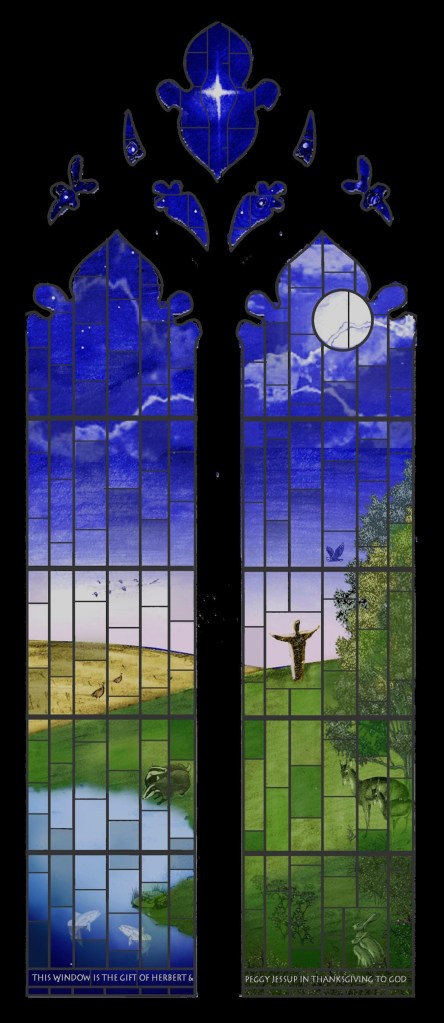
St. Francis Window, Transfiguration Chapel @ the Parish Church of St. John the Baptist, Epping. Design picture by Piers Northam.
Pope Leo has proclaimed, this week, a year of Jubilee for Saint Francis to commemorate the 800th anniversary of his death.The year will run from now until January 10th, 2027. The Pope encourages the faithful to use this time to follow the example of St. Francis as models of holiness and witnesses of peace.
Here is a poem I wrote in 2023 about St. Francis.
Dearest Francis, You were led from your raucousness and debauchery. As leader of the pack they gathered around you, your followers, attracted by a charisma that lit up their lives. Of course, your pockets held the wealth which made living as free spirits so easy. You took it all for granted. The centre of your life was within you, focusing on that self which has ruined so many.
But another Charisma sought your energy. Different followers waited to be your disciples. Different values, to be ripened by true joy. Perplexed, perhaps that you were losing direction, uncertainty gripped that carefree heart and nothing satisfied.
From the centre of things, you were called to the margins, where your destiny would discover you. Kneeling, questioningly, in the dereliction of Damiano’s chapel, You were led to examine your own crumbling life. In the midst of your despair, Jesus spoke to you,
“Francis, rebuild my Church.”
At first, a physical task, drawing others to your side as only you could, but there was so much more to come. You did not always get it right. None of us do. That is why God comes among us often, casting his grace over us, like rose petals at a wedding.
It is said that, near death, Jesus gifted you with stigmata, scars, wounds of Christ, as marks on your own body. But you had received these on your heart long ago, when you walked as a companion of Jesus. The Way of the Cross gave you Stations of prayer by which you were able to shepherd poor, unloved, uncared for humanity; vulnerable animals; dancing birds, whose capricious flight was a sign of God’s joy. And you did not forget the rich, who more than most need to walk with you, into heaven.
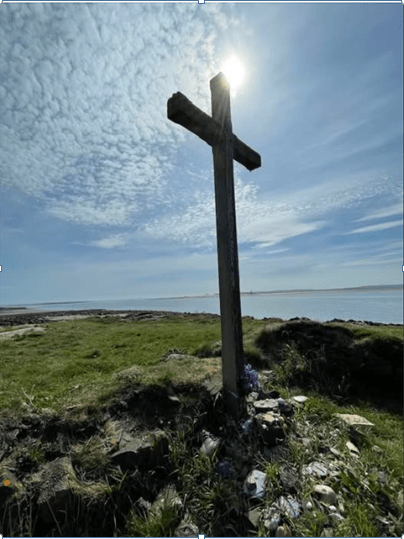
St Aidan of Lindisfarne, whom the church remembers today, modelled humility. He was active in Northumbria in the 7th Century. Aidan was of Irish descent and was a monk at the monastery on Iona. Oswald, who became king of Northumbria in 634, wanted to bring Christianity to his people and the Venerable Bede tells us that he contacted the monastic community on Iona and they sent a bishop called Corman to bring the good news to Oswald’s people. But Corman didn’t go down well – he was haughty and harsh, and thought the Northumbrians were too stubborn and stupid to be converted. On his return to Iona, Aidan criticized the way that he had gone about things: “Shouldn’t you have been a little gentler and more patient brother?” Aidan is reported to have asked and, before he knew it, he was being sent off to have a go himself.
So what was it that differed in Aidan’s approach? Well, first, he was aware that if he was going to bring a lasting Christian faith to this part of the country he was going to have to have a long-term strategy. So his first move was to set up his little monastery on the island of Lindisfarne and in it a school that took in local Northumbrian boys. In doing so, he was valuing the people of Northumbria rather than assuming that they were stupid and stubborn. He was noticing, valuing and nurturing their potential, because they were to be the very foundation of this local church.
His next move was to begin to learn the language of the local people so that he could go out into the lanes and farms talking to people and telling them the Gospel stories in a language they could understand. You have to remember that Aidan would have spoken Old Irish and the Northumbrians Old English – two languages that had no linguistic ties – so this was no mean feat. Thankfully, King Oswald came to his rescue being bilingual. If you think about it, that’s the exact opposite of a colonial approach, where you take your own culture and impose it on another society and culture – again, Aidan saw the value in what was there and approached the task with humility.
In those times, people were in the habit of carrying knives – and not just to cut their meat up – allegiances were fiercely local; foreigners and outsiders generally mistrusted and Aidan, of course, was one such outsider. Yet Aidan and his followers refused to tuck a knife in their belt – a risky strategy, but a courageous one, for it showed that they were essentially defenceless and meant that they were reliant on people to help them – trusting them to do so. And, of course, we see the parallels between that and the gospel account of Jesus sending the disciples out in pairs. Whereas Corman, Aidan’s predecessor had ridden around the farms and villages of the area on horseback, gathering people together, preaching to them and then aiming at mass conversions, Aidan’s methods were far more humble: he literally walked thousands of miles, tramping the lanes and pathways, and getting into conversation with those he met. His was a patient approach: aiming to kindle a curiosity in his listeners so that in time they were drawn into the way of Christ and would ask to be baptised. His methods did not hinge on mass conversions which had little to back them up, but rather on personal, long-lasting relationships that led to a real desire to learn more about Christ. He was not talking down to people from the back of a horse, rather, he was encountering them face-to-face – eye-to-eye – on a level: treating them as equals – all valued, beloved and precious to God.
Needless to say, Aidan’s approach found far greater success than Corman’s and Christianity took hold and became deeply rooted in the North East of England. His humility and the way that he approached and valued people was effective in spreading the Good News of Jesus Christ.
[Extract from a sermon by Piers Northam, preached on St. Aidan’s Day, Sunday 31st August 2025]

 Mr G's Ponderings