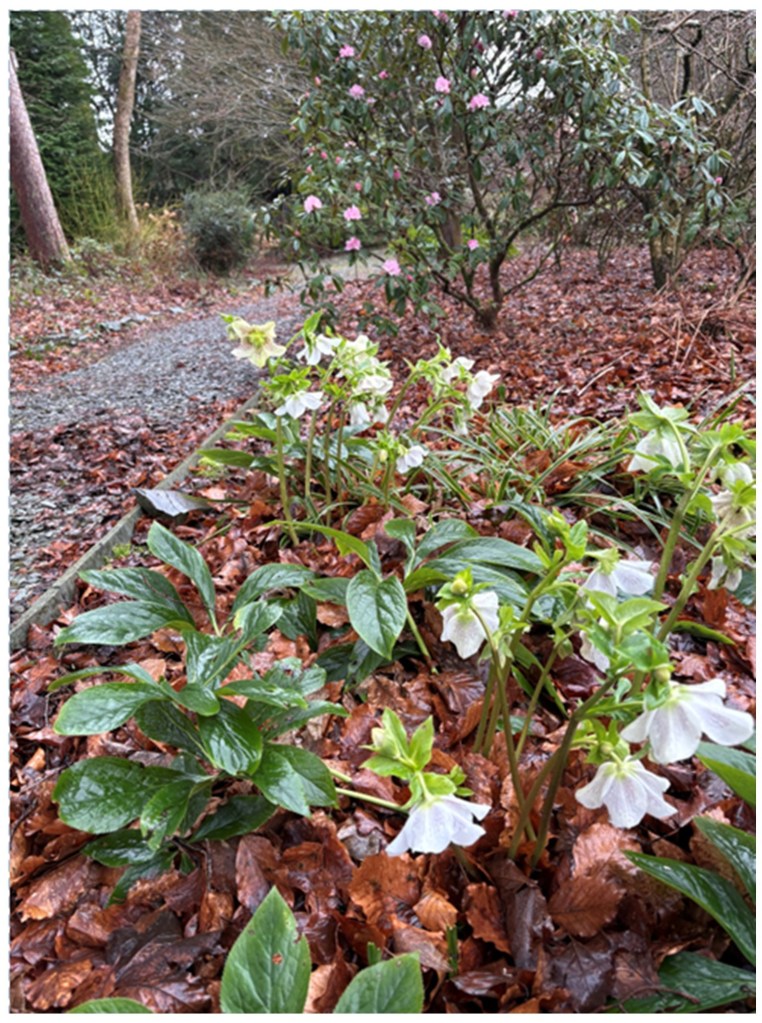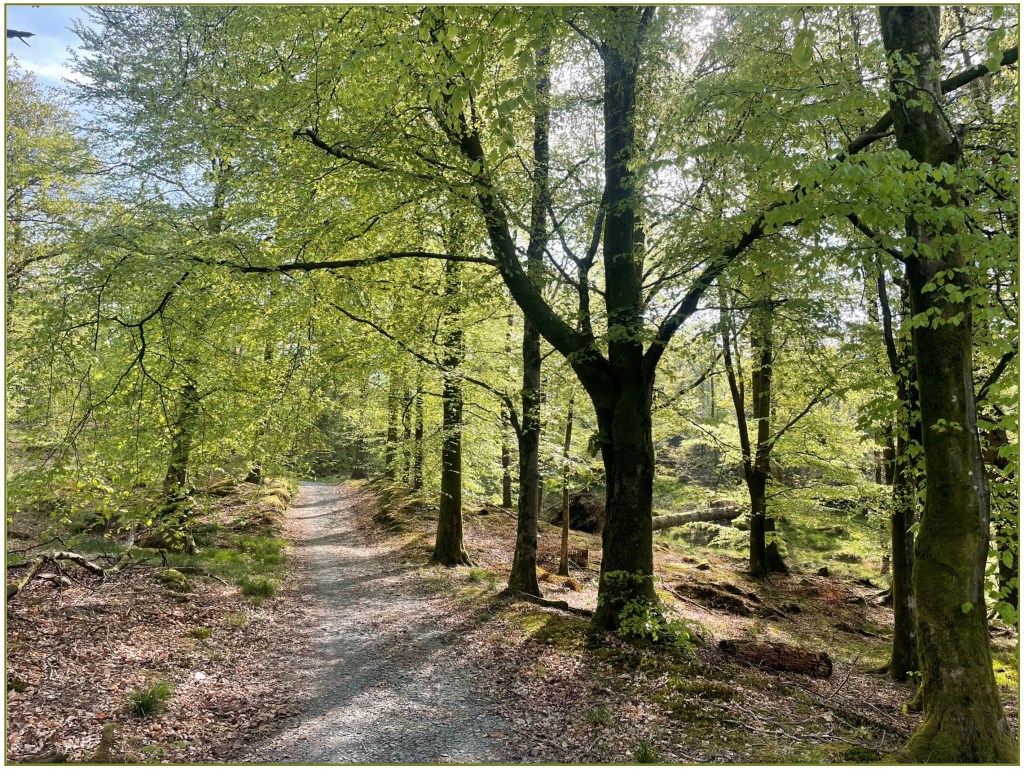
Morning near Tarn Hows, Lake District. Photo by Gill Henwood
An early morning reflection from the Lake District by my friend, Gill Henwood.
Out early morning, the dogs have swum in Tarn Hows and we’re returning through the woods above Coniston. The birds are singing all around us, in the unfurling tender canopy of leaves and tree blossom. No wind: the day is rapidly heating in the nearly-summer sun.
A cuckoo sounds across the fells. We heard two yesterday in Little Langdale … heralds of summer (and danger, if you are a future foster parent bird sitting on eggs). The shade of the delicate canopy brought to mind:
“Keep me as the apple of your eye Hide me under the shadow of your wings.”
Psalm 17.8
The peace and calm of protecting shade, the ‘wings’ of myriad mature trees above.
But other wings break into the birdsong (though they ignore them). Fighter jets are training, flying circuits below the fell tops, preparing for defence, reminding us that peace and calm have a terrible cost. Thinking of Ukraine, the Middle East, people in conflict wherever. May they one day hear the birds sing, the cuckoo call, and find shelter under shading trees.
Till then, may our prayer be with the psalmist,(above) prayed at Night Prayer, Compline, the traditional offices, prayed at Night Prayer, Compline, the traditional offices.
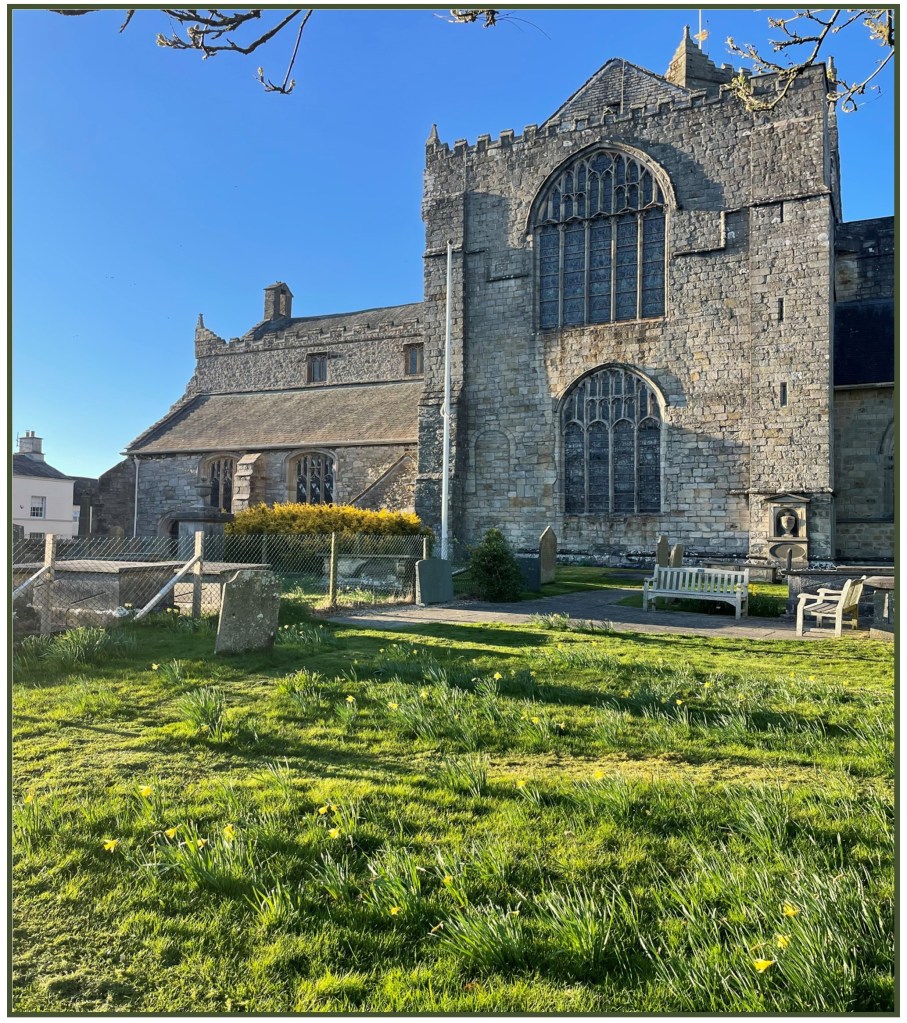
Cartmel Priory, Cumbria ~ Remembrance garden. photo by Gill Henwood.
Posted the day after President Trump sent shockwaves of uncertainty around the world, this beautiful Oasis of peace at Cartmel reminds us how much the world is actually caught up in the love of God. Cartmel Priory has been a reminder of that love for centuries and will go on being so long after the world has forgotten who Mr Trump was. Gill’s words below help us to refocus.
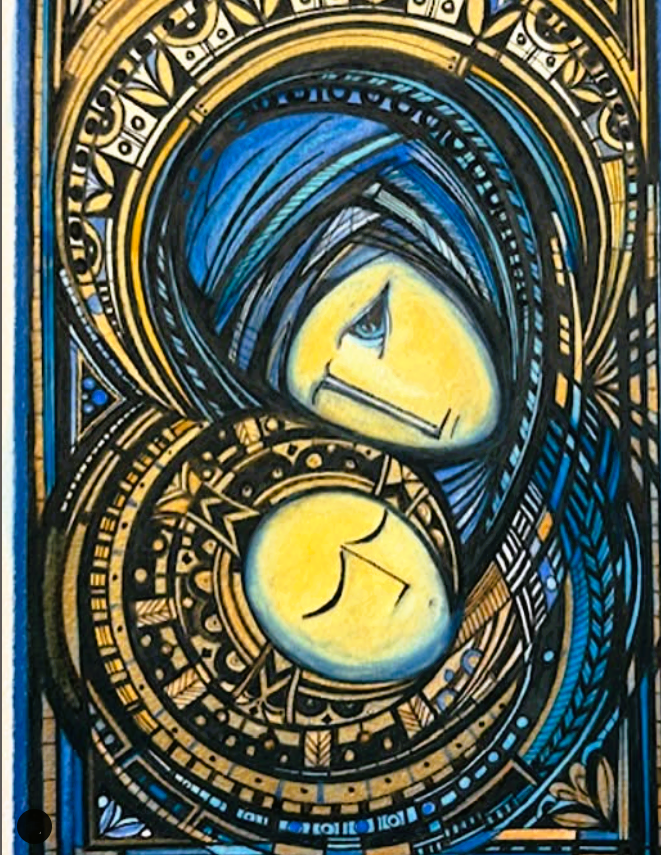
The drawing above of the Blessed Virgin Mary and Jesus is by my artist friend, Kay Gibbons. It was recently exhibited in The Oxford Arts Society Show. Kate works in various mediums, especially stained glass; glass sculpture; water colour; sculpture; oil and much more. Her designs are often striking and bold and she has a tremendous eye for colour. To see more examples of her work, visit her on Instagram. (PS, I am a big fan!)
A Thought on Mothering Sunday from Kay
When all around is busy , crazy and chaotic … I like to sit quietly and draw and think and ponder and wonder… about this , that and the other …..
[Kay Gibbons]
Mothering Sunday is aChristian holy day, celebrated throughout Europe, that falls on the 4th Sunday inLent. It is a time when we traditionally celebrate the church as the place where our Christian family finds its home.In the past many people worked away from home—many children in service to big households—but on this day they were given time off to return home to their families, and to their ‘mother church’. They would pick flowers along the way to give to their mothers. It was also a day in Lent when the rules about fasting were relaxed, and it was a time when special Easter cakes were prepared, so it also became known as Refreshment Sunday, Pudding Pie Sunday and Simnel Sunday – after the practice of baking Simnel cakes to celebrate the reuniting of families during Lent. Mother’s Day** is a more recent invention when is a celebration of the role of mothers and families. It is celebrated on the same day that Mothering Sunday so the two celebrations have now been combined.
{ ** mothers’ day is kept at another time of the year in the USA and other places}
A Prayer on Mothering Sunday and beyond
Loving God, you have given us the right to be called children of God.Help us to show your love in our homes that they may be places of love, security and truth. Loving God, Jesus, your Son, was born into the family of Mary and Joseph; bless all parents and all who care for children; strengthen those families living under stress and may your love be known where no human love is found.Loving God, we thank you for the family of the Church. We pray that all may find in her their true home; that the lonely, the marginalized, the rejected may be welcomed and loved in the name of Jesus.Loving God, as we see the brokenness of our world we pray for healing among the nations; for food where there is hunger; for freedom where there is oppression; for joy where there is pain; that your love may bring peace to all your children. Amen
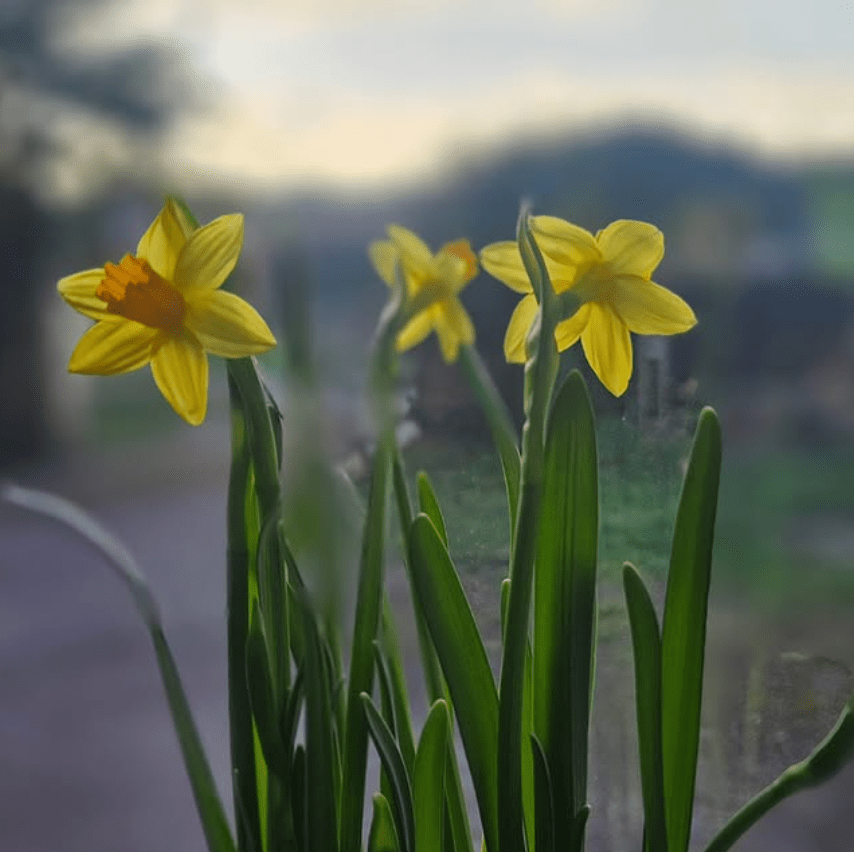
Wild daffodils in the Lake District photographed by my friend Gill Henwood
In this coming week, we who live in the earth’s Northern Hemisphere, move from the season of Winter to that of Spring. The Spring equinox is often known as the ‘Astronomical’ Spring to differentiate it from the ‘Meteorological’ Spring which is used by weather forecasters and is always on March 1st. The season of Spring generally falls on either March 20th or 21st (19th in a Leap Year) This year it is on March 20th. Nature, however, prefers to set its own time and has already begun showing growth from the earth; songs from the birds and a gentle ‘greening’ of the leaves as trees create a dusting of new life.
One of the most important signs is the arrival of spring flowers, especially the Daffodil which symbolises re-birth and hope. The poet, Cecil Day-Lewis, calls the ‘full-throated’ daffodil, “our trumpeters of gold” which “call resurrection from the ground.” This association with Easter has also led to daffodils being called ‘Lenten Lilies’ because they tend to flower in the period between Ash Wednesday and Easter Sunday. (Sometimes they naughtily come too early for church flower displays when Easter Day is late!)
The most famous poem about the Daffodil begins with the words, “I wandered lonely as a cloud” which begins the Daffodil poem by William Wordsworth. It drew its inspiration from his sister, Dorothy, with whom he took a walk around the Lake District on the 15th April, 1802. We know the exact date and the detail of the journey from Dorothy’s diary, published later as her ‘Grasmere Journal’. Intrepid walkers, Dorothy wrote that the weather was threatening, misty but mild’, though the wind was ‘furious’. She described the walk in great detail including avoiding some cows! She noted the flowers they saw along the way – wood sorrel, anemone, scentless violets and a starry yellow flower known locally as pile wort. When they got to woods beyond Gowbarrow they saw a few wild daffodils close to the water-side and Dorothy then wrote in her journal:
“as we went along there were more and yet more; and at last, under the boughs of the trees, we saw that there was a long belt of them along the shore, about the breadth of a country turnpike road. I never saw daffodils so beautiful. They grew among the mossy stones about and above them; some rested their heads upon these stones, as on a pillow, for weariness; and the rest tossed and reeled and danced, and seemed as if they verily laughed with the wind, that blew upon them over the lake; they looked so gay, ever glancing, ever changing.
It has been suggested that it was these words which inspired her brother, William, to write his own poem in praise of daffodils. The sentiments and imagery expressed by Dorothy are certainly traceable in his poem. William became famous and eventually Poet Laureate whilst Dorothy was all but forgotten at the time but there are some who would suggest that his daffodil poem might constitute plagiarism! What can be certainly said is that between them they helped to make the Daffodil become a joyful sign of Spring and of Resurrection. [Mr G]
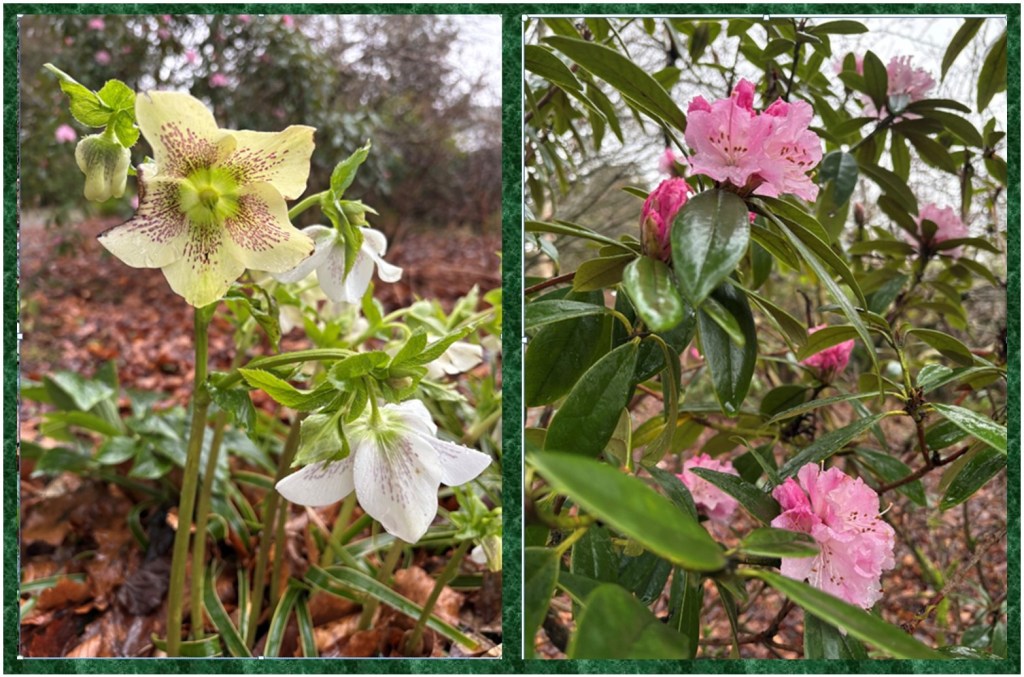
photo GH
I wandered lonely as a cloud That floats on high o’er vales and hills, When all at once I saw a crowd, A host, of golden daffodils; Beside the lake, beneath the trees, Fluttering and dancing in the breeze.
Continuous as the stars that shine And twinkle on the milky way, They stretched in never-ending line Along the margin of a bay: Ten thousand saw I at a glance, Tossing their heads in sprightly dance.
The waves beside them danced; but they Out-did the sparkling waves in glee: A poet could not but be gay, In such a jocund company: I gazed—and gazed—but little thought What wealth the show to me had brought:
For oft, when on my couch I lie In vacant or in pensive mood, They flash upon that inward eye Which is the bliss of solitude; And then my heart with pleasure fills, And dances with the daffodils.