Yesterday, at church in Fakenham, we sang the hymn, For the healing of the Nations, by Fred Kaan. The second line begins, ‘Lord we pray’, a reminder that hymns are musical prayers which begin life as prayer/poems. As such they are an important part of our devotional resource, whether they be as hymns, psalms, anthems of chants. This prayer by Fred Kaan speaks deeply to our human condition which cries out for healing of our brokenness in so many ways.
For the healing of the nations, Lord, we pray with one accord, for a just and equal sharing of the things that earth affords. To a life of love in action help us rise and pledge our word.
Lead us forward into freedom, from despair your world release, that, redeemed from war and hatred, all may come and go in peace. Show us how through care and goodness fear will die and hope increase.
All that kills abundant living, let it from the earth be banned: pride of status, race or schooling, dogmas that obscure your plan. In our common quest for justice may we hallow brief life’s span.
You, Creator God, have written your great name on humankind; for our growing in your likeness bring the life of Christ to mind; that by our response and service earth its destiny may find.
Fred Kaan
Fred Kaan was uniquely placed to offer this poetic insight of a world in need of healing. As a child of the occupation of the Netherlands, he experienced first-hand the horrors of Nazism, His parents were part of the Resistance in Holland and they also sheltered a young Jewish woman who was kept safe for over two years. Fred was doubtless shaped by a global conflict which was also experienced personally. He was filled with a passion for social justice, global peace and a reconciliation between people. When he discovered Christ, this strong desire met the explosive love of the Gospel. His faith was expressed in Christian ministry and a spirituality that found expression in prayer/poems which could be sung powerfully as hymns or quietly as Gospel -based prayers as part of personal devotion. It is offered here as a pinprick of soul-light for our praying. After all, for many, the best action for human justice, freedom and the outpouring of love, is through prayer. Action flows from prayer because it changes us.
To a life of love in action help us rise and pledge our word.
[Mr G]
***for more on Fred Kaan see my blog entry June 29th 2023
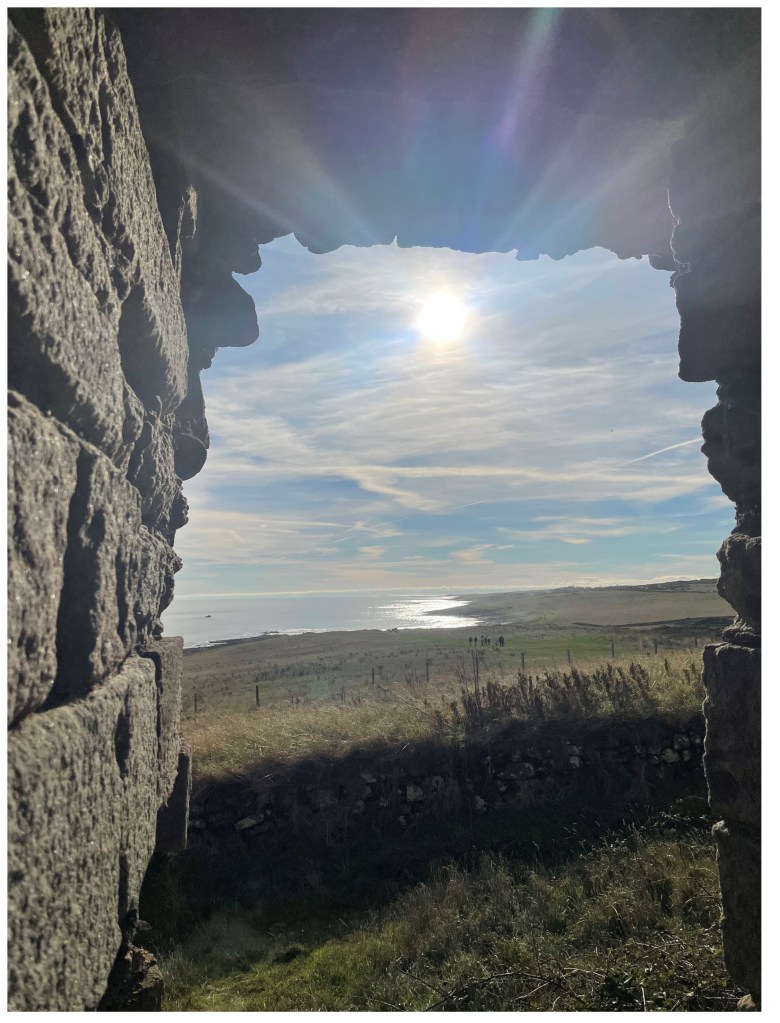
View from the ruins of Dunstanburgh Castle. Photo by Gill Henwood
“Much to ponder”
Light on sea, sparkling Dancing in the sun floodlight. Light starburst through Ancient windows Blazing on the warm weathered stones. People walking, all ages Carrying infants, or usually sticks Pilgrims to our past, wondering Who was here, in savage beauty Raging storms with Threatening invaders.
Now all is peaceful, open, safe Every age comes to ponder In awe. One day, Peace will come again to Ukraine, To Gaza, to lands of conflict Violence and hatred.
One day. Much to ponder.
[Gill Henwood] inspired by a visit to Dunstanburgh Castle, Northumbria.
Dunstanburgh from the shoreline (Photo. Gill Henwood)
A Pondering on BIBLE SUNDAY, by my friend, The Revd. Becs Challis.
So, it’s Bible Sunday, this is a time where we pay special attention to and give thanks for the Bible in our lives as disciples…. I’ll be honest, for me I find this easier said than done….
First, the bible that I am currently paying most attention to is the NIV study bible (a big large hardback book) and I’m paying attention not because I am referencing it but because it’s just the right size as a laptop stand on my desk.
Secondly, rather than simply give thanks in my inner thoughts, I want to add “but did it really have to be SO long and SO complicated (not only to read but also to understand) And I’m not being flippant I am just recognizing my human condition and the fact that actually the bible if I think about it as a “book”, for me is the source of a lot of shame. And I am going to hedge my bets that I am not totally alone in sometimes slipping into thinking things along these lines?
Yet this is actually the one day when many churches will be praying and giving thanks for the bible, so it’s worth us really understanding what we mean when we say that we are paying attention to and giving thanks for, the Bible. So let’s use this time to take away any barriers we may have to connecting with God when we are thinking, praying or blowing the dust off and potentially even reading the bible!
So what is it, that we are actually giving thanks for, and can we put words to the impact that that has had on our lives and those around us? We’re told in 2 Timothy (3:14-4:5) that all scripture is inspired by God, all of it. – The passages we love, the passages we’ve read over and over again, the verses we can recite and the bit’s we’re less familiar with, those sections we skim over or the ones we’ve never read, those passages that we can’t quite reconcile with our view of God, and those ones that have been interpreted differently and used as weapons against us or those we love…. All of them every word is inspired by God. The bible is God breathed; all 66 books all 700 thousand plus words are inspired words of God. It is the most sold book (not necessarily most read) but most controversial books in the world. Yet it’s not a book at all, it’s an invitation into relationship with Jesus, it’s admittedly a very large, dense, wordy invitation. But it is an invitation all the same…
This is an invitation of hope:
an invitation to us here in church.
an invitation to those who we know aren’t here today
an invitation to those who ‘have never’ and ‘will never’ come here….
an invitation to the whole human race, the whole world, to all of us grace gifted misfits[1] that in some way don’t think we are good enough
But what do we do, how do we access this invitation?
Well in Paul’s letter to Timothy there’s a sense of urgency, whatever you do, do something because the Bible is invitation into relationship with Jesus, it is not something to put off for a rainy day.
“Hold fast to what you have learned.” It might be just one word or one phrase but hold onto it. However, right at the heart of this instruction, it isn’t about gripping tightly with fists closed. Instead, it’s a reminder to hold on with an openness, with a heart ready to receive, a mind willing to explore. The Bible, or “scripture” for Paul, is not a cage meant to confine us. It’s Jesus as light within us, illuminating dark corners, showing us paths of justice, mercy and peace.
The bible, this invitation, is not just to know Jesus, but to be known. This is wisdom for salvation, Paul says – not salvation only in some distant, other-worldly sense, but salvation that reaches into the here and now, into our living, breathing lives on the good days and on those that are more challenging. The Bible when we let it breathe, has the power to show us how to live in rhythm with God’s grace, in sync with God’s love. – This invitation instead of us reading it, allows us to be read and in turn, to be known.
The interesting thing about invitations is that they generally come with an RSVP, it’s not good enough to just receive the invitation of the Bible we have to respond as well:
In John’s Gospel (5:36b-end) Jesus says: You study the Scriptures diligently because you think that in them you have eternal life. These are the very Scriptures that testify about me, yet you refuse to come to me to have life.
The RSVP to the invitation we have all been given is not found in echo chambers and divisions, or in those voices that are heard louder and more confidently than the rest, it’s not found in words that flatter rather than challenge… The response, the real response to us receiving the gift of the Bible, the inspired word of God, is to take it in with each breath we take , each pause, each silence each chaotic unplanned moment, each waking minute of every day move closer to Jesus.
And as with all invitations, they generally always come with a +1 For Timothy, and for us the invitation to be in relationship with Jesus is not about how much you’ve read or whether you can quote it word for word, it is about how you respond in the ordinariness of your life. How you embody the Good news in all you say and do. It’s about living life in a way that others can see Jesus through and in you. So if you do nothing else, just find a way that works for you to connect and engage with the Bible and let God’s inspired breath become part of all of us. This invitation is to a dynamic relationship, one with a God that is very much alive, not a relic of the past covered in dust, but rather, a living breathing divinely inspired word unfolding all around us, calling us to new depths of love and wisdom and inviting us to be shaped, transformed and in turn transform others.
(based on a sermon preached at St. Mary-at-Latton, Harlow. on Sunday October 27th 2024.
[Becs Challis, Programme Manager Mission & Ministry, Diocese of Chelmsford
Acer in autumnphotographed by my friend Gill Henwood in her Lakeland Garden. It reminded her of the Burning Bushing Exodus which got me thinking.
BURNING BUSH – a pondering on Exodus 3: 1-15 (4-17)
Arresting attention, the bush burned by the wayside, impossible to ignore, flame beckoning. A sign of glory. Tongues of fire, like hands waving to excite our curiosity “Come Near!” A way of saying, Come and See”; God’s words of calling us.
An angel appeared in the midst of the fire, becoming flame. Moses didn’t flinch. In those days Angels were common-place and expected. Doers of God’s bidding, as they still do today but people have a tendency to rationalize away what they prefer not to understand.
Then God spoke, like a friend hiding in a favourite place, waiting. “Moses! Moses!” Urgent, eager. Disturbing too because whenever God calls us by Name it so often means that in some way we are about to change the direction of our life. – Abraham, Moses, David, Daniel, Mary and Joseph, Mary of Magdala, Peter, Paul…. The well tried and tested vocational call which is not entirely about doing something but a recognition that we are called to become someone. “I call you by Name, you are mine.” We are more truly children of God who comes to be with us. “Immanuel”.
“Here I am” says Moses. God invites him to take off his sandals for the ground is Holy. It is infused with God’s presence. This is the language of pilgrimage, an intentional journey to the heart of God. “Speak, Lord, for your servant is listening.”
What he hears is that The God of Abraham, Isaac, Jacob, has a plan, He has heard His people’s cry. They are burdened and brought low by the oppression of Pharaoh. “I intend to free them” says God, “and you’re going to help me.” He then tells Moses his intention.
Despite the heat, a shiver of uncertainty and fear works quickly through him. He would prefer God to be silent just now.
It does not escape his attention that God is sending him to Pharaoh, in whose family he was brought up. How can he stand against the might of Pharaoh? Like so many whom God calls to some new task or way of life, excuses are sought and made. Moses stutters his way to a reason why it should be others. “Here am I, send someone else.”
When I was at School and I hadn’t done my homework, I would make up not one but usually about three excuses, just in case the first one failed. They all failed of course! It feels a bit like that with Moses. He’s scared of Pharoh; the people of Israel won’t accept him; they won’t believe God has sent him; he can’t talk eloquently and he stutters; besides which he has a murky past. Oh dear! It won’t convince God.
But Moses has a point. He really could imagine the peoples’ reaction when he told them of the bush that burned but was not consumed and of an angel suddenly greeting him from the middle of it; and of God suddenly talking to him; Surely they would think him either mad or drunk! “Just tell them that I sent you”. “But they’ll want to know who you are. What could I tell them. What is your Name?”
Oh, that again! They always want to know so much. “Who are you, Lord?”
Precisely that! I am the Lord who will now give you what sounds a bit like a riddle. “I AM WHO I AM”. So, Moses was to tell them that I AM has sent him. God reveals who He IS. He is the One who is. He is the heart of all Being. HE has brought into being the life of Abraham, of Isaac, of Jacob, of Moses himself, and of all Creation, including you and you and you …. The Name of God is forever and He is Lord for all generations. Because God IS, We ARE.
It took a bit more to convince Moses that he was the right person and he probably wished that he hadn’t taken notice of the Burning Bush but he could not deny that God had spoken with him and that God was absolute Being and was with him.
So in everything that followed, Moses could pray as we can pray:
Yours, Lord, is the greatness, the power, the glory, the splendour and the majesty; for everything in heaven and on earth is yours. All things come from you, and of your own do we give you. Chronicles 29:14



 Mr G's Ponderings