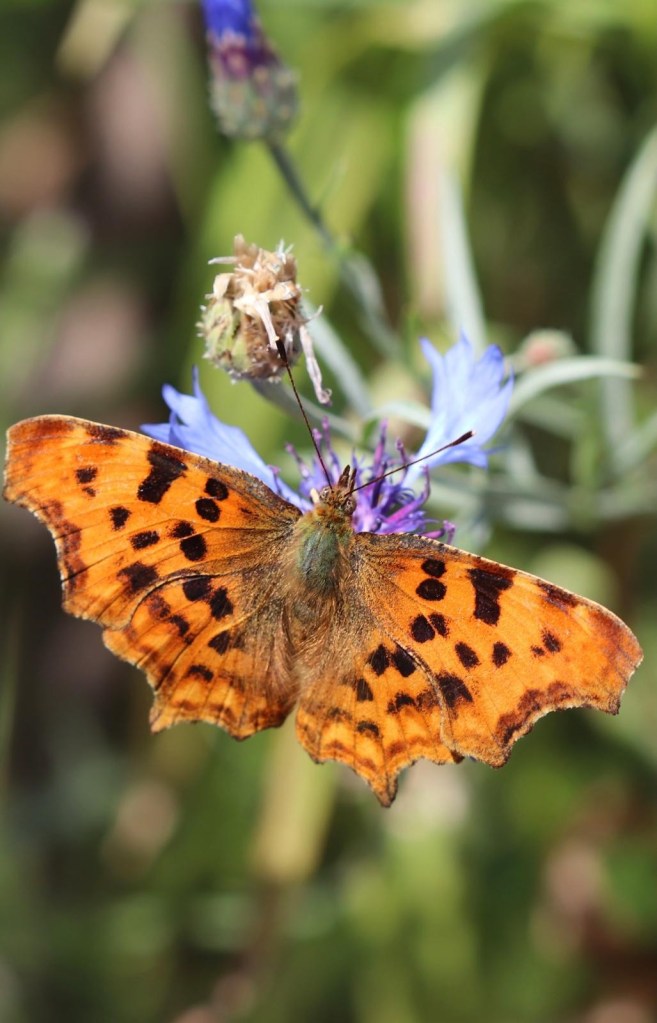
Photos of the Comma Butterfly in Latton Vicarage Garden, by Canon Lynn Hurry.
These photos by my friend Lynn Hurry are of the Comma Butterfly. It is so called because its orange-brown colouring is punctuated on the underwing with a distinctive white comma shape. It has ragged wing edges which, when it is at rest, resembles a dead leaf.
Unlike many butterfly species, which are becoming rarer, it is a success story of Nature, being more prolific and widespread. Some attribute this to global warming. It is commonly found in Britain, Europe, North Africa and Asia.
Spiritually, this butterfly has several meanings including renewal; rebirth; unconditional love; transformation and hope.
Personally, I see in its name ~ comma~ an invitation to pause briefly and for a moment enter into stillness. A comma links two parts of a sentence and so we can allow a pause to be a link between one kind of activity and another. The purpose of this brief moment can be to renew our connection with God and with Nature. The Psalmist of Psalm 46 gives us a picture of a world in turmoil, whether it be of nations; planet earth, or more personal. Throughout this upheaval, God is our refuge and our strength. His voice melts the angry clamour of human voices; of our human spirit. God makes wars to cease, within our hearts leading hopefully to a renewed understanding of God’s presence in our hearts. So, the Psalmist encourages to Be still and know that I am God.
We can see, therefore, that the grammatical pause in this butterfly’s very being has a purpose and a meaning which calls us to reflection, renewal and transformation. This comes if we pause with God.
Too often, in our daily life we are on the go in frenetic activity. So is the world. It is vitally important then to be still and to form a new connection with the World of Nature, represented by the Comma Butterfly, and appreciate the beauty of God’s world. Only then might we cherish all that God has made and find a new hope and a new beginning. Only so might we become deeper instruments of God’s healing love. The Comma Butterfly is known as a pollinator, bringing the means of new life to the Natural World. That is a role we can learn from this butterfly in all our dealings with each other.
“The hedgerows are arching with dog rose blooms, buzzing with bees and heralding summer.”
My friend Gill has sent me this photo of a dog-rose growing in the Lakeland hedgerow near her home. It is a sign that summer is bursting forth in our part of the world, even though June rain storms try to tell us otherwise! The dog-rose is perfect for pollinators such as bees and later in autumn, as its blooms are transformed into rose-hips, it is a source of food for birds.
The legend that gave it its name is attributed to ancient times. It is suggested that the Roman naturalist, Pliny, encouraged a belief that the plant’s roots could cure the bite of a mad dog. Hence its botanical name is ‘Rosa Canina’. The plant was popular for treating bites from rabid dogs in the 18th and 19th centuries. Another view is that the name is related to the hooked prickles of the plant which have a look of dog’s teeth. It’s thorny, unruly stems make it an ideal hedge plant, giving it a density which allows it to do it’s job of protection. It may, of course, simply mean wild rose, of which there are several species, to differentiate it from cultivated and posher roses! Maybe that could remind us that wild beauty is a God-given pointer that Nature has its own way of painting our world with a rare and joyous beauty.
This can be related to some of the meanings of the dog-rose. One such meaning is that of ‘Purity’, especially in a religious and spiritual sense. It is also known for its ‘resilience’in that, whilst having delicate flowers, it can withstand harsh conditions. In affairs of the heart the Dog-Rose has been linked with ‘love and beauty’, in many cultures and mythologies. In Victorian times the flowers were given as a sign of affection which, if returned, suggested an interest in marriage. You can always trust the Victorians to find ways of expressing sentimentality.
Though there is no specific reference to the Dog-Rose in the Bible, it has been linked with the Rose of Sharon In the Song of Solomon 2:1, we read : I am the rose of Sharon, the lily of the valleys. Links have also been drawn with Isaiah 11: I – a shoot shall sprout from the stump of Jesse and from his roots a bud shall blossom, which has been interpreted as a reference to Jesus. There is no real link with the Dog-Rose in either passages and the Rose of Sharon is usually taken to refer to the plant, Hibiscus Synacus.
However, in one symbolic meaning of the plant, there is a direct link with Jesus Christ. The Dog-Rose is strongly associated with Rebirth-and Resurrection. This is partly because of its association with love and purity but it is also linked with a legend about the Crucifixion of Jesus. In this legend there is a suggestion that the tree was once very large and the wood was strong. It was thus able to be used in Crucifixion. According to the story it was the dogwood tree that was used to make the Cross on which Jesus was crucified. Because of this, it is said that God both cursed and blessed it. It was destined to be forever small so that it could never grow strong and tall again and be used as a cross for crucifixion. Also, its branches would be crooked and twisted which would make it useless for such a purpose. Then God also blessed it. It would produced beautiful flowers each Spring, white or pink, as a sign of Easter glory. God also made its petals in the shape of the Cross, each flower having four such petals. In the centre was a crown of gold.
Like all legends there are things that could be disputed but, legends are never made-up stories nor fanciful thoughts. They always contain a truth which, whilst sometimes clothed in mystery, leads us into a deeper understanding. God is always bigger than the words and thoughts we have of him and we would be wise to see His signs and hear His language in Nature and in the Cosmos and also in our hearts where God’s Spirit constantly dwells. So the lovely Dog-Rose has much to teach us and we who seek God’s truth have always more to learn.
In this spirit, I print below an anonymous version of the Legend. Make of it what you will but don’t just dismiss it for it may be that otherwise you will, to quote the poet Frances Thompson, you may miss the many splendid thing.
In Jesus’ time, the dogwood grew To a stately size and a lovely hue. ‘Twas strong and firm, its branches interwoven. For the cross of Christ its timbers were chosen. Seeing the distress at this use of their wood Christ made a promise which still holds good: “Never again shall the dogwood grow Large enough to be used so. Slender and twisted, it shall be With blossoms like the cross for all to see. As blood stains the petals marked in brown, The blossom’s centre wears a thorny crown. All who see it will remember Me Crucified on a cross from the dogwood tree. Cherished and protected, this tree shall be A reminder to all of My agony.
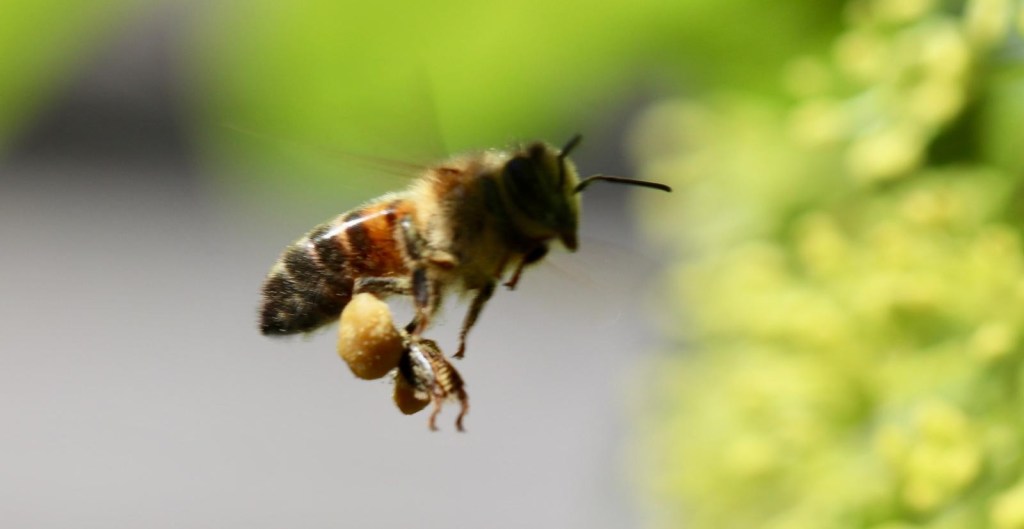
Bee and flower kiss and make nectar. Photo : Lynn Hurry
World Bee Day
According to all known laws of aviation, there is no way that a Bumble Bee should be able to fly. Its wings are too small to get its fat little body off the ground. It’s something to do with its body mass in relation to its wing span. It’s all been tested out, using the science of aerodynamics and a wind tunnel. The Bumble Bee is, however, blissfully ignorant of this scientific fact and, possessing considerable determination, and refusing to accept a low expectation of its capabilities, it not only does fly, but it makes a little honey too.
[Perhaps we can bear that in mind when we are faced with difficulties about things we can or can’t do. Even more important when others tell us what we can’t do. Think of the bee and don’t let others put you down.]
Despite possessing determination, the bee population needs our help at present.
This week, the United Nations led us in the observance of a World Bee Day. It is generally held on May 20th. The date was chosen to honour Anton Jans̆a, a pioneer of modern beekeeping who was born on May 20th, 1734.The main purpose of the Day is to raise awareness about the essential role that bees and other pollinators play in “in maintaining healthy ecosystems and ensuring food security.” (UN). By encouraging the observance of this day, it is hoped that actions might be promoted to protect and enhance bees and other pollinators and their habitats which are threatened increasingly by human activities such as habitat loss, increasing and indiscriminate use of pesticides and the effects of climate change. Pollinators, which include bees and also endangered butterflies, are responsible for a staggering reproduction of over 75% of the world’s food crops BUT 40% of them are currently at risk of extinction.
The United Kingdom Government has issued suggestions how gardeners and other’s involved in the growth of plants, might help to nurture nature and help our pollinators to thrive:
Grow more nectar rich flowers, shrubs, and trees. Using window or balcony boxes are good options if you don’t have a garden;
Let patches of garden and land grow wild;
Cut grass less often;
Do not disturb insect nests and hibernation spots; and
Think carefully about whether to use pesticides.
In addition you could build abee hoteland make a bee watering station. Bees and butterflies, wasps and other pollinators need water and bowls placed around your garden or window box can be a real lifeline.
Don’t forget to commit this action to prayer: In Ecclesiasticus Chapter 11, verse 3, we can read: The bee is small among flying creatures, but what it produces is the best of sweet things.
Here’s a prayer inspired by this:
O God, Creator of the earth, We pray for tiny, buzzing bees who work so hard and true to pollinate and bring life anew. May we protect them from harm and wrong and cherish the gifts they bring along. All creation speaks of Your divine glory. May we honour and protect it, in Your divine name. Amen.
Gill Henwood, photo towards Gooseyfoot Tarn, Lake District.
Behold I make all things new (Book of Revelation 21: 5) This is a hope expressed at the end of the New Testament and it is re-enacted each year as Spring approaches.Despite the effects of climate change, Nature is determined to keep Planet Earth going. This, despite attempts by some of the human species to do the opposite. But we can rejoice and have hope. The Witch-Hazel in my garden is already producing its leaves on which it will build new growth. Tulips, daffodils and other bulbs are beginning to peep over the parapets of their pots. Things are being made new.
Gooseyfoot Tarn. (Photo by Gill Henwood)
My friend Gill who sent me the photos of Nature at work in her part of the Lake District, at Gooseyfoot Tarn, has also sent me this comment:
“Young beech saplings keep their copper leaves during the harshest weather – a promise of new growth in the slender buds along their twigs The green tubes in the foreground of Gooseyfoot Tarn (above) are seedlings planted among the roots of fallen and felled trees. All the larches were diseased and beeches on the tarn fringe were taken down too. It’s now open, with natural generation of conifer saplings and planted native deciduous woodland. Gooseyfoot Tarn is thought to be an old duck pond shoot from before the forestation, when Grizedale was moorland. There is still a wide variety of fungi in the soil and wild flowers along the tracks, despite the forestry activity. The ‘naff daff’ shoots are naturalised old bulbs from when this track was a field boundary. They started flowering a few years ago after the waterlogged land drains were restored and now line the path with jolly profusion! Survivors when much else drowned…
As February approaches, in the Northern Hemisphere, we can look forward to more light and the greening of new growth. Life in our world is far from easy just now and sometimes it is hard to have hope. The world’s political situation is very uncertain and wildfires and other climatic disasters make it hard for many others. Yet, there is a renewal and regeneration which tells us a different story. Below is a prayer which many will find helpful. In whatever way we are able, may we all try to take up what it is telling us about our Stewardship of the earth and our share in the creative process of God.
A Prayer: Heavenly Father, creator of all things, help us to realize that we are custodians of the wonderful heritage with which you have so generously endowed us. Give us the minds and the hearts to rejoice in your creation, and to walk through your beautiful world with seeing eyes. Help us to save the good earth, the stately trees, the dainty wildflowers, the birds and all things that have no voice to protest against destruction. We thank you for your bounty and pray we may be worthy of it. Amen